
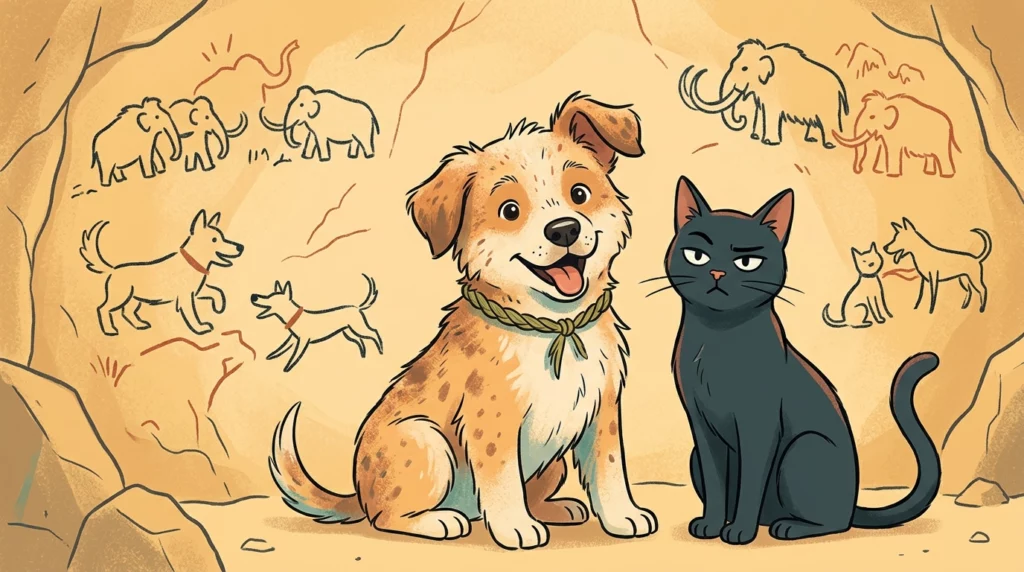
Hello, human servants and fellow animal companions. It is I, Pisino—the sleek, black, three-year-old chief of the SnoutScoop household. Normally, I spend my days supervising Blu’s chaotic zoomies, making sure Niki’s grammar remains up to standard, and wondering why humans haven’t built a monument in my likeness yet.
But today, we need to talk about something that transcends our usual species rivalry. As a cat, I pride myself on maintaining a healthy, dignified distance. Dogs, on the other hand, are famous for their desperate, drooly need to be near you. I always assumed this was a modern design flaw. However, a fascinating piece of history proves that this intense, codependent love affair between humans and dogs has been going on for a very, very long time. Specifically, about 14,000 years.
Let us travel back to the Ice Age to meet the Bonn-Oberkassel dog: history’s oldest confirmed pet dog, and the undisputed “Good Boy” of the Paleolithic era.
The Discovery in the Quarry

Our story begins in 1914 in Bonn-Oberkassel, Germany. Quarry workers blasting through basalt stumbled upon a grave. Inside were the skeletal remains of a man in his late forties, a young woman in her late twenties, and some animal bones. At the time, the workers didn’t realize they had just uncovered one of the most significant archaeological finds in human-animal history.
According to the Wikipedia record of the Bonn-Oberkassel dog, these remains date back to the late Paleolithic period (around 14,000 years ago), belonging to the Federmesser culture. While the human remains were fascinating, it was the canine teeth and bones that eventually stole the scientific spotlight decades later.
Initially, scientists thought the animal bones belonged to a wolf. But further analysis revealed they were actually the remains of two domestic dogs. One of them was an adult, and the other was a young pup, roughly 7.5 months old when it died. And it is this puppy that teaches us everything we need to know about the human heart.
The Ice Age Pediatric Unit
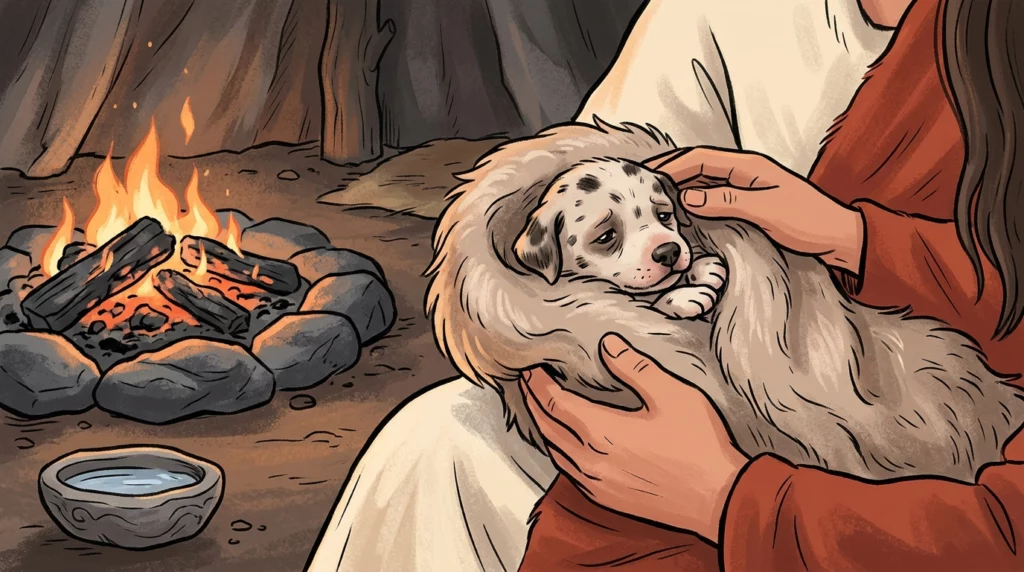
For a long time, the prevailing theory was that early humans domesticated dogs purely for utility. Dogs helped with hunting, guarded the camp, and probably kept everyone warm at night. It was a transaction: “I give you scraps, you keep the saber-toothed cats away.” (A terrible trade, if you ask me, but let’s stay focused).
However, in 2018, a team of researchers led by veterinarian and archaeologist Luc Janssens decided to re-examine the puppy’s teeth. What they found, which was published in a UCL human evolution study, completely shattered the cold, utilitarian view of early domestication.
By looking at the damage to the puppy’s teeth, Janssens and his team diagnosed the 14,000-year-old dog with a severe case of canine distemper.
Distemper is a brutal, highly contagious viral disease. It causes fever, respiratory issues, severe dehydration, vomiting, diarrhea, and eventually, neurological damage and seizures. In the late Ice Age, a puppy contracting distemper was essentially a death sentence. The disease typically kills a young dog within three weeks.
Yet, the dental analysis showed this puppy didn’t die quickly. He had survived three distinct, severe bouts of the disease. He lived for at least eight to nine weeks after getting sick.
Keeping a Sick Puppy Alive in 12,000 BC

As detailed by the Smithsonian Magazine, surviving distemper for that long would have been physically impossible for a wild animal. A sick puppy cannot hunt, cannot travel with the pack, and cannot find water.
This puppy survived only because his humans kept him alive.
Think about the sheer amount of work this required, as highlighted by reports on Space Daily. In a harsh, freezing environment where every calorie counted, these hunter-gatherers spent weeks nursing a dying dog. They had to:
- Manually hydrate him when he couldn’t drink.
- Feed him pre-chewed meat or soft food.
- Keep him warm next to the fire.
- Clean up his vomit and diarrhea (no small feat in a small shelter!).
- Comfort him through terrifying neurological seizures.
And here is the kicker: this puppy was of absolutely no practical use to them. He couldn’t hunt. He couldn’t guard the camp. He was, in modern terms, a massive drain on precious resources.
Why did they do it? The only logical explanation is love. They loved this clumsy, sick little wolf-cousin. They viewed him as a member of their family, not just a tool.
The Ultimate Farewell
Despite their best efforts, the puppy eventually succumbed to his illness at around 28 weeks of age. But the story doesn’t end there.
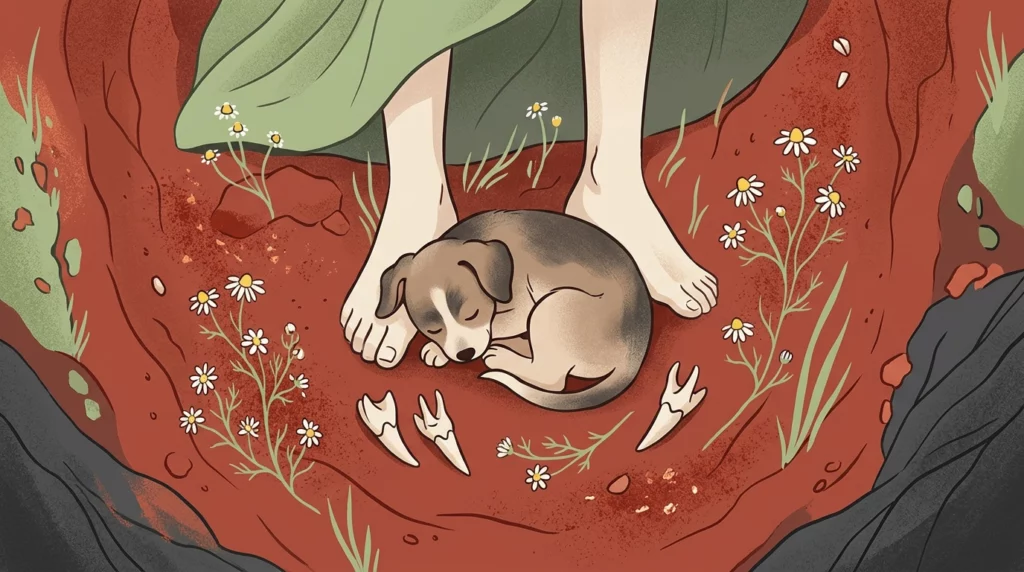
When the puppy died, his humans didn’t just toss him into the brush. They buried him. And not just anywhere—they buried him in their own communal grave, alongside a man and a woman, beneath a heavy slab of basalt, and showered the entire site with red hematite powder as a sign of respect and grief.
This joint burial is the earliest known evidence of a dog being buried alongside humans. It shows that, even 14,000 years ago, the bond between humans and dogs was so profound that they couldn’t bear to be parted, even in death.
A Cat’s Perspective on an Ancient Bond
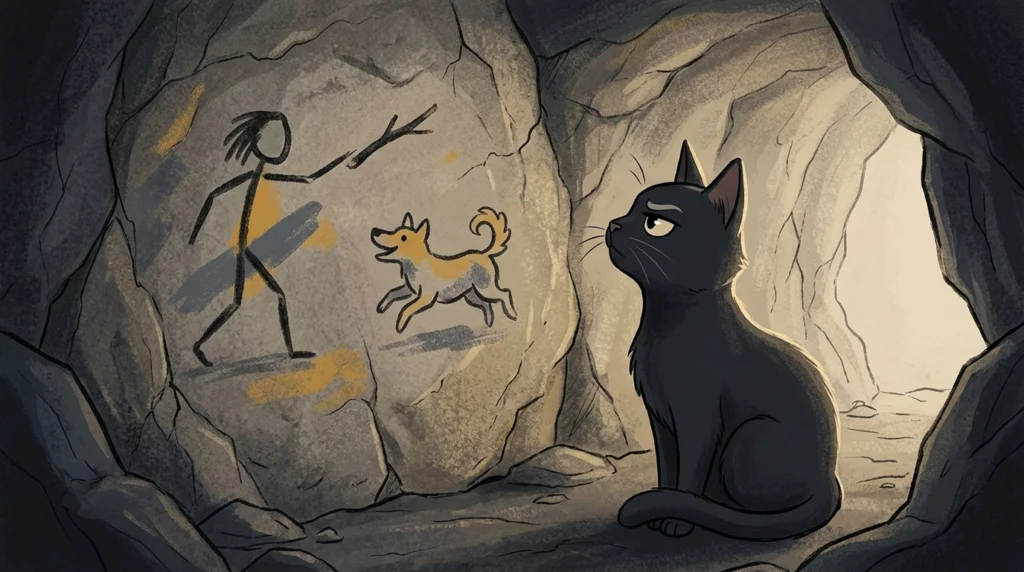
I must admit, reading about this makes my usually stoic, feline heart feel a little warm. I might spend my days knocking pens off desks and giving Blu the “death stare” when he tries to sniff my tail, but I get it. Humans and dogs have a weird, beautiful thing going on.
It is comforting to know that long before smartphones, taxes, and microchips, an Ice Age human sat shivering by a fire in what is now Germany, gently stroking the head of a sick puppy, whispering the 14,000-year-old equivalent of: “It’s okay, buddy. You’re a good boy.”
So, the next time your dog does something incredibly silly—like eating your left shoe or barking at a plastic bag—remember their ancestors. They earned their spot on your couch through thousands of years of mutual devotion.
Now, if you’ll excuse me, I must go wake up Blu. He is napping on my favorite rug, and I need to remind him that while his ancestors were legendary, I am still the boss of this living room.