
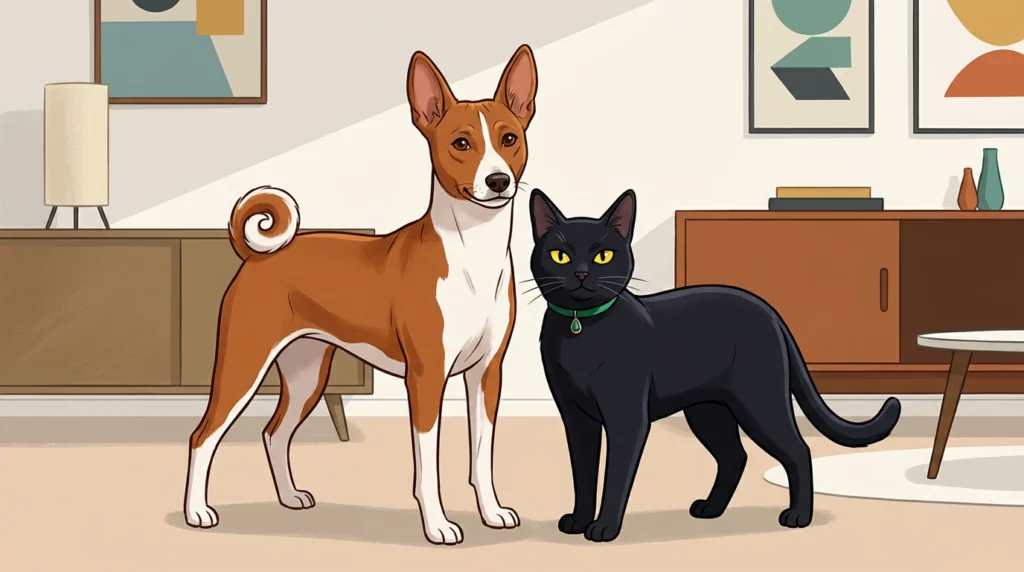
As the undisputed chief of the SnoutScoop pack—yes, me, Pisino the black cat—I generally find canine vocalizations to be… uninspired. A coarse "boof" at the mail carrier, a shrill whine when a kibble rolls under the refrigerator, a monotonous howl at a passing siren. It lacks nuance. It lacks dignity. Looking at my slobbery roommate Blu, I often find myself sighing for a touch of class in the canine world.
But then, I did some research. Tucked away in the annals of dog history is a creature that defies the noisy, chaotic stereotypes of its species. A dog that doesn’t bark. A dog that grooms itself like a cat, doesn’t smell like a wet rug, and expresses its inner soul through a series of dramatic, artistic yodels.
Allow me to introduce you to the Basenji. Finally, a dog I can actually respect.
Why Doesn’t the Basenji Bark?

When humans first hear about a “barkless dog,” they often assume it’s a myth or the result of some cruel surgical intervention. Rest assured, this is entirely natural. The Basenji’s silence is a beautiful gift of evolutionary biology.
According to scientific investigations compiled by Snopes, the Basenji is physically incapable of producing a traditional canine bark. The secret lies in the anatomy of their throat. In most domestic dogs, the laryngeal ventricle (a small pocket in the larynx) is deep, allowing the vocal cords to vibrate freely and produce that classic, booming sound.
In the Basenji, however, this ventricle is exceptionally shallow, as noted by National Purebred Dog Day. Because of this anatomical difference, their vocal cords cannot vibrate in the manner required to produce a bark. Instead, they are limited to flatter, quieter air movements. But don’t mistake their physical limitation for a lack of personality. They have plenty to say—they just choose a much more sophisticated medium to say it.
Enter the “Barroo”: The Famous Basenji Yodel
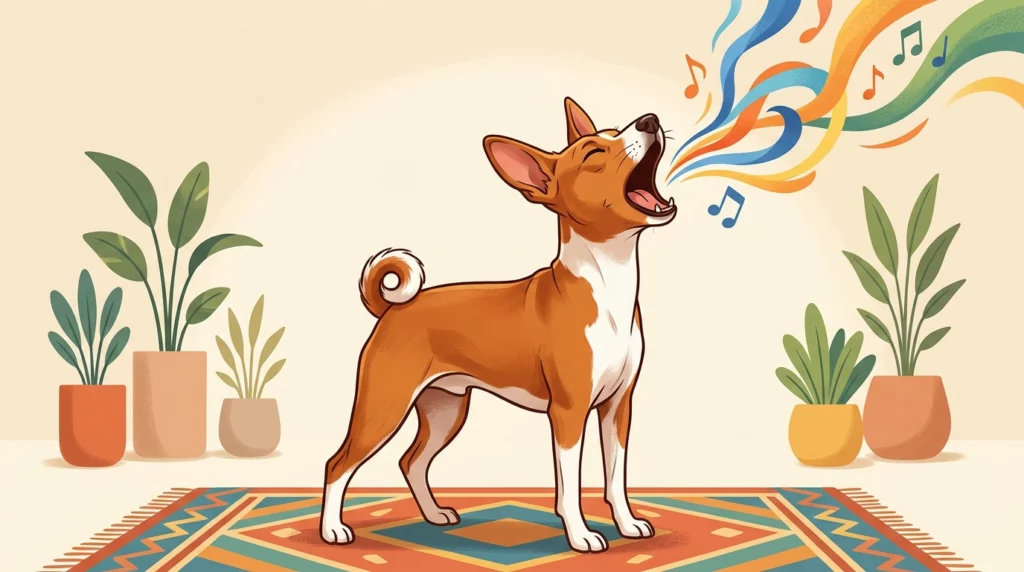
Just because they cannot bark doesn’t mean they are mute. When a Basenji is happy, excited, or perhaps mildly inconvenienced because their dinner is thirty seconds late (a feeling I know well), they produce a sound known as a “barroo.”
It is a mixture of a chortle, a howl, and a Swiss yodel. It is musical, slightly eerie, and utterly delightful. If you want to hear this vocal masterpiece in action, you can listen to this classic Basenji yodeling video on YouTube. As a connoisseur of dramatic vocal expressions, I must give credit where credit is due: it is an acoustic triumph. They also growl, whine, and scream when they are particularly displeased. Truly, they are the drama queens of the dog park, which is a title I can appreciate.
An Ancient, Royal History

You can tell just by looking at a Basenji that they carry themselves with an air of superiority. According to the breed standards of The Royal Kennel Club, they are lightly built, aristocratic-looking animals with an elegant, high-set carry.
These are not modern designer dogs; they are one of the oldest semi-wild dog breeds in existence. Originating in the Congo Basin of Central Africa, they were highly prized by local tribes as silent, efficient hunting companions. According to historical records on Wikipedia, they were used to flush game into hunting nets, a task that required stealth—hence the evolutionary advantage of not barking and alerting the prey.
They were even presented as gifts to Pharaohs in ancient Egypt, who valued their cat-like grace and quiet demeanor. Their physical traits, like the tightly curled tail and those charming, deeply furrowed forehead wrinkles, are perfectly detailed in the Tanza Basenjis Illustrated Breed Standard. Those wrinkles make them look permanently worried or deeply analytical. Personally, I think they just look like they are judging everyone around them. Relatable.
The Cat-Like Dog (My Favorite Part)
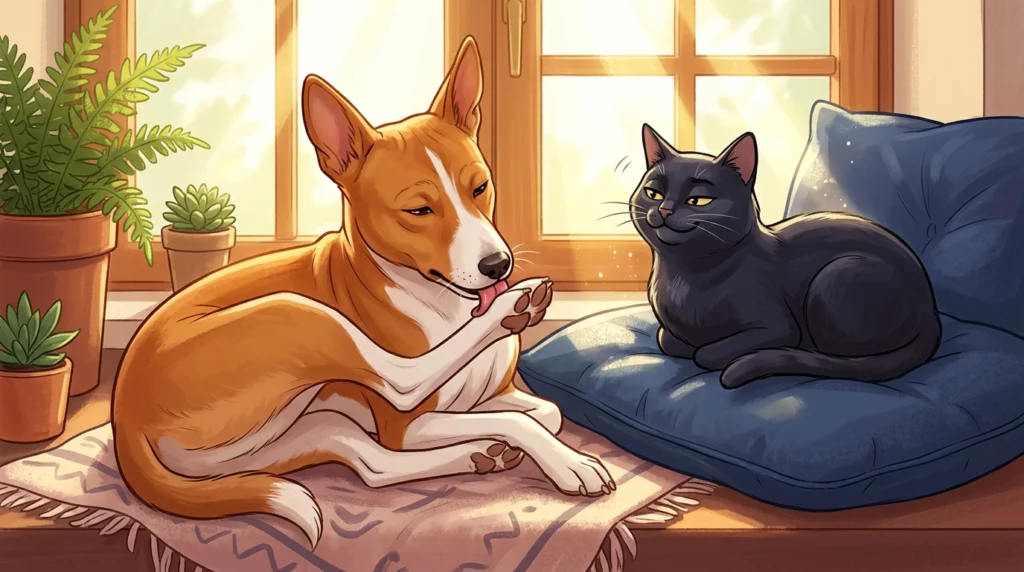
The similarities between a Basenji and a cat do not stop at their quiet nature. In fact, many experts refer to them as the most feline of all dog breeds.
- Meticulous Grooming: Like myself, Basenjis are incredibly clean. As highlighted by Bark Potty, they will sit and groom their coats with their paws, licking themselves clean just like a cat.
- No Doggy Odor: Because of their self-cleaning habits and short, fine coats, they lack the typical oily “dog smell.” You won’t need to hold your breath when they sit near you.
- The Art of Perching: According to Zealandia Pets, Basenjis love to climb. Do not be surprised to find one perched on the back of your sofa, staring out the window like a gargoyle. They want the high ground. (I respect this immensely; the view from above is always superior).
- Independent Spirit: They do not live to please humans. They are highly intelligent but fiercely independent, often described as aloof with strangers. They have a “what’s in it for me?” attitude that I find highly refreshing.
Is a Basenji the Right Companion for You?
Before you run out to find your own yodeling roommate, let me offer a word of feline caution. They may have cat-like qualities, but they are still hounds. This means they possess an intense, instinctual prey drive. If it runs, they will chase it. (Which means I would have to keep them firmly in their place if one ever entered my house).
They are also escape artists of the highest order. A fence is merely a suggestion to a Basenji, and their high energy means they require plenty of mental and physical stimulation. If they get bored, they will find creative ways to entertain themselves, which usually involves destroying something you love.
But if you appreciate an elegant, quiet, clean companion who marches to the beat of their own drum (and occasionally sings you a lovely yodeling song), the Basenji is truly a breed apart. They prove that you don’t need to make a lot of noise to make a massive statement. Now, if you’ll excuse me, I must go look out the window and judge Blu from a safe, elevated distance.