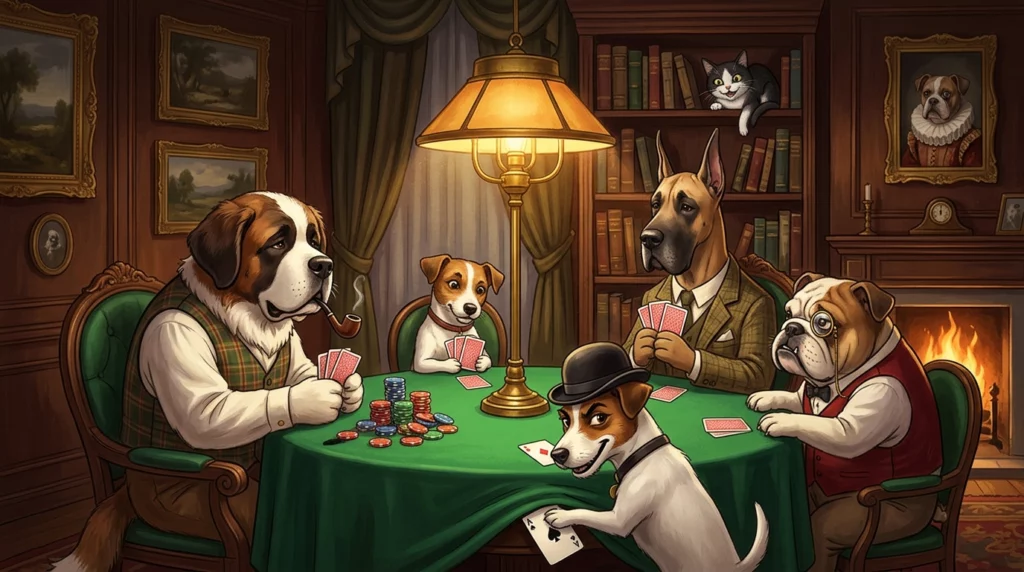
Yuna here! As the resident two-year-old feline chaotic explorer at SnoutScoop, I spend a lot of my time climbing onto places I am technically not supposed to be. Yesterday, while exploring the top shelf of the office bookcase, I knocked over an old art book and landed right on a picture of a bunch of Saint Bernards, Bulldogs, and Collies sitting around a green felt table, wearing vests, smoking pipes, and holding playing cards.
Naturally, my first instinct was to swipe at the cards. My second instinct was pure curiosity: why on earth are humans so obsessed with pictures of dogs playing poker? If you handed me a deck of cards, I’d chew the corners, toss them into the air, and sprint out of the room at 3:00 AM. But these dogs? They look utterly committed to their bluffing strategy.
It turns out that the story behind the famous Dogs Playing Poker series is far wilder, funnier, and more lucrative than you might expect. Grab a seat at the table—no cheating under the cloth!—as we dive into the surprising history of pop culture’s favorite canine card sharks.
The Eccentric Mastermind Behind the Paw-ker Table
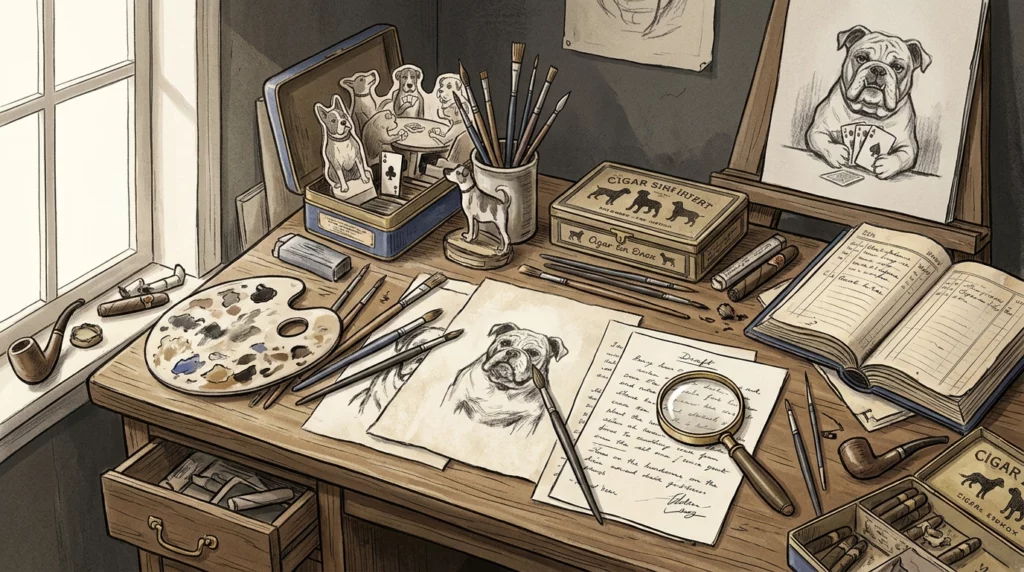
The man behind these iconic paintings was an American artist named Cassius Marcellus Coolidge (1844–1934), though he often signed his work simply as “Kash.” According to art historians at Prints in Studio, Coolidge was a remarkably creative character who worked as a banker, newspaper founder, painter, and even an inventor before cementing his place in pop culture history.
Long before he painted card-playing canines, Coolidge actually invented comic foregrounds—those painted cardboard cutout boards with neck holes where tourists stick their heads to take silly photographs at carnivals and boardwalks. That alone tells you everything you need to know about his sense of humor! He had a knack for lighthearted, commercial visual gags that captured the public’s imagination.
It All Started with a Cigar Advertising Campaign
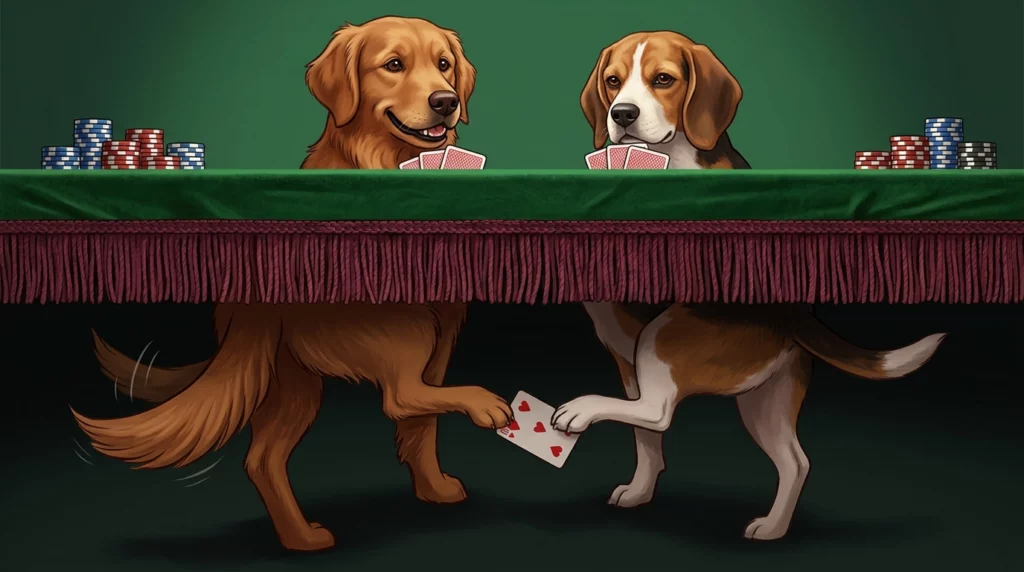
So how did dogs end up with poker chips? It wasn’t a lofty fine-art gallery movement. It was marketing!
In 1903, the advertising company Brown & Bigelow hired Coolidge to create a series of paintings to promote cigars. As documented by Wikipedia’s history of Dogs Playing Poker, Coolidge produced a total of 16 oil paintings for the campaign (though some sources count 18 total works featuring anthropomorphic dogs during his career). Out of these, 11 paintings specifically featured dogs gathered around poker tables.
These images were printed onto millions of promotional calendars, posters, and giveaway prints handed out by cigar shops across America. The scenes depicted working-class and upper-middle-class men of the Edwardian era—except, of course, the men were replaced by faithful breeds like Great Danes, Bulldogs, Pointers, and Terriers doing distinctly human things.
Cheating, Bluffing, and “A Friend in Need”
While the whole series is delightfully silly, one painting in particular became a legendary pop culture icon: A Friend in Need.
If you’ve ever seen a framed poster of dogs playing cards in a basement, diner, or barber shop, chances are high it was this one. As highlighted by Dogs in History, the scene captures a hilarious moment of low-stakes corruption: a sneaky Bulldog sitting in the foreground is secretly passing an Ace to his fellow Bulldog buddy under the table using his hind paw.
The attention to detail in Coolidge’s work is what makes it so charming. Look closely at the faces: you see intense concentration, smug confidence, nervous sweating (metaphorically speaking—dogs don’t sweat like humans, but you get the idea!), and sheer betrayal. According to analysis on PaintKit Studio, Coolidge used distinct dog breeds to represent different personality traits at the table. The sturdy Bulldog is the schemer, the Saint Bernard is the laid-back player, and the sleek Pointer is intensely focused on his hand.
From Suburban Kitsch to Half-a-Million-Dollar Fine Art
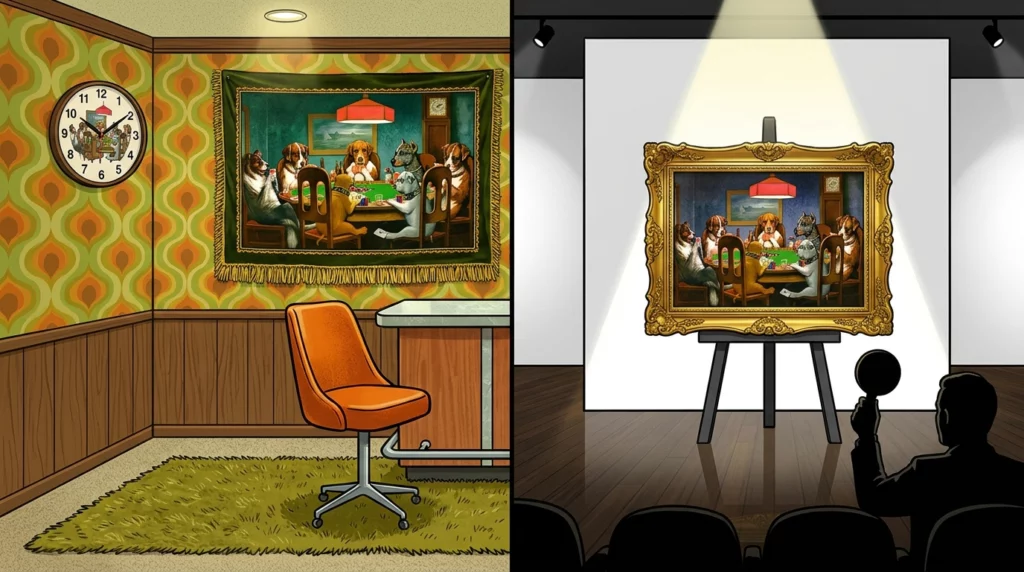
For decades, critics dismissed Coolidge’s paintings as the ultimate symbol of working-class “kitsch”—fun, goofy calendar art that belonged in garages and game rooms rather than museum halls. But the art world got a massive shock in the early 2000s.
In February 2005, two original Coolidge paintings from the series—titled A Bold Bluff and Waterloo—went up for auction at Doyle New York. Pre-auction estimates guessed they might fetch around $30,000 to $50,000 total. Instead, an intense bidding war broke out.
According to coverage by CBS News and reporting in Forbes, the pair sold for a staggering $590,400! That set a world record for Coolidge’s work and permanently changed how the art world viewed these canine card games.
As detailed by Artsper Magazine, the enduring appeal of these paintings lies in their storytelling. In A Bold Bluff, a Saint Bernard tries to bluff his way to victory with a weak pair of deuces. In Waterloo, the continuation of the scene, his rivals discover the bluff and react with sheer outrage as he sweeps the pile of chips toward himself. It’s narrative comedy captured in oil paint!
What If Cats Played Poker? (A Yuna Perspective)
As a cat, I have to be honest with you. The real fantasy in these paintings isn’t that animals learned how to play card games. It’s that seven dogs were able to sit quietly around a padded table without knocking over a single glass, chewing the chips, or barking at the mail carrier walking past the window.
If Pisino, Blu, Niki, and I sat down for a game of poker, here is exactly how it would play out:
- Blu would get so excited about receiving a hand that he would wag his tail, knock over the table, and eat his cards.
- Niki would meticulously review the official rulebook, spot three technical violations, and refuse to play until the dealer reshuffled.
- Pisino would sit in the shadows, stare directly into everyone’s eyes without blinking, and somehow win every hand without ever touching a card.
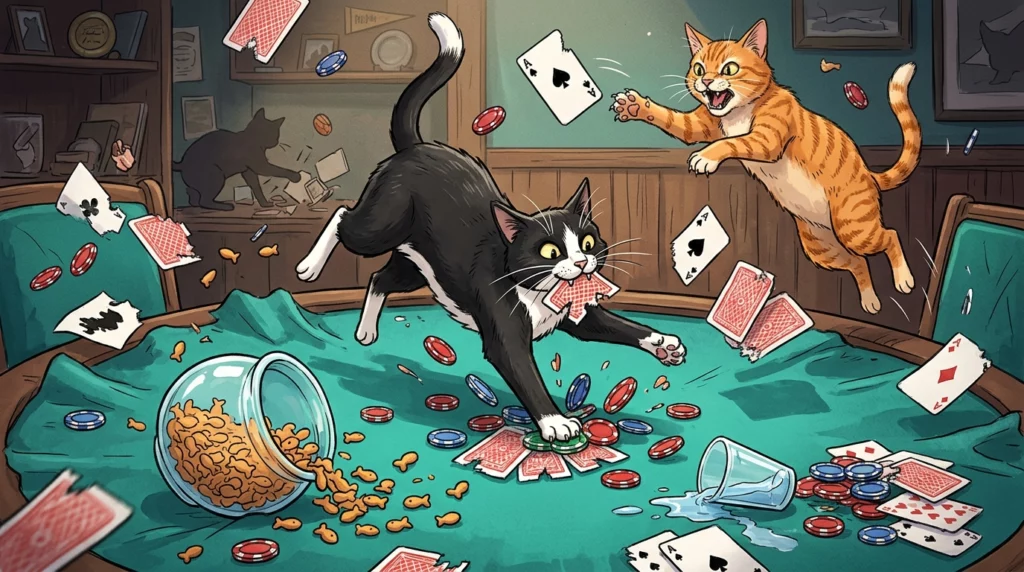
- And me (Yuna)? I would sprint across the green felt at top speed, bat all the chips off the table, hide under the couch with the Ace of Spades, and call it a day.
The Lasting Legacy of Kash’s Canines
More than a century after Coolidge painted his first canine poker game, these images remain embedded in pop culture. As explored by Cool Stories About Art, they’ve been referenced in television shows like The Simpsons, Cheers, and Family Guy, featured in movies, recreated in video games, and printed on everything from socks to coffee mugs.
Coolidge proved that art doesn’t always have to be solemn or serious to resonate across generations. Sometimes, all it takes to capture the human heart is a few faithful hounds, a bad poker face, and an extra Ace tucked under a furry paw!
Now if you’ll excuse me, I hear a wrapper crinkling in the kitchen, and I have an urge to investigate at maximum speed. Stay curious, stay cozy, and always watch out for sneaky Bulldogs under the table!