Dogs and sacred canids in ancient Egypt
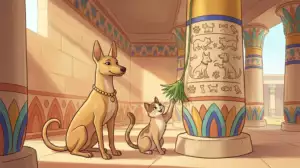
Meet the dogs and sacred canids of ancient Egypt through museum objects and religious imagery. Discover Anubis, Wepwawet and Duamutef, alongside playful figures and ingenious craftsmanship. Learn to distinguish an animal, a divine image and an interpretation, without assigning modern breeds to every ancient silhouette.
Training mode
Dogs and sacred canids in ancient Egypt
Questions covered in this exam
- Were dogs in ancient Egypt found only in religious images?
- An Egyptian dog image resembles a modern breed. What can we safely conclude from that resemblance alone?
- Which activity is especially associated with Anubis in Egyptian belief?
- Why might an Egyptian priest wear an Anubis mask during a ritual?
- An Anubis amulet accompanies a deceased person. What is its intended religious role?
- In the Egyptian weighing of the heart, what lies on the other side of the balance?
- What does Anubis do in the weighing-of-the-heart scene?
- What does the name Wepwawet mean?
- Are Wepwawet and Anubis simply two names for the same god?
- Which Egyptian city was an important centre of Wepwawet's cult?
- Which jackal-headed figure is one of the four sons of Horus?
- Which organ was placed under Duamutef's protection?
- What were canopic jars used to preserve?
- The Met's ancient Egyptian Mechanical Dog has a movable part. Which one?
- What is the main material of the Met's Mechanical Dog?
- What does the British Museum's ivory puppy EA13596 hold in its mouth?
- The same ivory puppy lowers its front and raises its hindquarters. How does the museum describe the pose?
- A Wepwawet figure on a standard could be associated with what activity?
- A museum suggests several possible uses for a miniature Wepwawet figure. How should we report its function?
- Why is it risky to assign every Egyptian sacred canid image to one exact animal species?