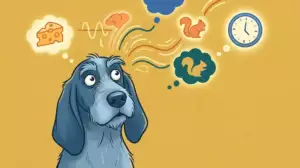
Understanding frustration
Explore frustration through blocked access, difficult tasks and changing routines. These scenarios ask what to observe and adjust, rather than assigning a single emotion or motive to every unwanted behaviour.
Training mode
Understanding frustration
Questions covered in this exam
- Which situation can produce frustration?
- Two dogs bark behind a fence. What is unsafe to assume?
- A puppy expects to greet every dog. What useful experience can also be taught?
- A dog repeatedly interrupts desk work. What should be checked before an attention exercise?
- A new task produces repeated errors and agitation. What should the next attempt change?
- A dog offers several actions rapidly during learning. What can a well-timed learned marker clarify?
- You keep interrupting a simple exercise to search for rewards. What preparation helps?
- A dog can wait comfortably for a brief moment. How should a harder task be introduced?
- A dog becomes increasingly agitated watching play it cannot join. What can management change?
- A digging opportunity must be blocked for safety. What can accompany the boundary?
- Two dogs receive the same puzzle; only one enjoys it. What does this suggest?
- A workday alternates constant attention and unexpected long gaps. What may help?
- A gate prevents access to a room. Has it also taught a calm alternative?
- Someone repeatedly offers a toy then snatches it away to build patience. What is the concern?
- You notice yourself getting angry during practice. What is a useful choice?
- A dog chews furniture after its routine changes. What deserves investigation?
- A frustrated-looking dog may have swallowed pieces of an object. What takes priority?
- Frustration episodes include snapping towards people. What is appropriate?
- Waiting is still difficult, but recovery is quicker. What should the record include?
- A previously patient dog suddenly struggles with familiar waits. What should not be overlooked?