Hello, friends! Blu here, your resident floppy-eared rescue dog with boundless energy and a heart that beats in sync with the squeak of a tennis ball. Today, I want to talk about one of my absolute favorite sports: the mid-air snatch.
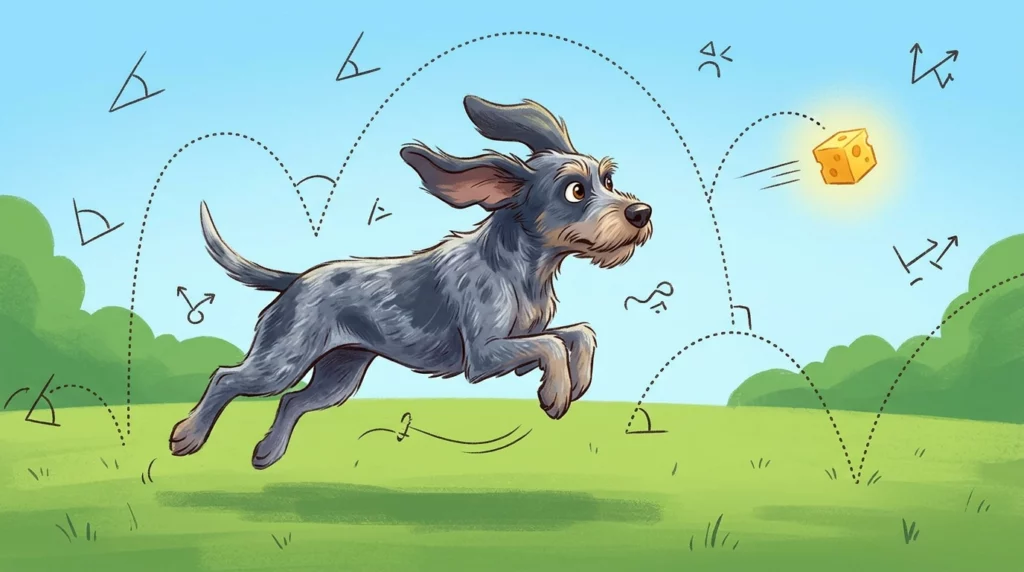
Picture this. My human holds up a piece of cheese or a flying disk. My tail freezes. My eyes lock on. They toss it. In a blur of blue fur and pure determination, I leap, twist, and—CHOMP. Success! To my humans, it looks like magic (and, let’s be honest, extreme athletic grace). But to science, it is a fascinating mix of physics, geometry, and specialized canine biology.
So, how do we dogs actually calculate the flight path of a flying treat or toy? Let’s dive into the amazing science behind how our brains and eyes work together to make the perfect catch!
The Canine Superpower: Motion Detection

First, let’s talk about how I see the world. Humans often boast about their “high-definition” vision, but when it comes to speed, you guys are living in slow motion. According to the veterinary experts at Ophtalmoveterinaire, dog eyes are built differently than human eyes. While we have lower visual acuity—meaning we see things a bit more blurry at a distance than you do—we absolutely dominate when it comes to motion detection.
Our retinas are packed with specialized cells called rods, which are incredible at detecting movement and operating in low-light conditions, as explained by South Coast Vet. While humans have more cones (which help you see a vast spectrum of colors and fine details), we dogs have a high concentration of rods. This means that even a tiny twitch of your wrist throwing a treat is instantly flagged by my brain.
Additionally, our “flicker fusion rate” is much higher than yours. As detailed by the National Protective Security Authority (NPSA), dogs can process rapid visual changes much faster. A television screen that looks like a smooth, continuous movie to you might look like a flickering slideshow to me. But when a treat is flying through the air, my high-speed visual processing allows me to track its movement frame-by-frame with incredible precision.
The Secret Math: Linear Optical Trajectory (LOT)
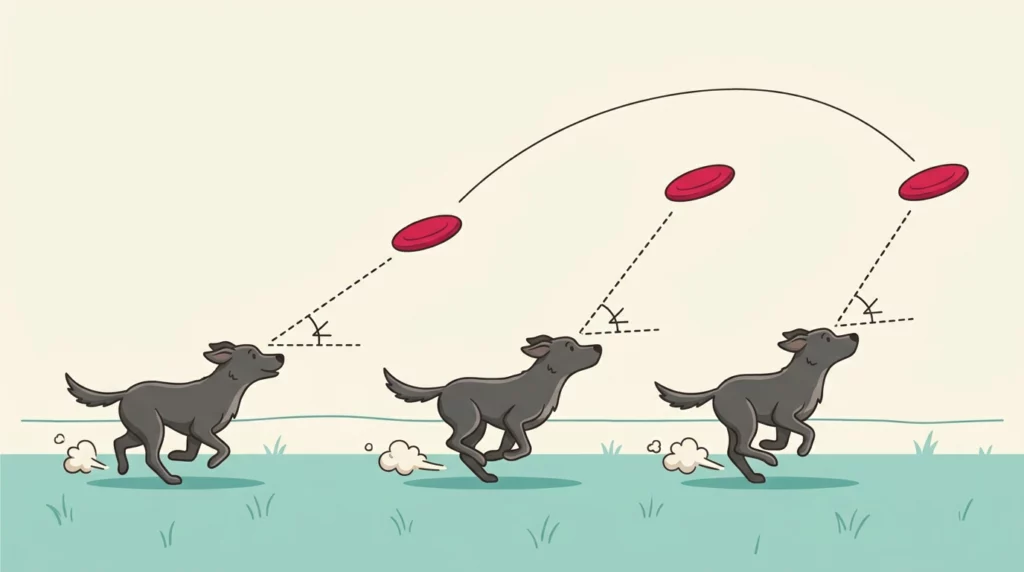
You might think I am doing complex calculus in my head to figure out the wind resistance, gravity, and velocity of a flying disk. I hate to break it to you, but math makes my head itch. Instead, dogs use a brilliant, elegant shortcut called the Linear Optical Trajectory (LOT).
This concept was famously studied by researchers who wanted to know how dogs intercept flying objects. In a groundbreaking study published on PubMed and discussed in Science News, scientists tracked dogs as they ran to catch Frisbees. They discovered that dogs do not predict where the disk will land and run to that spot. Instead, they run in a very specific way that keeps the target looking like it is moving in a straight line at a constant speed relative to their eyes.
If you want to get nerdy about it, you can read the full breakdown on ResearchGate. When I run to make a catch, I adjust my running speed and direction so that the angle of my gaze toward the target remains constant. If the treat seems to be rising in my field of view, I need to speed up. If it looks like it’s falling, I slow down. By keeping that optical angle steady, I guarantee that my mouth and the treat will arrive at the exact same spot at the exact same millisecond. Boom! Science!
Why We Run in Curves
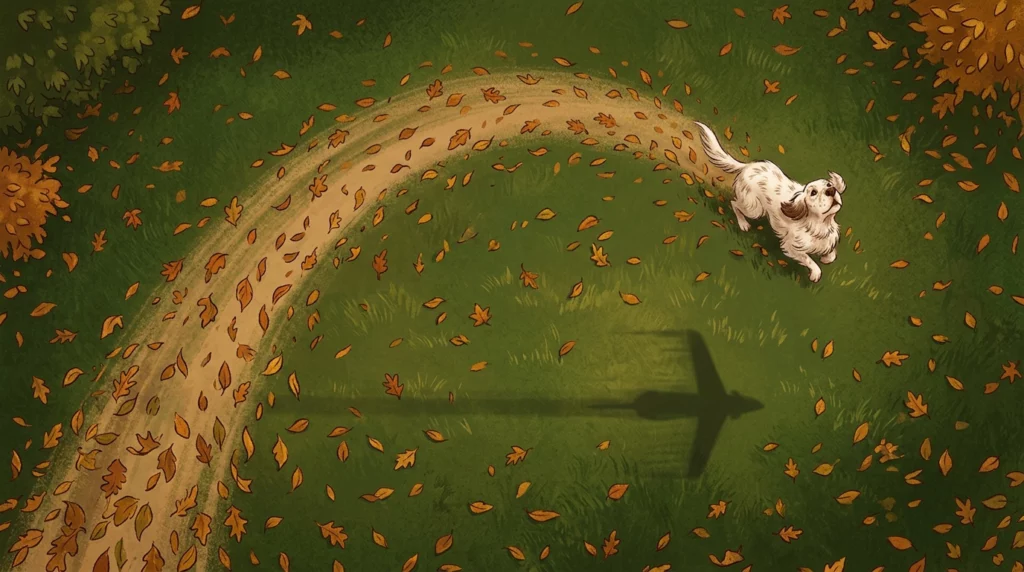
Have you ever noticed that your dog rarely runs in a perfectly straight line to catch a toy? We often run in a swooping, curved path. This is not just because we like to show off our good sides.
As explained by dog flight physics enthusiasts at Michael Diamond, the curved path is a direct result of the LOT strategy. Because flying disks drift and hover on air currents, they do not travel in a simple straight line. By running in a curve, we maintain that sweet optical angle, adjusting to the wind’s tricks on the fly. It allows us to keep the object perfectly framed against the background so we never lose sight of it.
How Humans Can Help Us Make the Perfect Catch
Now that you know the physics behind my acrobatic snack-grabbing, here are a few ways you can help your pup become an Olympic-level catcher, based on how our eyes actually work:
- Choose the right colors: According to PawPots, dogs have dichromatic vision, meaning we see colors mostly in shades of blue and yellow. Red and green look like a dull grayish-brown to us. If you throw a red toy onto green grass, it is incredibly hard for us to see! Opt for blue or bright yellow toys to give us the best visual contrast.
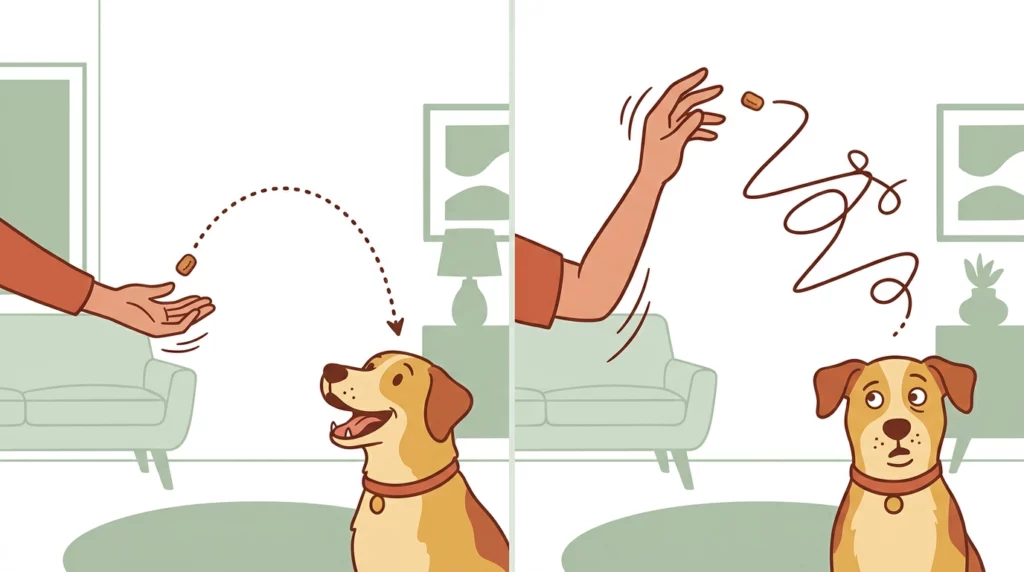
- Give it some loft: When tossing treats, do not fire them like a bullet straight at our noses. Throw them in a gentle, arching path. This gives our visual tracking system time to lock onto the trajectory and use the LOT strategy to perfection.
- Watch the lighting: Thanks to our rod-rich eyes, we can track objects beautifully in dim light, but sudden glare can blind us just like it does you. Try to throw toys with the sun at your back, not shining directly into your pup’s eyes.
Ready, Set, Throw!
The next time you toss a piece of kibble or a disk, take a moment to appreciate the incredible, high-speed biological computer operating inside your dog’s head. We are adjusting our pace, tilting our heads, and calculating optical angles at lightning speed—all for the love of the game (and the snack!).
Now, if you will excuse me, all this talk of physics has made me incredibly hungry, and I see my human holding a very aerodynamic piece of cheese. Wish me luck! *Leaps into the air*