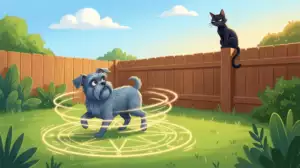
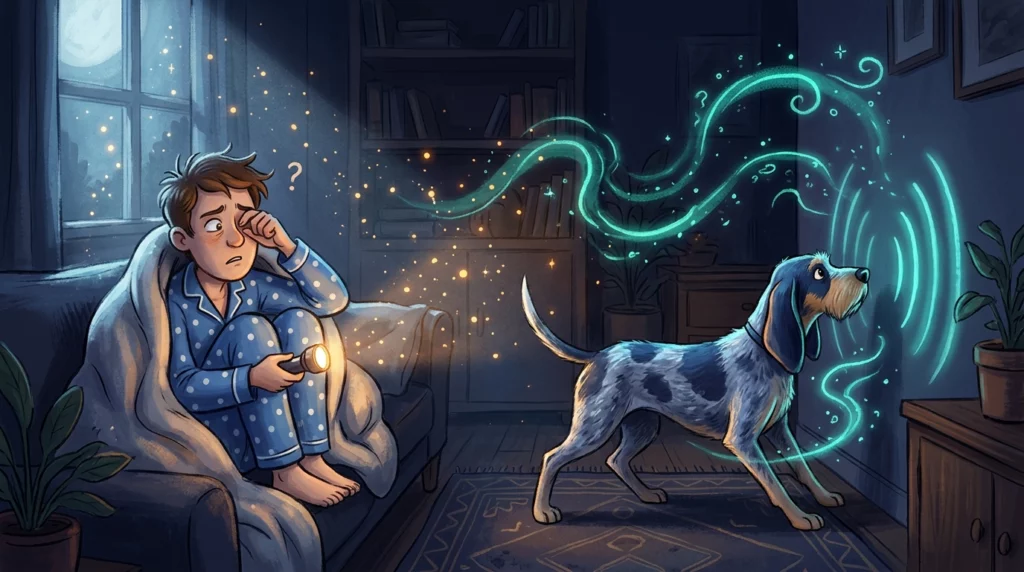
Picture this: It is 11:47 PM. The house is completely quiet. You are tucked under the covers, halfway into a cozy dream about endless pizza crusts. Suddenly, I—Blu, your friendly neighbourhood Griffon Bleu de Gascogne rescue pup—leap to full attention. My long floppy ears perk up as far as physics allows. My tail goes rigid. I stare intensely at the empty corner of the living room ceiling and unleash a chest-thumping, room-shaking WOOF.
You sit up, heart pounding. You look at the corner. There is nothing there. No intruder, no floating Victorian ghost child, no glowing orb. Just drywall. You sigh and ask, “Blu, what on earth are you barking at? There’s nothing there!”
Well, my human friend, I am here to tell you that from where I stand, there is never ‘nothing’ there. What looks like an empty room to you is actually an overwhelming symphony of sounds, smells, and flickering shadows to me. Before you call a paranormal investigator, let us look at the real, scientific reasons why we dogs bark at seemingly invisible phantoms.
1. Ultrasonic Hearing: We Hear the Secrets of the Universe
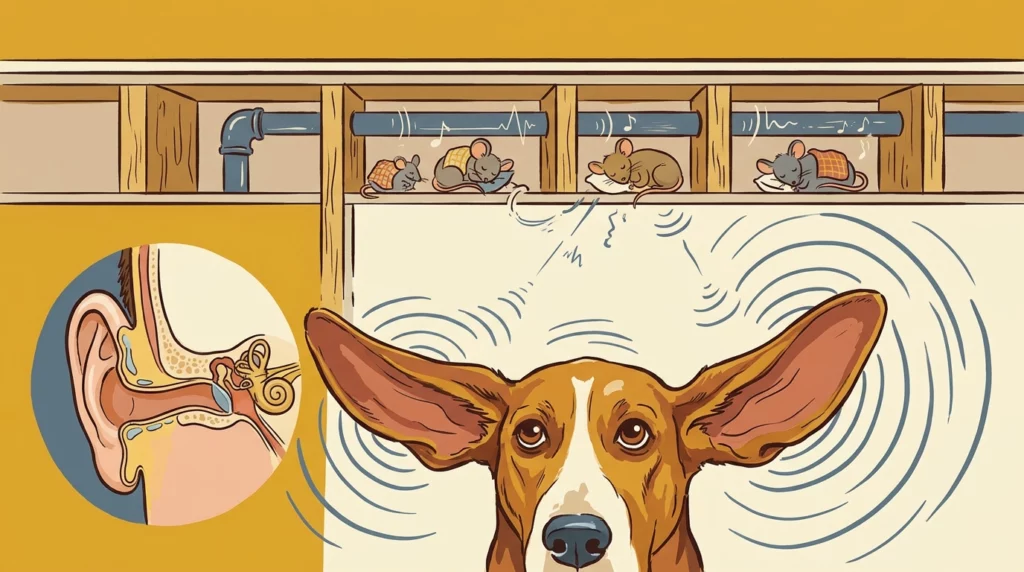
First off, let us talk about these beautiful, velvety ears of mine. While human ears are pretty decent at catching gossip across the dinner table, dog ears are practically high-powered satellite dishes. According to research cited by the American Kennel Club (AKC), dogs can hear frequencies as high as 45,000 Hz to 67,000 Hz, whereas typical human hearing tops out around 20,000 Hz.
This means while you hear peaceful silence, I might be listening to:
- A tiny field mouse scurrying inside the insulation three rooms over.
- The high-pitched electronic whine of your phone charger plugged into the outlet.
- Water rushing through the pipes behind the drywall.
- A dog three streets away letting out a subtle whine.
When I bark at a blank wall, I am often not barking at the paint. I am telling that sneaky mouse inside the wainscoting that I know his secrets!
2. The Nose Factor: A World Painted in Scents
If you think our hearing is wild, wait until you consider our snouts. VCA Animal Hospitals notes that a dog’s nose contains anywhere from 120 million to over 300 million scent receptors, compared to a paltry 5 or 6 million in humans. Furthermore, the part of our brain dedicated to analyzing smells is about 40 times larger than yours!
When a cool breeze slips under the front door, you might not feel a thing. But my hound nose picks up the subtle scent profile of a raccoon that walked across the porch two hours ago, mixed with the distant aroma of barbecue from a block down. To me, that smell is so vivid it might as well be standing right in the room. I am just giving the lingering scent a friendly (or stern) warning.
3. Low-Light Vision and Subtle Motion Detection

Humans have great color vision, which is wonderful for picking out stylish dog bandanas. But when the lights go down, your vision drops dramatically. Dogs, on the other hand, evolved as crepuscular hunters (active at dawn and dusk), meaning our eyes are built for the dark.
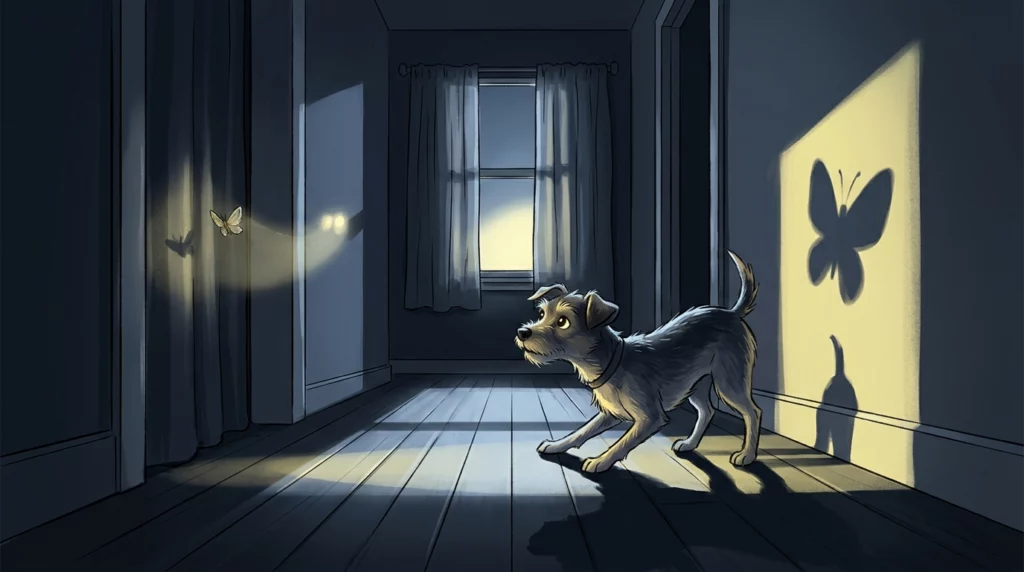
Our retinas are packed with light-sensitive cells called rods, and we possess a mirror-like layer at the back of the eye called the tapetum lucidum (which is why our eyes glow eerily in flash photos). This gives us exceptional night vision and makes us hyper-sensitive to movement. A tiny gnat fluttering near the lamp, a shadow shifting as a car drives by outside, or a dust mite caught in a sunbeam looks like major action to us!
4. Boredom, Big Energy, and Demand Barking

Now, I have to be honest with you. Sometimes, it is not a secret noise or an invisible bug. Sometimes… I am just a 2-year-old rescue hound with a whole lot of hound feelings and nowhere to put them!
If I haven’t had enough playtime, mental enrichment, or a good long sniff-walk, that pent-up energy has to come out somehow. Barking at the window or the hallway is a great way to release tension. Plus, let us be real: when I bark, you immediately look at me, talk to me, and sometimes hand me a chew toy to keep me quiet. In dog math, that means Barking = Human Attention! It is a win-win in my book.
5. Anxiety or Aging (Canine Cognitive Dysfunction)
While most phantom barks are just super-senses at work, sometimes there is a medical or emotional reason behind the vocalizations. Veterinary behaviorists point out that anxious dogs may bark out of hyper-vigilance or fear when they feel uncertain about their environment.
Additionally, if an older pup starts staring at walls, getting stuck in corners, or barking bewilderedly into blank space, it could be a sign of Canine Cognitive Dysfunction (CCD), which is similar to dementia in humans. If an aging dog suddenly develops strange barking habits, a visit to your trusted veterinarian is always the best move.
How Humans Can Manage the “Ghost Bark”
If my fellow canine companions are keeping you up at night hunting phantom spirits, here are a few gentle, practical ways to handle it without losing your mind:
- Don’t shout back: When you yell “STOP BARKING!”, we usually assume you are joining in on the fun howl-fest. Calm energy works best.
- Acknowledge and redirect: Walk over, take a quick look at what I’m staring at (it makes us feel understood!), and then calmly redirect me to a cozy bed with a stuffed lick mat or a chew toy.
- Check for real pests: If your dog continuously barks at the exact same spot in the floorboards, you might actually have mice, squirrels, or termite activity. We are excellent furry exterminator detectors!
- Increase daily mental stimulation: A tired brain is a quiet brain. Puzzle toys, snuffle mats, and extra scent walks do wonders for calming our nocturnal detective work.
So the next time I bark into the darkness, don’t worry about haunted houses. Just remember that your dog is living in a rich, high-definition world of sound and scent that humans can only dream of. Or, you know… I might just really want a biscuit!