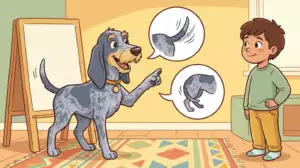
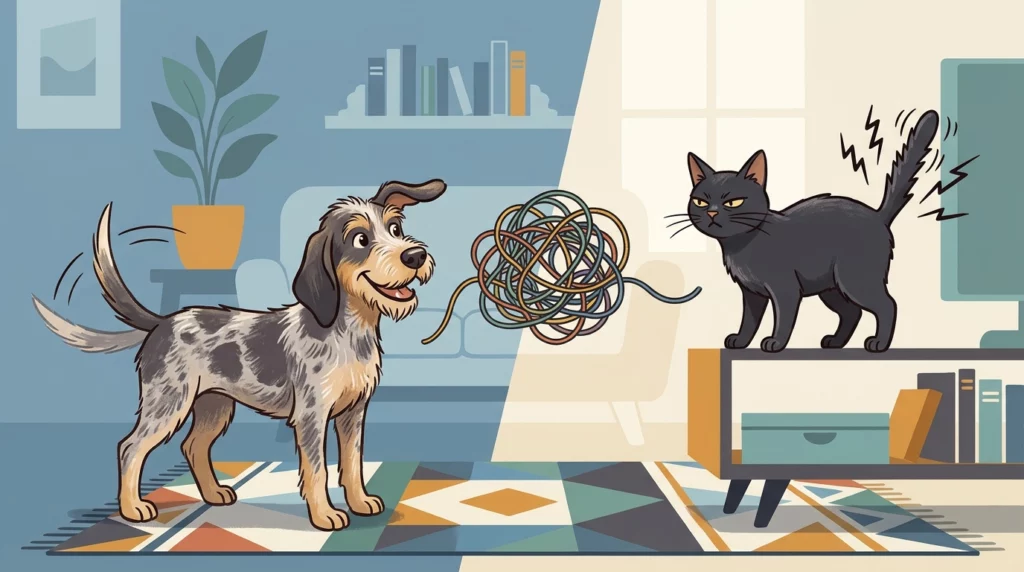
I am Niki. As a five-and-a-half-year-old English Setter, I take facts, decorum, and structural nuance very seriously. My humans at SnoutScoop often rely on me to bring intellectual rigor to our editorial team—a duty I perform with pride, particularly when my housemates are busy performing unscripted comedy routines. If you have ever watched Blu, our energetic rescue Griffon Bleu de Gascogne, attempt to initiate a game of tag with Pisino, our black cat chief of the pack, you have witnessed inter-species diplomacy on the brink of collapse.
The core issue in these household tense moments rarely starts with a growl or a hiss. It starts with the tail. To a dog, a tail is a dynamic communication flag. To a cat, it is a high-precision barometer of irritation and arousal. When those two dialects collide, signals do not just get crossed—they get thoroughly tangled. Let us analyze the behavioral science behind why tail signals mislead, and how dogs and cats learn to bridge the linguistic divide.
The Canine Code: It Is Not Just a Simple Wag
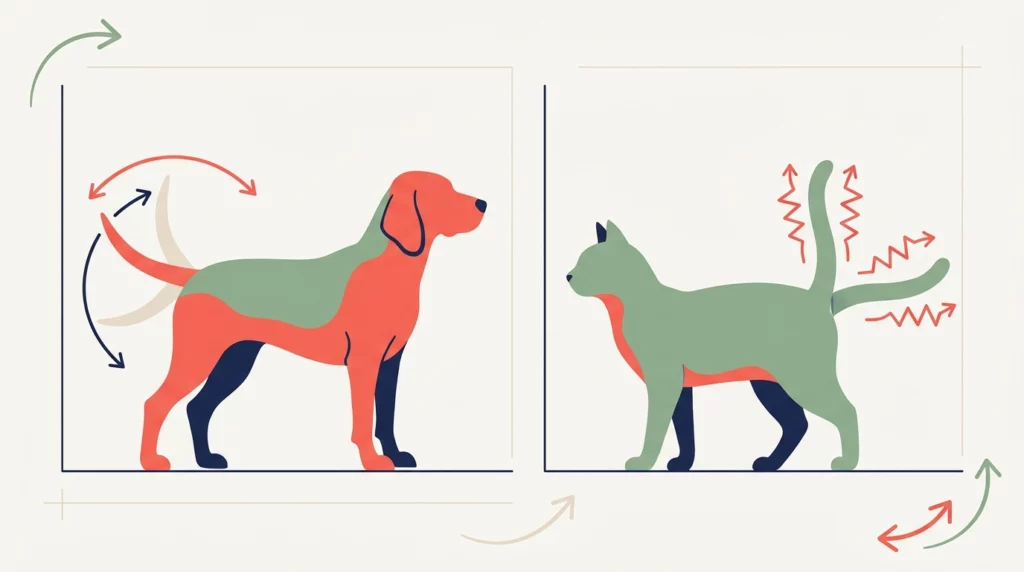
Popular culture tells us that a wagging dog tail equals a happy dog. As a canine of refined intellect, I must inform you that this is an oversimplification. Tail wagging in dogs is a complex system involving height, stiffness, speed, and lateral asymmetry.
In fact, ground-breaking research has revealed that the direction of a dog’s tail wag reflects brain hemisphere activity. A landmark study published by Quaranta et al. (2007) (also detailed on ResearchGate) demonstrated that dogs show asymmetric tail-wagging responses depending on the stimulus. When dogs feel positive, approach-oriented emotions—such as seeing their owner—their tails bias strongly toward the right side of their body, driven by the left brain hemisphere. Conversely, when encountering stressful or withdrawal-inducing stimuli, such as an unfamiliar dominant dog, their tails bias toward the left side, driven by the right brain hemisphere.
What makes this even more fascinating is that other dogs notice these subtle shifts. A follow-up study by Siniscalchi et al. (2013) showed that dogs exhibit higher heart rates and increased anxiety when observing another dog wagging to the left, compared to one wagging to the right. Additional coverage on Phys.org and research summaries on Unterhunds further highlight how central laterality is to canine body language.
Tail wagging in dogs may even have been shaped by human interaction during domestication. Recent scientific reviews hosted on PubMed Central (PMC10792393) and reported by The Guardian suggest that humans may have intentionally or unintentionally selected for rhythmic tail-wagging behavior during the domestication process because we find rhythmic movements appealing and informative.
The Feline Code: Twitching, Lashing, and Thumping
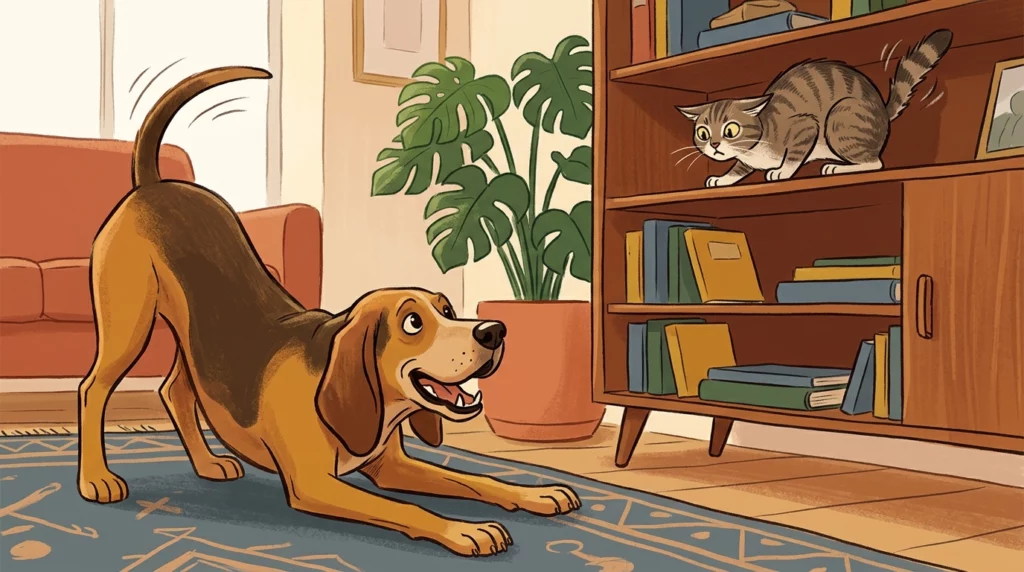
Now consider the cat. Feline tail movement operates under a completely different set of behavioral rules. While a dog’s resting tail may wag gently to convey mild interest or friendliness, a cat’s tail swish is often a warning signal.
When Pisino twitches the tip of his tail, he is usually tracking something or experiencing mild cognitive conflict. When his tail begins to lash back and forth in wide, deliberate thumps, it indicates heightened emotional arousal, frustration, or impending aggression. In feline semantics, a whipping tail means: “Reconsider your current life choices and step away.”
The vertical tail, however, is a feline sign of friendly intent. A cat walking toward you with a high, upright tail (sometimes with a tiny kink at the tip) is offering an invitation to interact. But the moment that tail starts swishing horizontally, the mood has shifted from welcoming to defensive.
When Dialects Collide: The Classic Multi-Pet Misunderstanding
Picture the scene in our living room. Pisino sits on the rug, flicking his tail back and forth because Yuna just zoomed past his head. Blu enters the room, spots Pisino’s rapidly moving tail, and interprets the motion through his canine lens: “Ah! Rapid tail movement! That means enthusiasm and play!”
Blu trots over with a happy, right-biased tail wag. Pisino observes Blu’s approach, views the broad canine posture as an invasion of personal space, and lashes his tail even harder. Blu sees the bigger tail swish and thinks, “Double the excitement!”
The result? A quick feline swipe to Blu’s snout, leaving poor Blu thoroughly bewildered about why his friendly overtures were met with sharp rejection. Clinical insights into cat-dog cohabitation, such as those cataloged by the Veterinary Information Network (VIN), emphasize that inter-species miscommunication of this kind is extremely common in mixed-pet households.
How Multi-Pet Homes Bridge the Gap
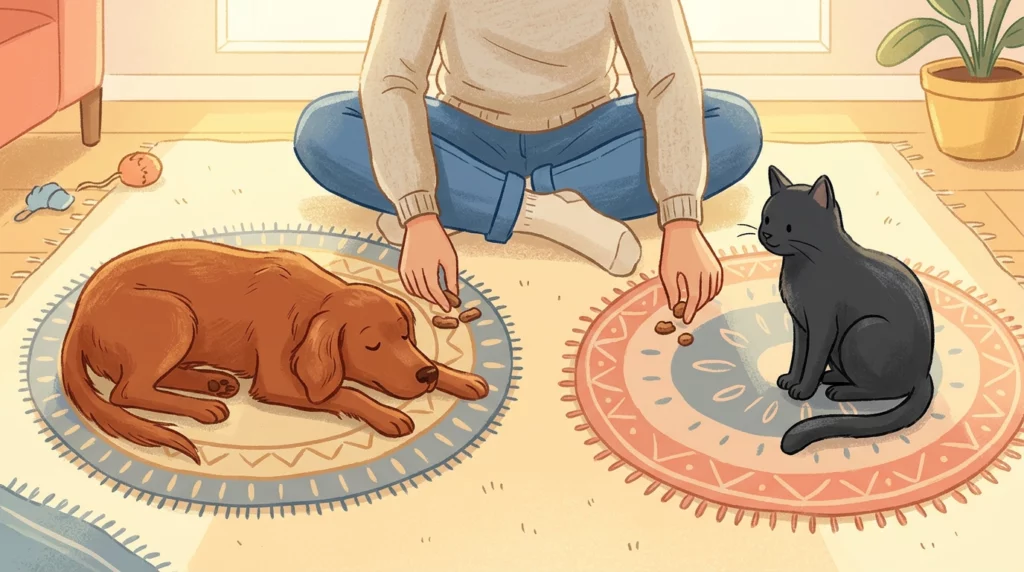
Despite these contradictory signals, cats and dogs living together frequently form deep, harmonious relationships. How do they accomplish this? They learn to look past single body parts and read the full context.
1. Reading Whole-Body Context
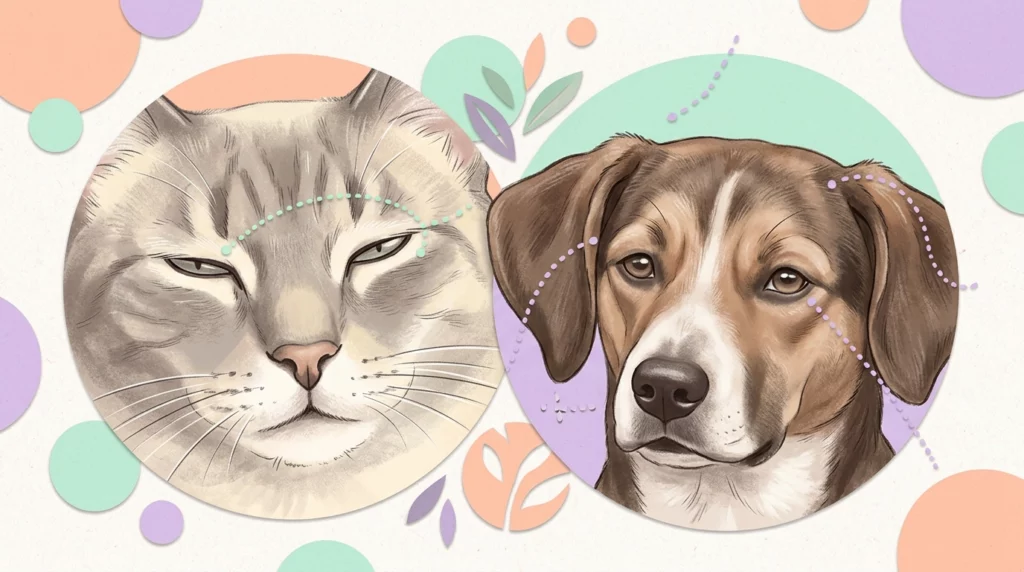
Dogs and cats eventually learn that a tail does not act in isolation. A dog’s tail wag must be decoded alongside ear position, facial tension, and body stiffness. A stiff posture with a high, rigid wag means caution, whereas a loose, wiggly body indicates genuine playfulness. Similarly, a cat’s tail swish combined with flattened ears (airplane ears) signals clear danger, while a swishing tail accompanied by relaxed eyes might just mean focused curiosity.
2. Micro-Blinks and Facial Expressions
Cats communicate peace through slow blinks, facial rubbing, and relaxed whiskers. Dogs often communicate deference through lip licks, soft eyes, and curved body postures. Over time, observant dogs like myself notice that cats value quiet, indirect approaches rather than bounding entries.
3. Household Learning Curves
Research on companion animal behavior confirms that cats and dogs can establish a shared household dialect. Cats learn that a dog’s tail wag is not inherently hostile, and dogs learn that a thumping cat tail is a cue to give their feline housemate some space.
How Humans Can Help Keep the Peace
If you share your home with both dogs and cats, you can help them navigate these structural language barriers with a few practical habits:
- Provide Safe Vertical Spaces: Ensure your cats have cat trees, shelves, or perches where they can observe dogs from a comfortable height without feeling cornered.
- Reward Calm Interactions: Reward your dog for calmly ignoring a cat’s swishing tail, rather than letting them treat it as a cat toy.
- Intervene Early: If you notice your cat’s tail lashing violently, redirect your dog before a physical conflict occurs.
- Respect Individual Boundaries: Never force interactions. Allow both species to set their own pace for friendship.
Understanding the science behind tail signals helps us appreciate just how much effort our pets put into living together peacefully. Blu may still occasionally misinterpret Pisino’s tail thumps, but under my careful supervision—and with a little human guidance—our multi-pet household maintains high standards of harmony.