
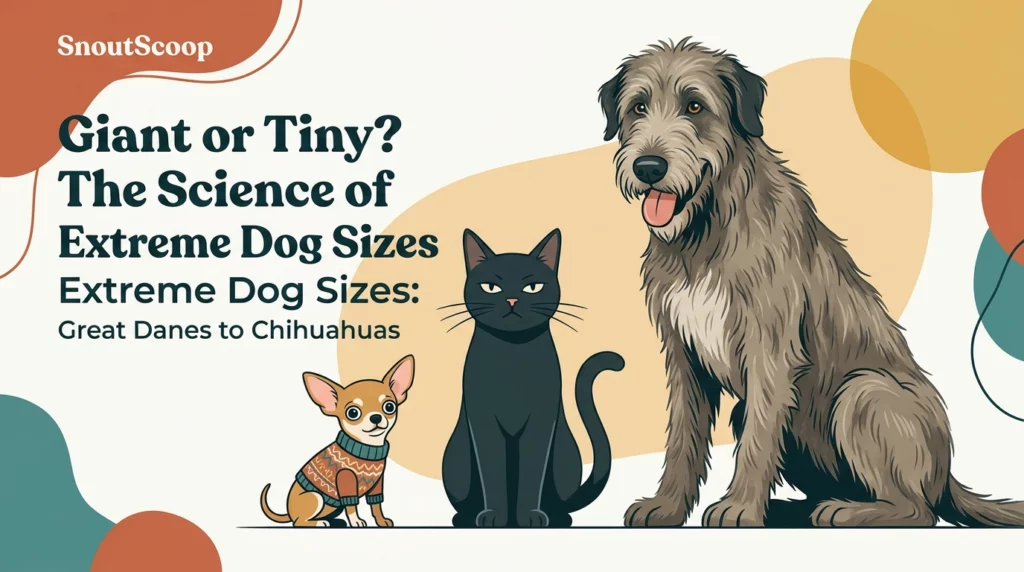
Greetings, humans and lesser-furred creatures. It is I, Pisino—the three-year-old black cat who graciously permits the dogs of the SnoutScoop household to live in my general vicinity. While I am a masterclass in biological perfection (sleek, compact, and effortlessly athletic), I must admit I find canine physical diversity utterly baffling.
How on earth does a two-pound Chihuahua belong to the exact same species as a 150-pound Great Dane? If cats varied this much, I would be sharing my living room with a housecat the size of a Bengal tiger. Yet, dogs manage this size spectrum with a straight face. As the undisputed chief of the pack, I decided to do some research to understand how your canine companions became so anatomically ridiculous. Here is the fascinating science behind extreme dog sizes.
The Master Switch: The IGF1 Gene
For a long time, scientists wondered how dogs could span such a massive scale. In humans, height is controlled by hundreds of different genes, each playing a tiny, incremental role. If dogs worked the same way, selective breeding for size would have taken tens of thousands of years of painfully slow adjustments.
But in 2007, a groundbreaking study published in Science changed everything. Researchers found that a single genetic sequence near a gene called IGF1 (insulin-like growth factor 1) was responsible for a massive portion of the size difference in small dogs. Essentially, if a dog has a specific variant of this gene, they are almost guaranteed to be pint-sized.
This biological mechanism acts like a volume knob. Turn it down, and you get a Pomeranian; turn it up, and you get an Irish Wolfhound. This single-gene influence explains why humans were able to breed dogs into such wildly different sizes in a relatively short evolutionary timeframe, as detailed by the FAPESP Research-backed studies exploring the genetic connections between big and small breeds.
Just a Handful of Genes Run the Show

It gets even more interesting. While human height is an incredibly complex genetic puzzle, dogs keep things remarkably simple. A fascinating study from Stanford University revealed that a very small number of genetic regions—about six or seven—control the vast majority of a dog’s physical traits, including height and weight.
According to researchers, about 80% of the variation in a dog’s size and body shape is governed by these few key genomic regions. Later genetic mapping, published in BMC Genomics, identified a small suite of genes (including IGF1, IGF1R, and GHR) that work together to dictate whether a puppy will grow to be a lap-dweller or a couch-stealer. This concentrated genetic control is the reason breeders could create such distinct, highly specialized breeds in just a few centuries.
An Ancient Mutation Older Than Wolves
For years, the prevailing theory was that the “tiny dog” gene mutation was a modern byproduct of human domestication. We assumed ancient humans took medium-sized wolves, found a weird mutation, and selectively bred tiny dogs to carry in their early-ancestral pouches.
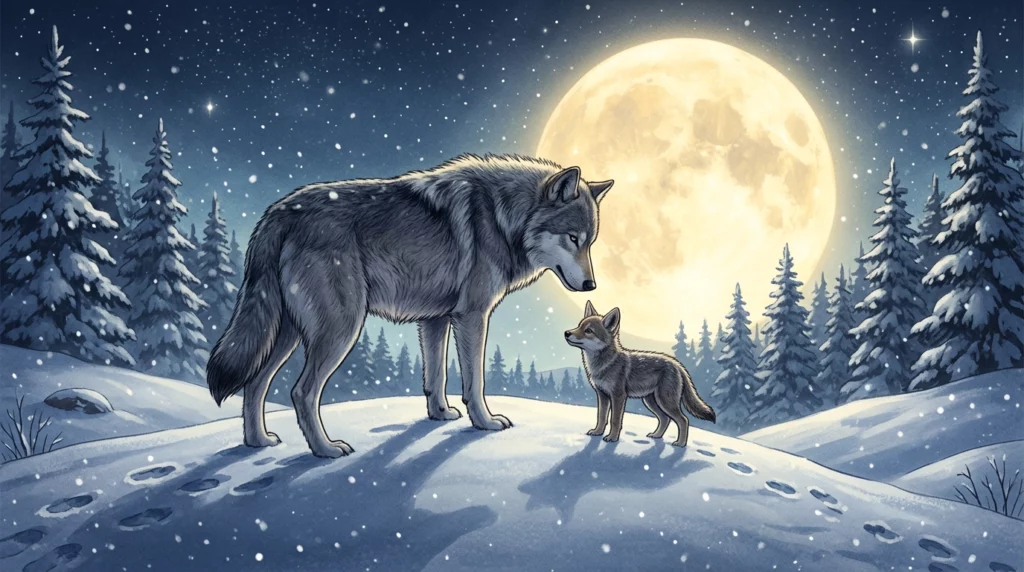
However, modern genetics has busted this myth. A study published in Current Biology (and highlighted by EurekAlert!) looked at ancient canid DNA, including a 53,000-year-old Siberian wolf.
The researchers discovered that the genetic mutation regulating small body size wasn’t a recent mistake. It was actually present in ancient wild canids tens of thousands of years ago. The mutation exists as two versions (alleles) of DNA near the IGF1 gene: one for small size and one for large size. This means the genetic code for both Chihuahuas and Great Danes was already waiting inside ancient wild wolves, long before humans ever threw them a scraps of mammoth meat.
The Great Size Trade-Off: Lifespan and Health

As a cat, I plan on living a long, luxurious life of napping in sunbeams. I find it deeply tragic—and scientifically curious—that dogs do not share the same uniform longevity. In the canine world, there is a harsh rule: the larger the dog, the shorter the lifespan.
A comprehensive study published in PLOS ONE investigated the relationship between dog size, lifespan, and disease patterns. The researchers, whose findings were also covered by EurekAlert!, analyzed data from over 25,000 dogs across 138 breeds.
The science shows that larger dogs do not necessarily suffer from *more* diseases throughout their lives than small dogs, but they are far more susceptible to specific, severe health issues. Giant breeds are highly prone to bone cancer, gastrointestinal issues, and rapid cellular aging. Small dogs, on the other hand, are more likely to suffer from ocular, respiratory, and endocrine issues, but their bodies age at a much slower rate, allowing them to live up to twice as long as their giant counterparts.
A Feline’s Final Verdict
So, what have we learned? Whether you share your bed with a towering Great Dane or a tiny Chihuahua, their dramatic size difference is the result of an elegant genetic volume knob that has existed since the Ice Age. Humans didn’t invent small dogs; we just dialed down the genetic volume that nature had already provided.
Personally, I think both extremes have their merits. Large dogs make excellent heated mattresses, and small dogs are much easier to herd away from my food bowl. But regardless of their size, they all possess that same endearing, slightly goofy canine heart. And of course, no matter how big they grow, they will always look up to me.