
Hello, discerning readers. Niki here. As an English Setter of refined tastes and impeccable pedigree, I like to think I know a thing or two about athletic grace. While my housemate Blu (a sweet but hopelessly chaotic Griffon Bleu de Gascogne) tends to run like a happy, loose-limbed noodle colliding with gravity, I prefer a more calculated approach. When I sprint across a field, there is a certain geometric beauty to it. It is precise. It is elegant.
But even I must bow to the absolute masters of velocity: the sighthounds. Breeds like Greyhounds, Salukis, and Whippets aren’t just fast; they are biologically engineered speed machines. They defy gravity, manipulate friction, and bend the laws of physics to their will. Today, we are putting on our safety goggles and analyzing the sheer science of how the fastest dogs on Earth manage to fly without wings.
The Double Suspension Gallop: Flying on Four Legs
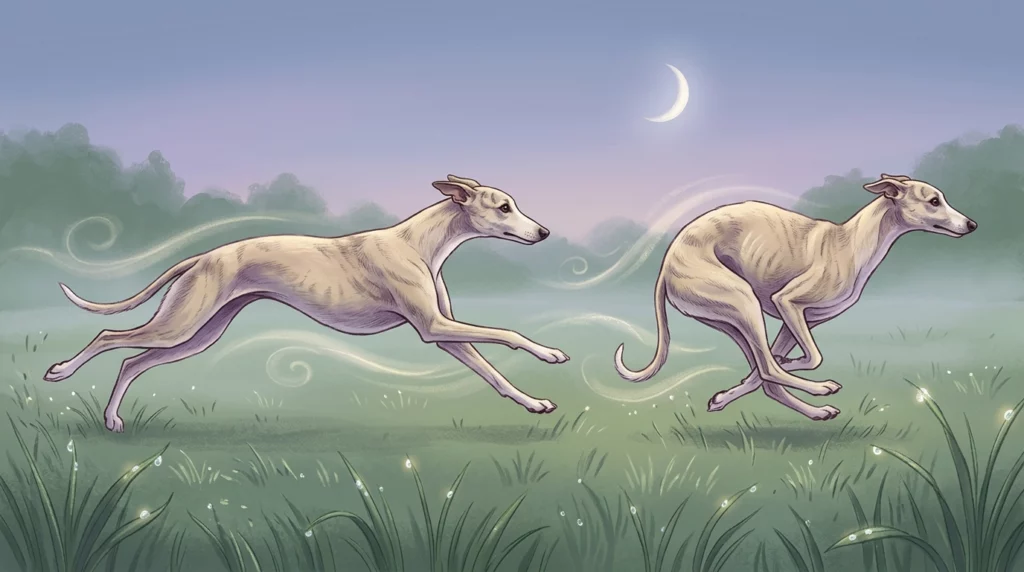
To understand canine speed, we have to look at how a dog moves. Most quadrupeds have gaits you are familiar with: the walk, the trot, and the canter. But when a high-speed dog hits maximum acceleration, they transition into what is known as the double suspension gallop.
This is where the magic happens. According to veterinary gait studies compiled by the University of Minnesota, a rotary gallop involves two distinct phases of complete suspension. This means that during a single stride cycle, there are two moments when absolutely none of the dog’s paws are touching the ground:
- The Extended Flight: The dog’s body is stretched out parallel to the ground, with front legs reaching forward and hind legs reaching backward.
- The Flexed Flight: The body is bunched up, with the hind legs crossing over the outside of the front legs as they prepare to propel the dog forward again.
As detailed by biomechanical breakdowns on Plato Pet Treats and guides from PitPat, this unique gait essentially turns the dog into a low-flying projectile. While a normal dog might spend most of their run pushing off the ground, a sprinting Greyhound spends more than half of their stride time completely airborne. They aren’t just running; they are leaping, landing, and launching again in milliseconds.
The Spine as a Kinetic Spring
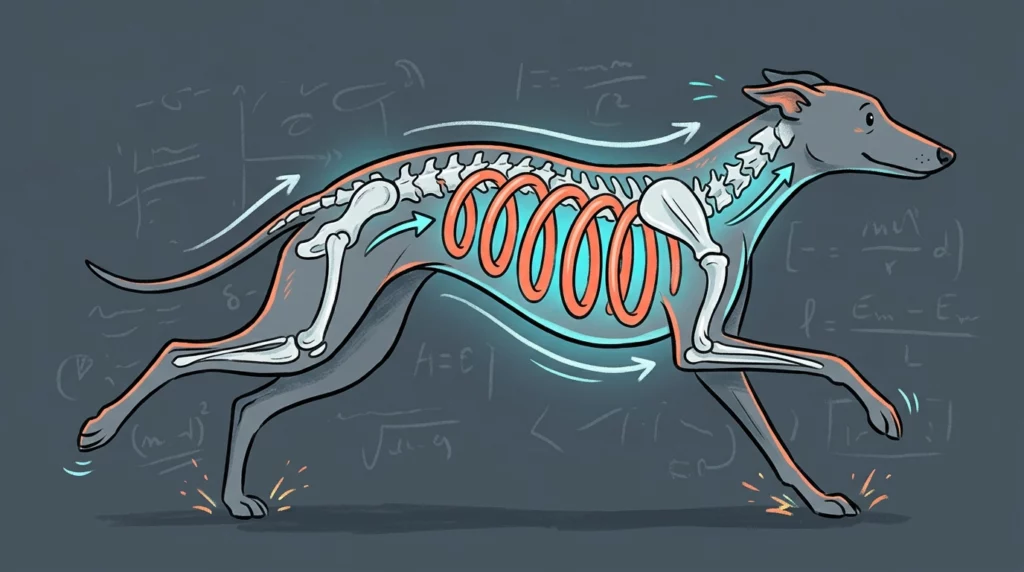
If you have ever watched a Greyhound run, you will notice their back arches and flattens like an accordion. This is not just for show. The canine spine in these elite athletes acts as a powerful, flexible spring that stores and releases kinetic energy.
Research by locomotion experts, such as those at Jim Usherwood Research, highlights how the extreme flexibility of the spine maximizes stride length. When the dog pulls its legs in under its body (the flexed phase), the spine arches upward, storing elastic strain energy. When the spine straightens out, that stored energy is released like a snapped rubber band, catapulting the legs forward with immense power.
This biological spring mechanism is incredibly efficient. A study highlighted by HealthDay notes that this specialized movement allows fast dogs to increase their speed without requiring their muscles to do 100% of the heavy lifting. The elasticity of their tendons and spine does a massive portion of the work, saving precious metabolic energy and preventing early exhaustion.
Ground Forces and the Whip-Like Leg

Speed is not just about moving your legs quickly through the air; it is about how much force you can apply to the ground to push yourself forward. In physics terms, this relates to Newton’s third law: for every action, there is an equal and opposite reaction. To go forward fast, you have to push the Earth backward hard.
A study published in the Journal of Experimental Biology measured the ground forces applied by galloping dogs. The researchers discovered that fast dogs distribute their weight and impact forces with incredible precision. As the paw strikes the ground, the leg undergoes a rapid deceleration and acceleration cycle, acting like a whip.
Furthermore, veterinary physical therapy insights from Canine Physio Care show that the muscle-to-tendon ratio in fast breeds is highly specialized. Their lower legs are exceptionally light, consisting mostly of tough, lightweight tendons rather than heavy muscle mass. By keeping the heavy muscle mass close to the body’s center of gravity (in the shoulders and hips) and keeping the lower limbs light, the dog reduces the rotational inertia of the leg. Translation? They can swing their legs back and forth incredibly fast with very little effort.
Aerodynamics: Slicing Through the Wind

At 40 miles per hour (about 64 km/h), air resistance is no joke. If you have ever tried to run against a strong wind, you know the feeling. Fast dog breeds have evolved an aerodynamic profile that would make Formula 1 engineers jealous.
Genetic and anatomical studies cataloged by the National Institutes of Health (NIH) point to several specific physical adaptations that minimize drag and maximize oxygen intake:
- The Deep, Narrow Chest: This shape slices through the air like a wedge while housing an oversized heart and lungs. A Greyhound’s heart can weigh up to 1.7% of its body weight, compared to about 0.8% in a standard dog. This massive pump keeps oxygen-rich blood flowing to the muscles at breakneck speeds.
- The Dolichocephalic Head: Sighthounds have long, narrow skulls. This aerodynamic shape minimizes wind resistance as they cut through the air.
- Low Body Fat: Unlike my fluffy coat or Blu’s floppy ears, speed-built dogs have paper-thin skin and minimal body fat, reducing extra weight and aerodynamic drag.
Niki’s Concluding Thoughts
So, the next time you see a Greyhound, Saluki, or Whippet absolutely tearing across a park, take a moment to appreciate the staggering physics on display. They are a perfect harmony of elastic energy, aerodynamic design, and mechanical efficiency.
Of course, you don’t need to be a biomechanical marvel to enjoy a good run. I personally find joy in a elegant, calculated gallop, and even Blu’s chaotic, floppy-eared bounding has its own clumsy charm. But when it comes to pure, unadulterated physics in motion, the fastest dogs are truly in a league of their own. Now, if you’ll excuse me, I believe it’s time for me to go practice my own kinetic spring dynamics in the backyard. Purely for research purposes, of course.