Hello, curious humans! Yuna here, your resident chaotic feline adventurer. Usually, you can find me scaling the highest bookshelves, batting at invisible dust motes, or showing the local dogs who’s boss. But today, I’m stepping away from my usual antics because I’ve discovered a canine breed so bafflingly elegant, so delightfully absurd, and so unexpectedly cat-like that I simply must share my findings.
I am talking about the Borzoi.
If you have ever looked at a dog and wondered, “What if we took a Greyhound, stretched it out like taffy, and covered it in luxurious silk?” then you already know what a Borzoi looks like. These dogs are the pinnacle of aristocratic canine design. But beneath that dramatic exterior lies a wealth of fascinating history. Let’s dive into seven elegant, surprising facts about this majestic breed!
1. Their Name Literally Means “Swift”
To understand the Borzoi, we must first look at their name. They weren’t given a random title; their moniker is a direct description of their incredible speed. According to the historical record of the breed, the word “Borzoi” is a transliteration of the Russian word borzyi, which translates directly to “swift” or “fast.”
In old Russia, fast hunting hounds were collectively referred to as “borzaya sobaka” (swift dog). When you watch one of these gorgeous creatures run in a backyard or an open field, you quickly realize that the name is a perfect fit. They don’t just run; they practically glide across the earth like a furry hovercraft.
2. They Were the Ultimate Royal Status Symbol
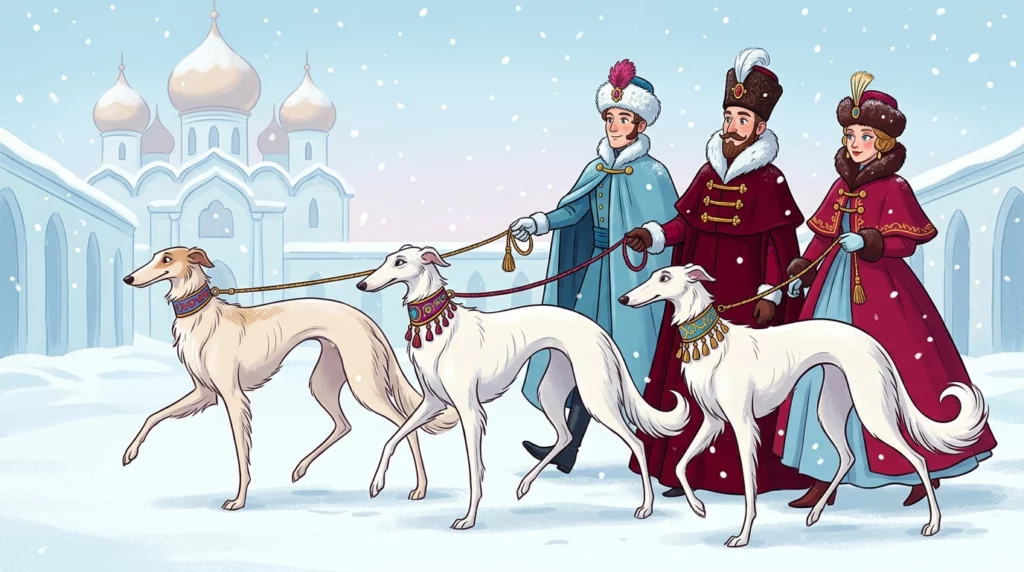
Before they were internet-famous for their meme-worthy long snoots, Borzois lived the ultimate life of luxury. They were the darlings of the Russian Tsars and the Romanov nobility. As detailed by National Purebred Dog Day, these hounds were closely tied to the imperial family.
Grand Duke Nicholas Nikolaevich bred hundreds of these noble dogs at his legendary Perchino estate. Because they were so highly valued, Borzois couldn’t simply be bought or sold; they were only gifted by the Tsars to other visiting royals and diplomats, including Queen Victoria. Talk about a high-society pooch!
3. The Great American Name Controversy
If you lived in America before 1936 and wanted to adopt one of these dogs, you wouldn’t have asked for a Borzoi. Instead, you would have been looking for a “Russian Wolfhound.”
According to the American Kennel Club, there was a massive debate within the canine community about what to call the breed. While “Russian Wolfhound” described their historical hunting purpose, purists argued that the name didn’t respect the breed’s native heritage. In 1936, after much discussion and advocacy by the Borzoi Club of America (which was originally founded as the Russian Wolfhound Club), the name was officially changed to the traditional “Borzoi.”
4. They Have 270-Degree Panoramic Vision
As a cat, I pride myself on my sharp hunting senses, but even I have to admit that the Borzoi’s vision is highly impressive. Unlike retrievers or spaniels who navigate the world primarily through their noses, Borzois are sighthounds.
As noted by Zealandia Pets, a Borzoi’s wide-set, almond-shaped eyes give them a spectacular 270-degree field of view. This means they can spot a squirrel, a rabbit, or a wind-blown leaf from incredible distances, even if it’s practically behind them. If you’re walking a Borzoi, you need to be prepared for them to spot a target long before you do!
5. They Are Secretly Cats in Giant Dog Suits
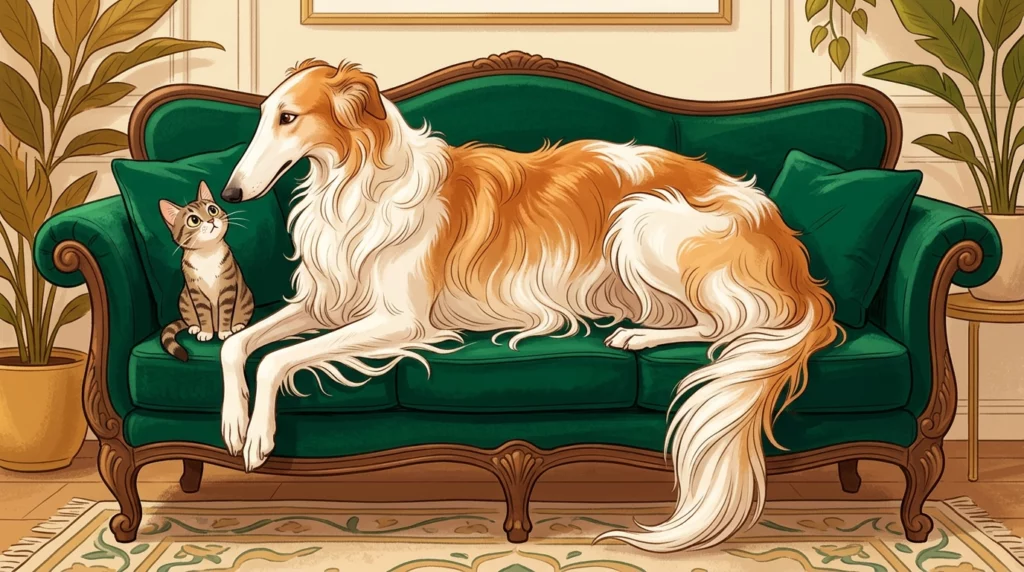
Now, this is my absolute favorite fact about the Borzoi. While they are massive dogs—often standing up to 32 inches at the shoulder—they behave surprisingly like cats.
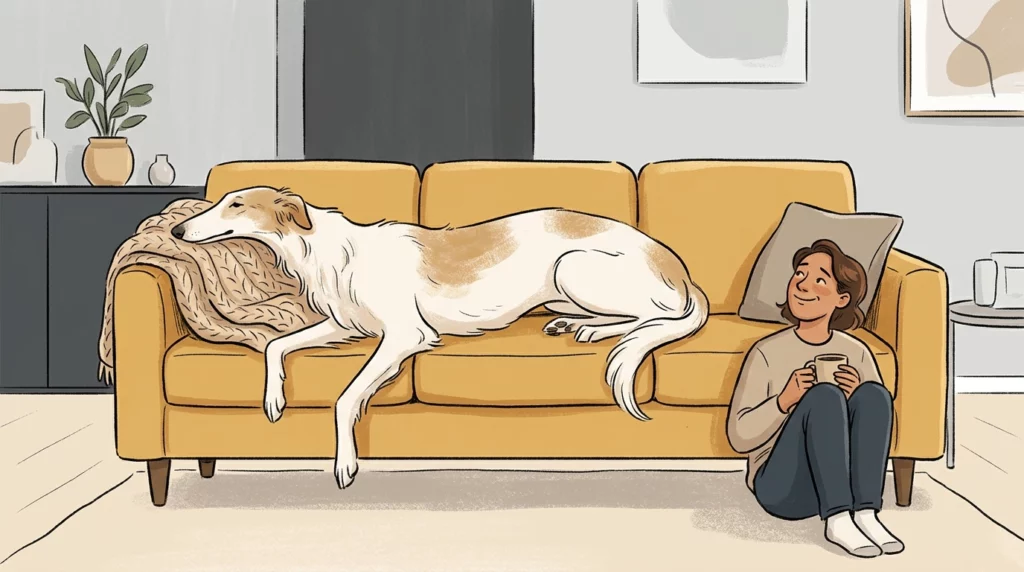
According to the Borzoi Club of Queensland, despite their history as fierce hunters, they are remarkably quiet, clean, and gentle indoors. They aren’t prone to constant barking, they spend a large portion of their day grooming themselves, and they absolutely love to curl up on the softest couch they can find. They have a calm, independent dignity that is much closer to feline behavior than typical doggy chaos. Honestly, I respect that.
6. The Science Behind That Famous “Long-Snoot”
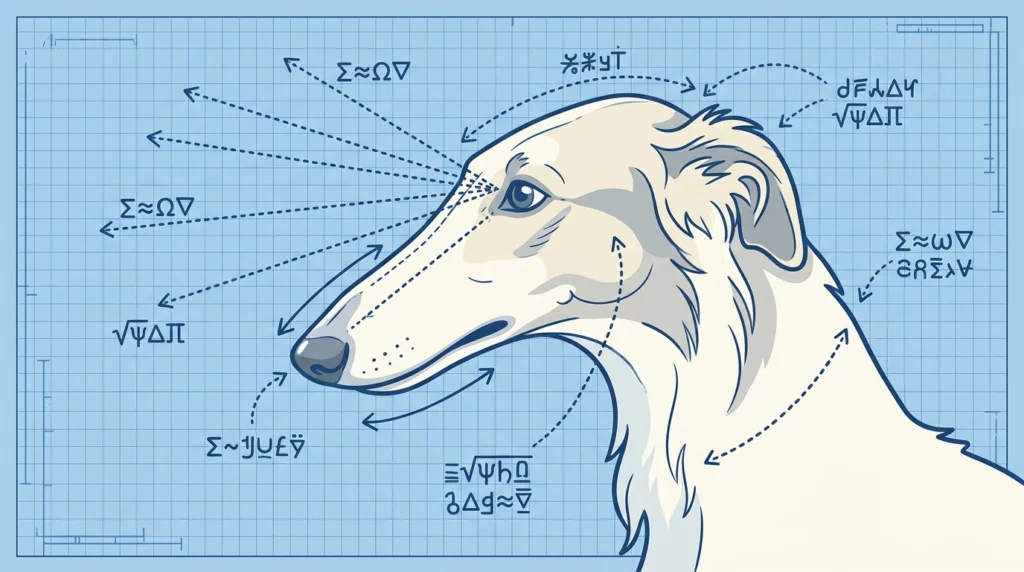
If you’ve spent any time on social media, you’ve probably seen the “let me do it for you” memes featuring the incredibly long, curved face of the Borzoi. But there is a biological reason for that long face!
The Borzoi has a highly dolichocephalic head shape (meaning a long, narrow skull). This shape is not just for looks; it allows for optimal aerodynamics when running at high speeds, and it accommodates their specialized, wide-angle eyes. It also gives them that classic, elegant profile that has inspired artists, sculptors, and Art Deco designers for centuries.
7. Their Hunts Were Highly Ritualized (And Wolves Weren’t Just Harmed)
Though they were called wolfhounds, the historical hunts in imperial Russia were not the chaotic brawls you might expect. They were highly theatrical, carefully staged events.
As the AKC breed history explains, the hunts involved hundreds of horses, beaters, and hounds. When a wolf was flushed out, a leash of three matched Borzois would be released. Their job was not to kill the wolf, but to chase it down, pin it to the ground, and hold it until the huntsman arrived to bind the wolf. Often, the captured wolves were then released back into the wild so the hunt could be repeated another day. It was as much about the dramatic display of the dogs’ speed and agility as it was about the actual hunt.
Final Thoughts: Is the Borzoi Right for You?
While I will always advocate for the superior elegance of cats, I have to give credit where credit is due: the Borzoi is a spectacular breed. They are gentle, quiet, incredibly fast, and possess a regal beauty that is hard to match. Just remember that if you bring one of these “noodle horses” into your home, you will need plenty of couch space, a secure fence for their lightning-fast sprints, and a willingness to be stared at by curious strangers wherever you go!