Hello, thoughtful humans and fellow canine intellectuals. Niki here. As a five-and-a-half-year-old English Setter, I pride myself on keeping the editorial standards here at SnoutScoop strictly ‘up to paw.’ While my energetic housemate Blu communicates primarily through chaotic leaps and a booming, unrefined baritone bay, I prefer a more analytical, elegant approach. Today, we are diving deep into a topic close to my heart—and my vocal cords: the evolutionary history of dog communication.
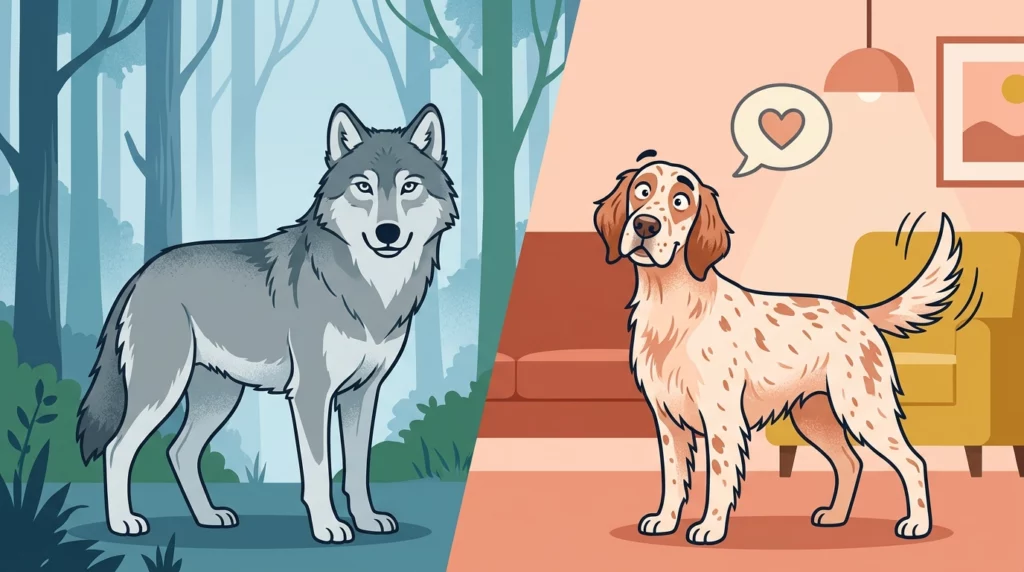
Have you ever stopped to wonder how we went from stoic, wild wolves to highly expressive, eye-contact-holding family members? It did not happen overnight. It is a beautiful, thousands-of-years-long masterclass in co-evolution. From our engineered eyebrows to the secret geometric language of our tails, let us examine the science of how dogs learned to talk to you.
The Masterpiece of Evolution: The ‘Puppy Dog Eyes’
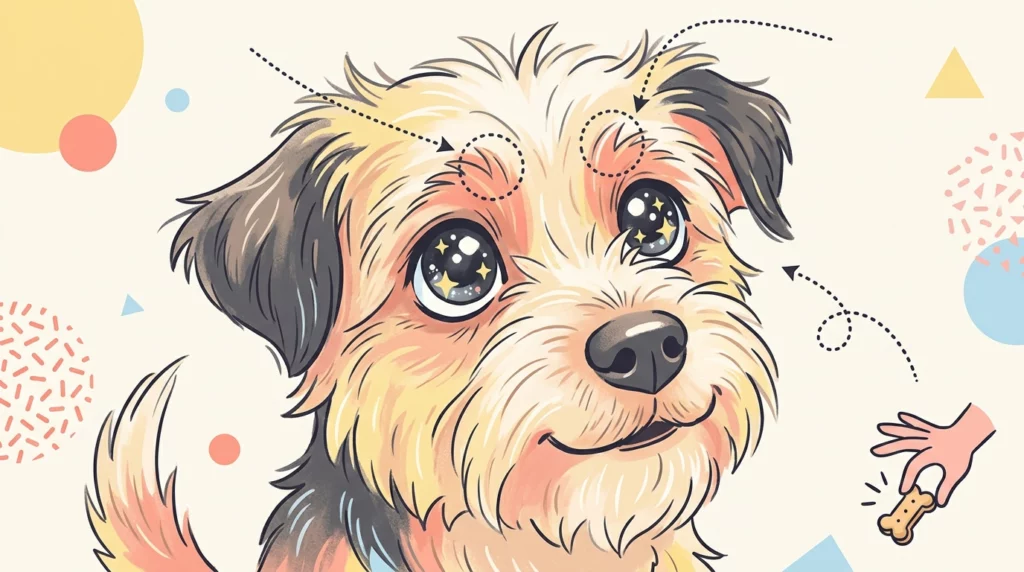
Let us begin with our most devastatingly effective tool: the look of pure, heartbreaking innocence. You know the one. It is the expression that magically compels you to drop a piece of roast chicken or let us onto the forbidden velvet sofa. As it turns out, this is not just a clever trick; it is an evolutionary miracle.
According to a groundbreaking study published in the Proceedings of the National Academy of Sciences (PNAS), dogs evolved a specialized facial muscle over thousands of years that wolves simply do not possess. This muscle, the levator anguli oculi medialis (LAOM), allows us to raise our inner eyebrows. This movement makes our eyes look larger, mimicking the facial expressions of human infants and triggering a powerful nurturing response in your brain.
As animal advocate Zak George playfully observed in a notable discussion on who trained whom, this physiological evolution raises a fascinating question. Did you domesticate us, or did we quietly re-engineer our own faces to ensure we would never have to hunt for our own dinner again? I will let you ponder that while I practice my eyebrow raises in the mirror.
The Complex Code of the Tail Wag
A common human misconception is that a wagging tail always equals a happy dog. As a discerning Setter, I must urge you to look closer. Tail wagging is a highly sophisticated communication network. In fact, scientists at the Max Planck Institute have dug deep into why and how dogs wag, exploring whether the behavior was directly selected by humans or evolved as a side effect of other domesticated traits like friendliness.
As detailed in research published via Max Planck Institute and featured on Sci.News, tail-wagging behavior may have been favored by humans during our shared history due to our natural human affinity for rhythmic patterns. This ‘domesticated rhythmic wagging hypothesis’ suggests humans selected dogs who wagged more frequently because we find rhythmically structured stimuli appealing. More details on these fascinating evolutionary pathways can also be found in PubMed Central.
But the real genius of the tail is its asymmetry. A fascinating study published in Current Biology reveals that the direction of a wag carries profound emotional meaning:
- The Right-Sided Wag: When a dog feels positive and wants to approach something (like their favorite human or a fresh bowl of kibble), the left hemisphere of the brain activates, causing the tail to wag predominantly to the right.
- The Left-Sided Wag: When a dog encounters something intimidating or wants to withdraw, the right hemisphere takes over, causing the tail to wag to the left.
Astonishingly, other dogs can read these subtle micro-expressions. When we see another dog wagging to the left, our own heart rates spike, and we become vigilant. It is a silent, rapid-fire safety broadcast system built right into our hindquarters.
Inside the Canine Mind: Processing Human Speech

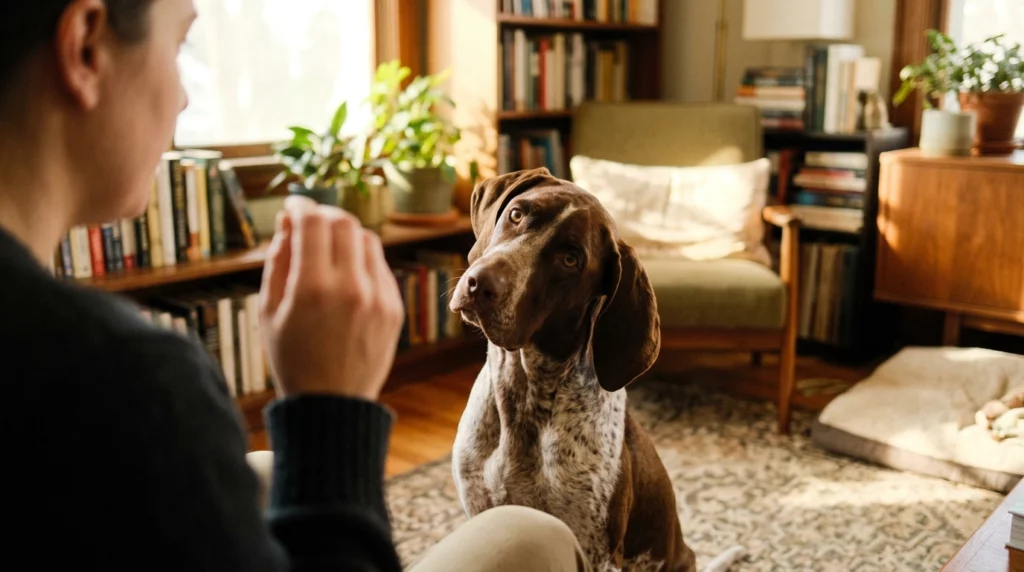
Our communication evolution isn’t just about what we show you; it is also about how we perceive you. We have spent millennia studying your voices, your expressions, and your patterns. Our brains have actually developed dedicated networks to understand human communicative signals.
Research on how selection and learning shape communication networks in the dog brain highlights that our brains are incredibly plastic. We have evolved specific pathways to process both the emotional intonation of your voice and the actual meaning of your words.
As highlighted in a compelling share by Companion Animal Psychology, this neurological adaptation means we are uniquely tuned to human social cues. We aren’t just reacting to noise; we are actively decoding your intent, your stress levels, and your joy. When you speak to us in that high-pitched ‘baby voice,’ our brains light up in areas associated with reward. We genuinely care about what you are saying—and how you are saying it.
The Evolution of the Bark
Finally, we must address the vocalizations. Wild wolves rarely bark; when they do, it is usually a brief, singular warning. Dogs, on the other hand, bark in a rich symphony of pitches, durations, and repetitions. We bark when we are excited, when we are suspicious, when we want to play, or when the mail carrier dares to walk on our street.
Why did we become so vocal? Because we realized that humans are auditory creatures. You communicate through speech, so we adapted our vocal repertoire to get your attention. We learned that a high-pitched yip gets us out the door faster, while a low, rhythmic growl keeps intruders at bay.
A Shared History Written in Love
At the end of the day, our communication methods are a love letter to humanity. We reshaped our faces, recalibrated our tails, and rewired our brains just so we could understand you better—and make sure you understand us.
So, the next time your dog looks at you with those deep, expressive eyes or gives you a gentle, right-leaning tail wag, take a moment to appreciate the thousands of years of history behind that simple gesture. We worked hard to learn your language. Thank you for taking the time to learn ours.