
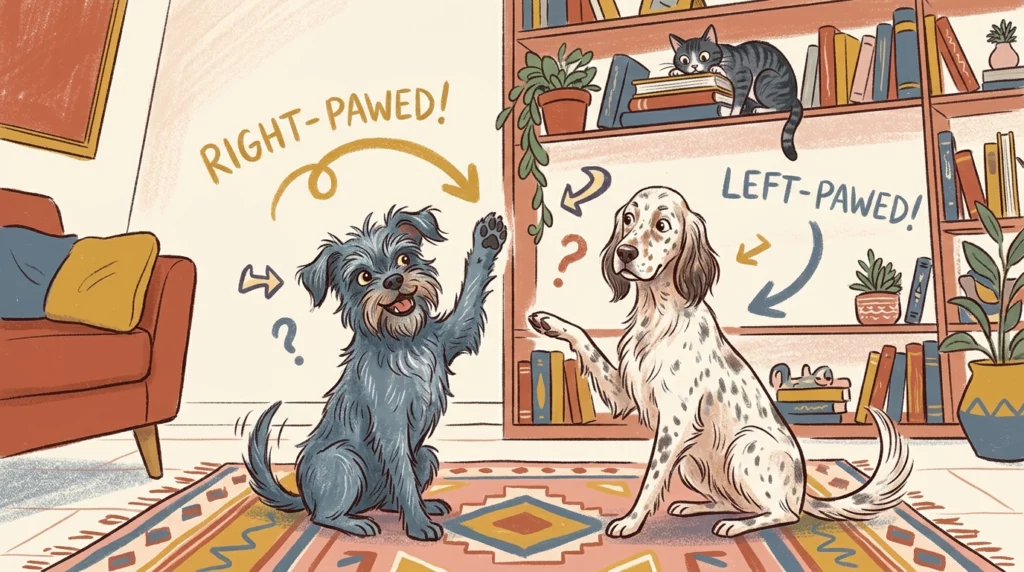
Hello, curious humans! Yuna here, your resident chaotic feline adventurer, writing to you from my favorite, highly strategic observation deck (the top of the living room bookshelf). From this glorious height, I have a front-row seat to the daily comedy show starring my canine roommates, Blu and Niki.
Blu, a two-year-old Griffon Bleu de Gascogne rescue, is essentially a walking, hyperactive blue cloud. He has boundless energy but, let’s be honest, his coordination is questionable. Niki, our English Setter, is much more dignified, stepping out of her bed like royalty preparing for a grand march. Watching them got me thinking: do dogs have a “dominant hand” like humans do? When Blu tries to pin down his favorite squeaky toy, or when Niki taps the human for breakfast, do they prefer one specific paw?
Being the curious cat I am, I did some digging into the science of dog lateralization (that’s the fancy scientific word for paw-preference). It turns out, dogs absolutely have a favorite paw! Here is what the science says, and how you can run a few fun, chaotic tests in your own living room to find out if your pup is a lefty or a righty.
The Great Paw Divide: Dogs vs. Humans
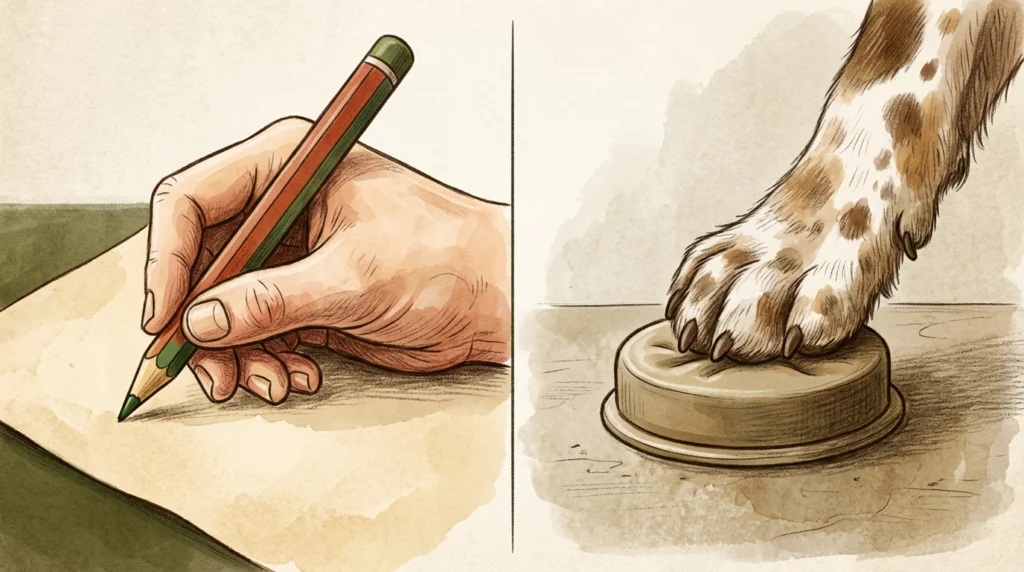
In the human world, lefties are a distinct minority. Only about 10% of humans are left-handed, which means the rest of you are living in a right-biased world of scissors, desks, and can openers. But in the dog world? Things are much more balanced.
According to researchers, dogs are far more evenly split. In a massive study discussed on Psychology Today, scientists analyzed data from thousands of dogs and found that roughly 60% to 70% of dogs show a clear paw preference. Unlike humans, however, the split between left-pawed and right-pawed dogs is much closer to 50/50, with a substantial portion of dogs being completely ambilateral (the dog equivalent of ambidextrous, meaning they use both paws equally).
Interestingly, gender seems to play a small role. Studies have shown that male dogs are slightly more likely to be left-pawed, while female dogs are more likely to be right-pawed. Why? Scientists think prenatal sex hormones might influence how the brain’s hemispheres develop. Fascinating, right? Even if it involves dogs.
How to Test Your Dog: 4 Easy DIY Experiments
You don’t need a high-tech laboratory to figure out your dog’s lateralization. You just need a few treats, some toys, and a little bit of patience. Because scientists like to keep things precise, they recommend repeating these tests multiple times over several days to get an accurate reading, rather than just relying on a single lucky swipe.
As outlined in a guide on Psychology Today, here are the best ways to test your pup at home:
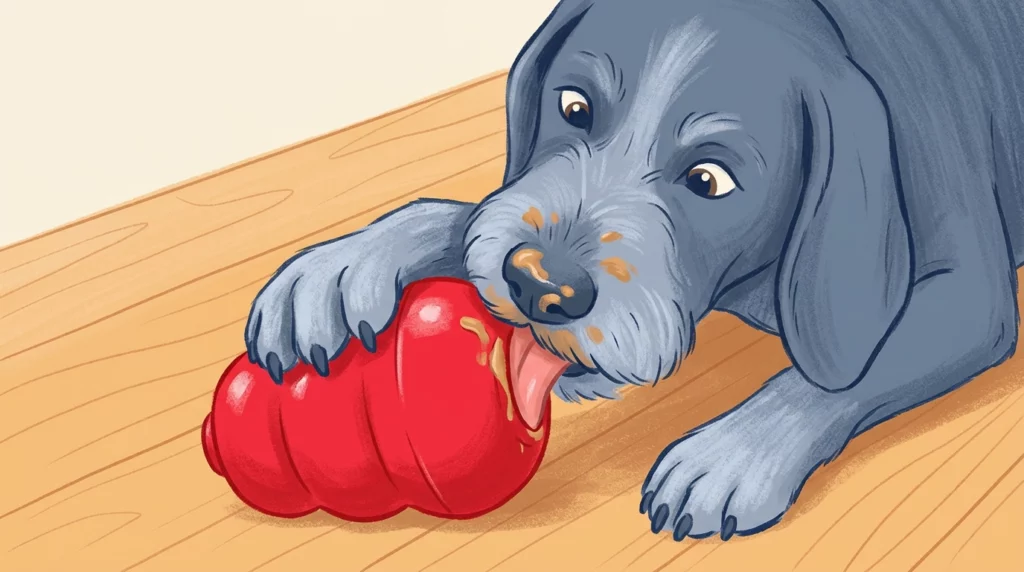
1. The Kong Test (The Gold Standard)
This is widely considered the most reliable test by animal behaviorists. Take a classic rubber Kong toy, stuff it with something delicious and sticky (like peanut butter or wet food), and place it on the floor in front of your dog. To get the food out, your dog will need to hold the Kong steady. Watch closely: which paw do they use to pin the toy to the ground? Repeat this test over a few days, tracking which paw they use first.
2. The First Step Test
This is one of the easiest tests, though it requires you to be very observant. When your dog is standing completely still and you call them to walk toward you, which front paw do they move first? According to a study covered by Smithsonian Magazine, tracking the “first step” over 50 or more repetitions is an excellent, non-invasive way to determine your dog’s dominant side.
3. The “Treat Under the Sofa” Trick
Find a low piece of furniture (like a sofa or a heavy cabinet) that your dog can’t fit their head under, but can easily reach with a paw. Toss a smelly, irresistible treat just out of snout-reach beneath the furniture. Watch which paw your dog instinctively uses to try and sweep the treat back out.
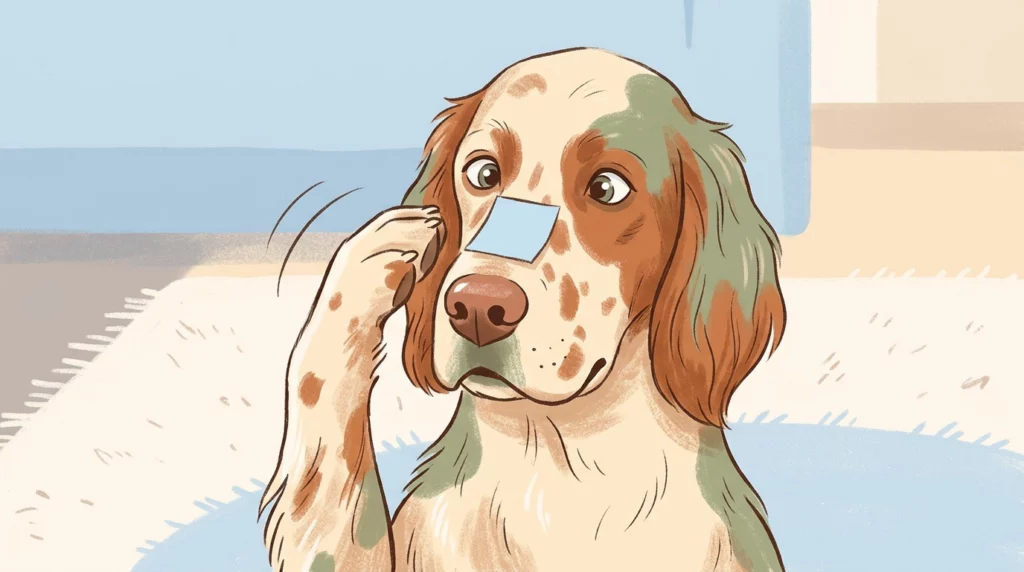
4. The Tape-on-the-Nose Test
I must admit, this one sounds like excellent cat entertainment. Scientists sometimes place a small piece of gentle, pet-safe tape or a sticky note on a dog’s snout or forehead. Naturally, the dog wants to get it off. The paw they use to swipe at their nose to remove the obstacle is usually their dominant paw. However, as noted by researchers on ZME Science, some dogs find this test a bit annoying, so make sure to reward them with plenty of treats afterward!
What Your Dog’s Dominant Paw Says About Their Brain
Now, you might be asking: “Yuna, why does this matter? Is this just a silly parlor trick?” Not at all! Just like in humans, paw preference reflects how a dog’s brain is wired.
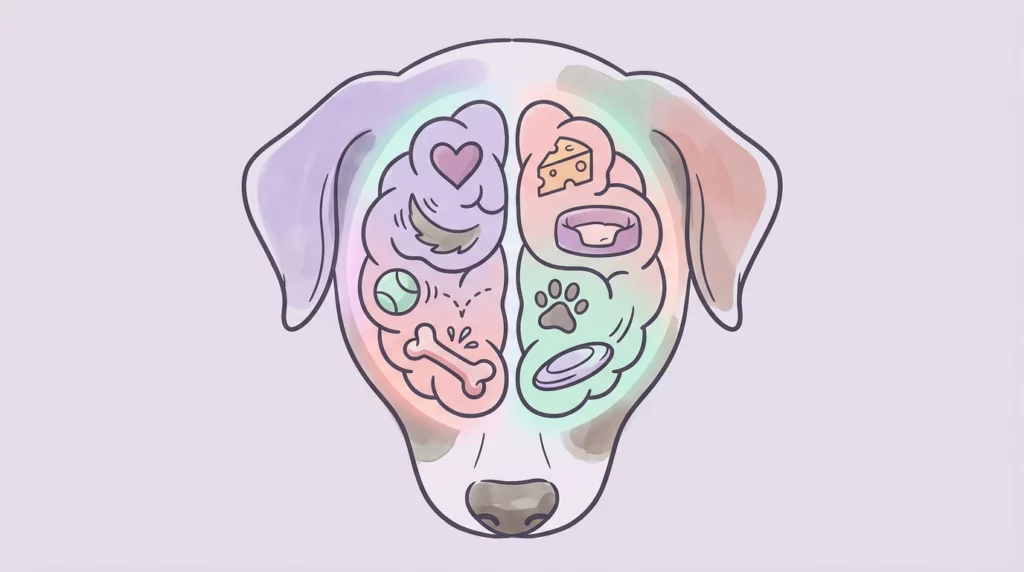
The left hemisphere of the brain controls the right side of the body, and the right hemisphere controls the left side. The left hemisphere is generally associated with processing positive emotions, approaching safe situations, and calm learning. The right hemisphere is more involved in processing threats, intense emotions like fear, and withdrawal behaviors.
Because of this brain connection, a dog’s dominant paw can actually give us a sneak peek into their emotional personality:
- Right-Pawed Dogs: These pups tend to be more optimistic, bold, and easily trained. Because their left hemisphere is dominant, they are often quicker to approach new objects and are less likely to show extreme fear reactions.
- Left-Pawed Dogs: These dogs are often a bit more cautious, sensitive, or reactive. A study published by researchers at Queen’s University Belfast (Cognitive Bias and Paw Preference) suggests that left-pawed dogs might exhibit a slight pessimistic bias, making them more wary of unfamiliar sounds or situations.
- Ambilateral Dogs (No Preference): Interestingly, dogs that don’t have a dominant paw can sometimes be the most sensitive of all. According to CalcMyPet, ambilateral dogs are often more reactive to loud noises, such as fireworks or thunder. Because their brains don’t have a highly dominant hemisphere to process the stress, they can feel a bit more overwhelmed by sudden stimuli.
Of course, as explained in Daybreak Notes & Beans, these are general scientific trends, not absolute rules. Every dog is an individual shaped by their genetics, environment, training, and how many belly rubs they receive daily.
So, What’s the Verdict?
After quietly observing Blu and Niki from my perch, I have some theories. Niki seems to be a solid right-pawed lady—poised, confident, and always leading with her right leg. Blu, on the other hand, is a chaotic lefty who gets startled by his own shadow but has a heart of pure gold.
What about your dog? Are they a steady righty, a sensitive lefty, or a wonderfully goofy ambilateral pup? Grab some peanut butter, fire up the Kong test, and let us know in the comments below!
Now, if you’ll excuse me, I hear Blu coming down the hallway, and I need to strategically knock a pen off the kitchen counter to see which paw he uses to chase it. For science, obviously!