
Greetings, human subjects. It is I, Pisino—the three-year-old black cat who valiantly oversees the daily operations and general chaos of the SnoutScoop household. Today, I am pausing my tightly scheduled series of strategic sunny-spot naps to clear up a massive misunderstanding about my canine subordinates, Blu and Niki.
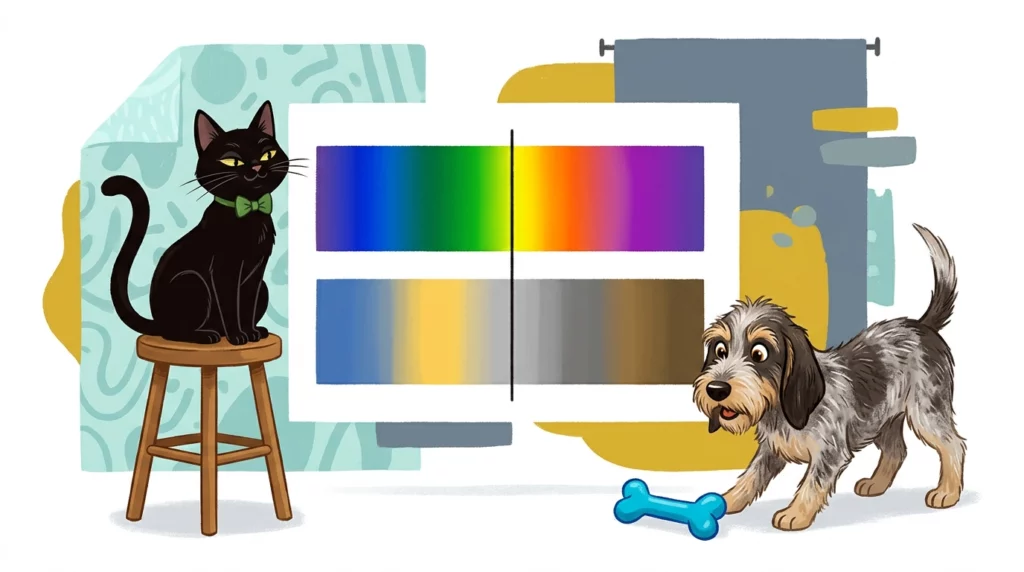
For decades, humans have walked around believing that dogs live inside an old 1920s black-and-white movie, gazing out at a monochrome world of grays, blacks, and whites. I watch Blu sprint headfirst into a couch cushion every afternoon, so I understand why you might assume his sensory apparatus is somewhat limited. However, as VCA Animal Hospitals points out, the idea that pets live in a colorless void is pure fiction.
Dogs do, in fact, see in color! It is just a very different color palette than the one you experience—or the superior visual array I possess. Let us dive into the fascinating science of the canine rainbow, figure out why your dog keeps losing their favorite fetch toy, and learn how to view the world through their eyes.
The Biological Hardware: Cones, Rods, and Color Photoreceptors
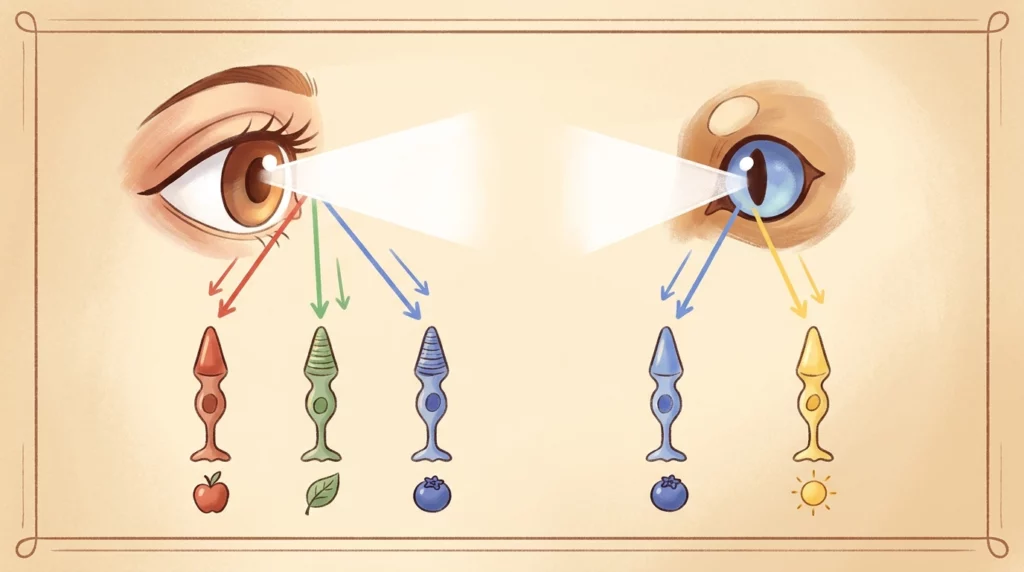
To understand what dogs see, we have to look inside the retina at specialized light-detecting cells called photoreceptors. There are two main types of photoreceptors at play here: rods, which process motion and low-light vision, and cones, which handle color discrimination and fine detail.
Human eyes are trichromatic. You possess three distinct types of cone cells sensitive to red, green, and blue light wavelengths. By blending signals from these three cones, human brains can perceive millions of color shades, spanning the full visible spectrum from vibrant violet to neon pink.
Dogs, on the other hand, are dichromatic. Groundbreaking vision studies led by researchers like Dr. Jay Neitz confirmed that dogs possess only two types of functional cone receptors. As detailed in updates from the University of Washington, canine cones are tuned specifically to blue wavelengths (around 429 nanometers) and yellow-green wavelengths (around 555 nanometers).
In plain English? Dogs miss out on the red-green portion of the color spectrum, making their vision remarkably similar to a human living with red-green color blindness (deuteranopia).
The Canine Spectrum: What Colors Do They Actually See?
So, if a dog looks at a sunset, a lush backyard, or a bright orange sign, what are they actually looking at? According to visual research summarized by Grove Animal Hospital and Trusted Pet Advice, here is how the world renders in canine vision:
- Blue: Crystal clear! Dogs see blue strongly and accurately.
- Yellow: Bright and vibrant. Yellow stands out sharply in a dog’s visual world.
- Red: Appears as a dark brownish-gray or murky black.
- Green: Renders as a muted yellowish-white or grayish tint.
- Orange: Looks like a muddy yellow-brown.
- Purple: Appears simply as another shade of blue, since they cannot perceive the red component of the blend.
Veterinary explanations from Bunko Pet emphasize that while dogs see fewer colors than humans, their world is far from dull—it is built around a distinct baseline of blues, yellows, and earthy grays.
The Great Red Ball Mystery Revealed

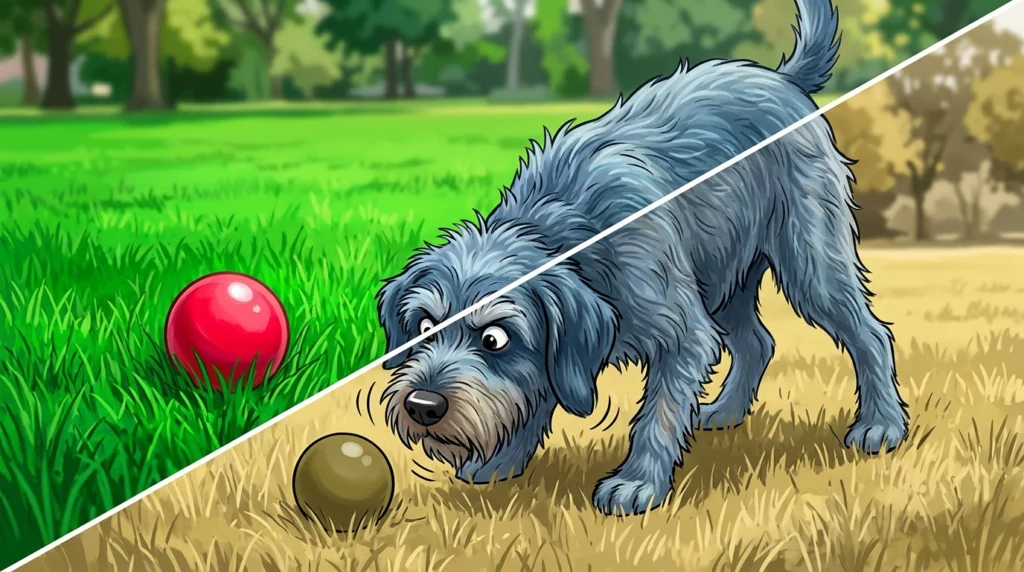
Now, let us apply this science to a classic household dilemma. Have you ever stood on a beautiful green lawn, tossed a bright, cherry-red ball for your dog, and watched in utter bewilderment as they ran right past it six times?
You might be thinking, “How can Blu not see that bright red ball sitting right in the middle of the yard? Is he being dramatic?” (Well, usually he is, but not in this instance).
To your trichromatic eyes, a red ball on green grass creates a striking, high-contrast visual image. But to your dog, you have effectively thrown a dark-brown sphere into a field of light-yellowish brown grass. As noted in Psychology Today, the ball virtually vanishes into the background background context visually! The reason Blu eventually finds the toy isn’t because he spotted the color red—it’s because he picked up on the movement of the bounce or located it using his magnificent snouter.
Super-Senses: What Dogs Gain in Return

Before you feel too sorry for our four-legged barkers, understand that nature made a very deliberate trade-off. What dogs sacrifice in color spectrum vibrancy, they make up for in low-light navigation and rapid motion detection.
The canine retina is densely packed with rod cells, which are far more sensitive to light and movement than cone cells. Additionally, dogs possess a mirror-like tissue layer behind their retina called the tapetum lucidum. This structure reflects light back through the photoreceptors a second time, giving dogs exceptional vision in near-darkness (and giving them those glowing, demon-like eyes in night-mode photography).
While a dog might struggle to distinguish a red apple from a green leaf on a static table, they can spot a tiny squirrel twitching a tail 100 yards away in twilight long before you even realize a squirrel is present.
Practical Tips for Dog Parents: Upgrade Your Pup’s Palette
As the undisputed intellectual chief of this household, I always insist on practical applications for scientific knowledge. Knowing how your dog sees should change how you shop for and interact with them!
1. Ditch the Red Toys for Outdoor Fetch
If you want fetch time to be snappy and fun, buy toys in bright **blue** or vivid **yellow**. A royal-blue rubber ball on green grass provides maximum contrast for a dog’s vision, allowing them to track and locate it instantly with their eyes.
2. Rethink Agility and Training Equipment
If you participate in agility training or trick work, pay attention to equipment colors. Blue and yellow weave poles, jumps, and target mats are dramatically easier for dogs to discriminate against neutral backgrounds than red or orange gear.
3. Leverage Smell and Contrast
When training or playing indoors, contrast matters more than bright hues. Dark toys on light carpet or light toys on dark hardwood floor stand out instantly thanks to luminosity differences, even if the actual colors blur together.
Final Verdict from the Pack Chief
So, there you have it. Dogs do not live in a drab, black-and-white vacuum, nor do they see the lush, neon spectrum that humans enjoy. They inhabit a lovely blue-and-yellow-hued reality, perfectly tailored by evolution for dawn tracking, twilight patrolling, and endless games of fetch with high-visibility blue toys.
Now, if you will excuse me, I must return to my lounge chair to oversee Blu’s afternoon training. Keep your colors bright, your science accurate, and your dog’s toy bin full of blue!