
Hello, curious humans! Yuna here, your resident feline explorer, chief of chaos, and self-appointed scientific investigator at SnoutScoop. Today, we need to talk about something that has been baffling me for months.
I have noticed a bizarre trend on your human internet. You are buying giant, colorful plastic floor mats covered in recordable buttons so your dogs can “talk” to you. Now, as a cat, I find this highly inefficient. If I want something, I simply knock a glass off the counter, scream at 3:00 AM, or stare deeply into your soul until you yield to my demands. It works every time. No batteries required.
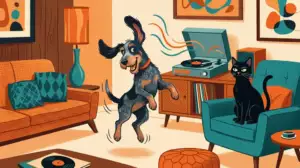
But dogs? Dogs are… let’s say, enthusiastically uncomplicated. My buddy Blu, a sweet Griffon Bleu de Gascogne rescue, communicates his emotions by vibrating, drooling, or doing a full-body wiggle. The idea of Blu calmly pressing a button labeled “existential” to discuss his feelings seems like a stretch.
Yet, millions of people watch dogs like Bunny the Sheepadoodle on TikTok apparently stringing together complex sentences like “Stranger cat outside mad” using Augmentative and Alternative Communication (AAC) devices. Are these dogs truly expressing their innermost thoughts, or are they just very good at training their humans to hand over treats? I decided to dig into the cognitive science to find out.
The Buzz About the Buttons: How We Got Here

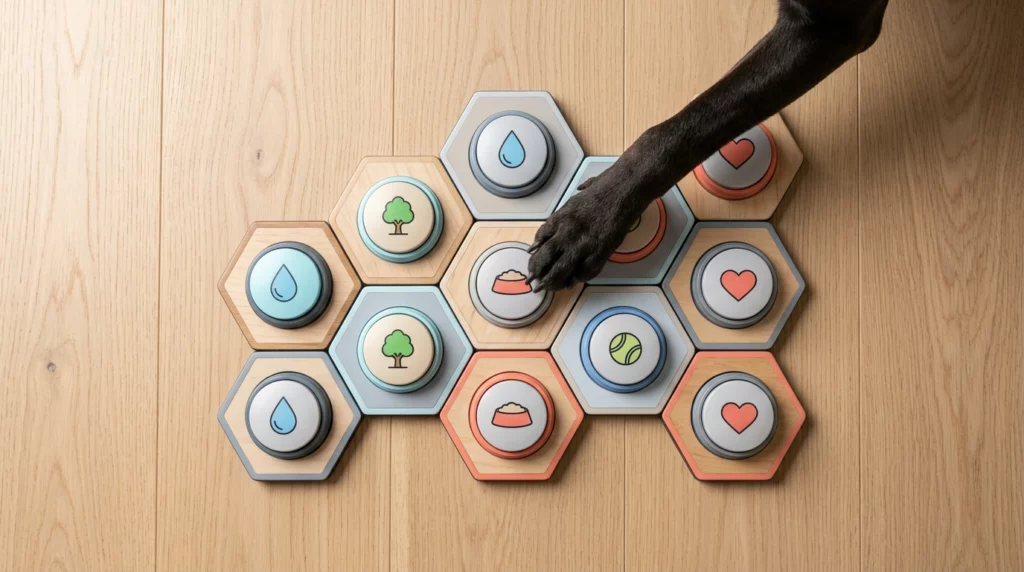
The concept of using AAC devices—originally designed for non-verbal humans—for pets exploded in popularity during the pandemic. Brands like FluentPet made it easy for anyone to set up a “soundboard” where each button plays a pre-recorded word like outside, play, food, or scritches.
Suddenly, the internet was flooded with “talking” dogs (and a few brave cats, though we already know how to get what we want). These pets appeared to be doing more than just asking for dinner; they seemed to be gossiping about the neighborhood birds, complaining about paw pain, and questioning the nature of their own reflections.
Naturally, the scientific community had some questions. Was this a genuine cognitive breakthrough, or a classic case of humans seeing what they wanted to see?
The Science: Inside the ‘TheyCanTalk’ Study
To separate internet hype from actual animal behavior, researchers at the University of California, San Diego (UCSD) Comparative Cognition Lab launched a massive citizen science project called “TheyCanTalk.” Led by cognitive scientist Federico Rossano, the study aimed to analyze real-world data from thousands of participants tracking their pets’ button use.
In August 2024, the team published a groundbreaking study in the journal PLOS ONE. The researchers wanted to know: Do these dogs actually understand what the buttons mean, or are they just responding to their owner’s physical cues?
The researchers conducted two pre-registered experiments, sending researchers directly into the homes of button-trained dogs to do controlled testing. The results? Dogs really do understand the words on their buttons.
- When owners pressed a button like “play” or “outside,” the dogs responded with the appropriate behavior.
- More importantly, when an impartial researcher (not the owner) pressed the button, or when the button was pressed while the owner couldn’t see or hear it, the dogs still responded correctly.
According to the study, this proves that dogs are not just reacting to subtle, accidental physical cues from their owners. They genuinely associate the sound of the button with the real-world outcome.
Are They “Talking” or Just Associating? (The Clever Hans Warning)
Before you run out and buy a 50-button soundboard expecting your dog to recite Shakespeare, we need to look at a very important concept in animal psychology: the Clever Hans effect.
In the early 1900s, a horse named Hans became famous for allegedly doing math. If you asked him what 3 plus 4 was, he would tap his hoof seven times. However, psychologists eventually realized that Hans couldn’t actually do arithmetic. Instead, he was incredibly skilled at reading human body language. He would stop tapping his hoof the exact moment his handler shifted their posture or raised their eyebrows in anticipation of the correct answer.
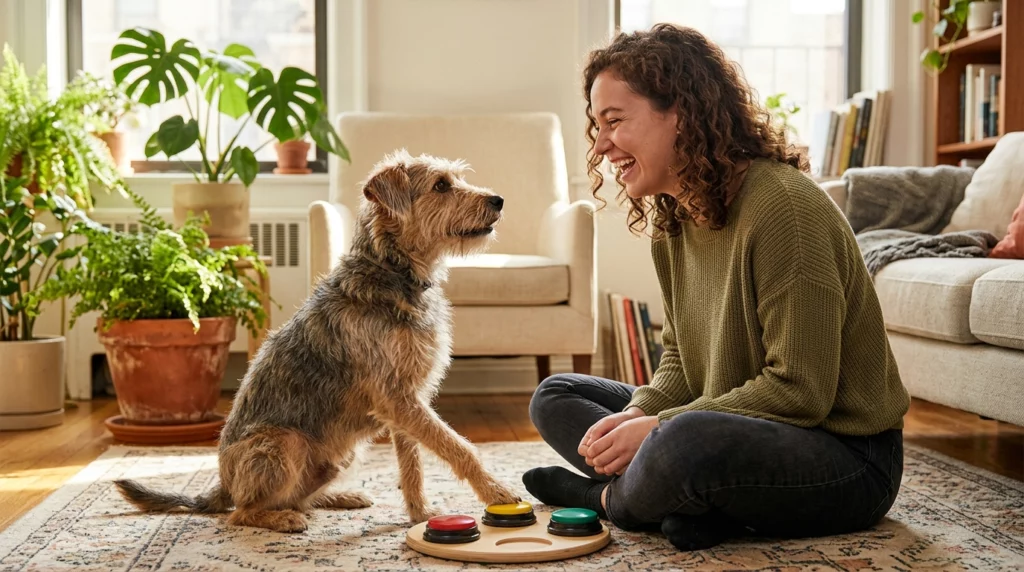
Many animal behaviorists argue that talking dogs are doing something similar. Dogs are absolute geniuses at reading our micro-expressions, breathing patterns, and muscle tension. If Blu accidentally steps on the “treat” button and I jump up to get him a piece of cheese, Blu learns a very simple equation: Press yellow circle = get delicious smelly snack.
This is called associative learning or operant conditioning. It is the foundation of all dog training. But is it language? Not quite. Associating a button with an immediate physical consequence (like food or going outside) is brilliant, but it is different from using syntax, grammar, and abstract thought to converse.
Can They Combine Words?
What about those viral clips where dogs press “stranger + dog + mad”? A recent pre-print study analyzed on ResearchGate examined whether soundboard-trained dogs produce non-random, non-accidental two-button combinations.
The data suggests that some dogs do indeed use multi-button combinations in ways that are not purely accidental or imitative of their owners. However, we are still a long way from proving that dogs have an internal grammar system. When a dog presses “outside” and then “ball,” they are likely just chaining two highly motivating concepts together to get what they want. (Basically, “I want to go outside, and also, I want my ball! Now! Please!”).
The Real Benefits: Why You Might Want to Try It Anyway

Even if your dog isn’t pondering the meaning of life through their soundboard, scientists and trainers agree that talking buttons can be an incredibly positive tool for your household.
1. Incredible Mental Stimulation
Dogs—especially high-energy working breeds like Border Collies, Shepherds, and Setters—need a lot of mental exercise to stay out of trouble. Learning to navigate a soundboard is a fantastic cognitive workout. It forces them to think, problem-solve, and focus, which can tire them out just as much as a long walk.
2. Strengthening the Human-Animal Bond
Teaching your dog to use buttons requires a massive amount of patient, positive training and close observation. You have to pay incredibly close attention to your dog’s subtle body language to figure out what they are trying to communicate. This shared focus inevitably strengthens the trust and bond between you and your pup.
3. Reducing Frustration
Some dogs get incredibly frustrated when they can’t make their needs clear. A dog who typically scratches the door frame until it ruins the wood might find immense relief in simply pressing an “outside” button instead. It gives them a clear, polite agency over their environment.
The Cons: Button-Mashing and Human Headaches
Before you commit to this journey, you should also prepare for the chaotic reality of living with a chatty dog:
- The “TREAT” Alarm: If your dog figures out that a specific button results in food, prepare to hear “TREAT! TREAT! TREAT!” at 4:00 AM, 4:05 AM, and 4:10 AM. You will have to teach “No more” or hide the button, which can lead to a very grumpy pup.
- Misinterpretation: You might start over-analyzing everything. If your dog accidentally steps on “sad” while looking for “water,” you might spend the next three hours worrying if your dog is depressed, when they really just had a dry throat.
- Patience Required: It takes months of consistent, daily training for most dogs to reliably use even three or four buttons. If you get frustrated easily, this might not be the game for you.
Yuna’s Final Verdict
So, do talking buttons work? The scientific consensus is a fascinating “yes, but with limits.” Your dog definitely understands that the buttons produce specific words that lead to real-world outcomes. They are communicating their desires in a structured way. However, they aren’t having deep, human-like philosophical debates about the universe—at least, not yet.
If you have the time, patience, and a sense of humor, introducing talking buttons is a wonderful, enriching game that can bring you and your pup closer together.
As for me? I will stick to my proven method of knocking your favorite coffee mug off the table. It’s efficient, classic, and requires absolutely no programming.
Have you tried talking buttons with your dog (or cat)? What is their favorite word? Let us know in the comments below!