
Building behaviour step by step

Explore shaping as the construction of an action through achievable steps. Compare it with capturing and luring, then practise choosing criteria, marking the right moment and adjusting a plan to the dog's responses.

Training mode

Building behaviour step by step

0 / 20 answered

  1. 1. Does shaping require punishing every movement that misses the current criterion?

    Does shaping require punishing every movement that misses the current criterion?
  2. 2. The dog has not approached a new training mat. Which starting criterion may be achievable?

    The dog has not approached a new training mat. Which starting criterion may be achievable?
  3. 3. Two carers practise the same new action but reward different versions without planning. What helps?

    Two carers practise the same new action but reward different versions without planning. What helps?
  4. 4. A dog spontaneously places its chin down and the trainer marks that complete action. Which technique best describes this?

    A dog spontaneously places its chin down and the trainer marks that complete action. Which technique best describes this?
  5. 5. Which note makes the next shaping session easier to plan?

    Which note makes the next shaping session easier to plan?
  6. 6. You want to mark a brief nose contact, but click after the dog turns away. What needs improving?

    You want to mark a brief nose contact, but click after the dog turns away. What needs improving?
  7. 7. After a harder criterion is introduced, a dog starts pawing and barking in confusion. What helps?

    After a harder criterion is introduced, a dog starts pawing and barking in confusion. What helps?
  8. 8. When is a useful time to attach a cue to a newly shaped action?

    When is a useful time to attach a cue to a newly shaped action?
  9. 9. You marked an approximation and then decided it was not perfect. What should follow that marker?

    You marked an approximation and then decided it was not perfect. What should follow that marker?
  10. 10. The shaped action works in one room but falters in another. What is a reasonable plan?

    The shaped action works in one room but falters in another. What is a reasonable plan?
  11. 11. The complete relaxed posture you want already appears naturally. Must every part be shaped separately?

    The complete relaxed posture you want already appears naturally. Must every part be shaped separately?
  12. 12. A dog follows a treat through a movement. What distinguishes this from free shaping?

    A dog follows a treat through a movement. What distinguishes this from free shaping?
  13. 13. What does shaping add when a complete new action is not yet offered?

    What does shaping add when a complete new action is not yet offered?
  14. 14. The target surface slides whenever the dog approaches. What comes before raising the criterion?

    The target surface slides whenever the dog approaches. What comes before raising the criterion?
  15. 15. The dog readily offers the current small step. What can the trainer do next?

    The dog readily offers the current small step. What can the trainer do next?
  16. 16. A dog is learning to touch a hand target. What should create the contact?

    A dog is learning to touch a hand target. What should create the contact?
  17. 17. What is a better measure of a shaping plan than finishing before another dog?
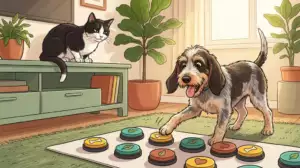
    What is a better measure of a shaping plan than finishing before another dog?
  18. 18. A nose touch is reliable. How can duration be introduced?

    A nose touch is reliable. How can duration be introduced?
  19. 19. The dog repeatedly moves away from a shaping game. What should guide the response?

    The dog repeatedly moves away from a shaping game. What should guide the response?
  20. 20. Which goal is easiest to break into observable shaping steps?

    Which goal is easiest to break into observable shaping steps?
Questions covered in this exam
  1. What does shaping add when a complete new action is not yet offered?
  2. A dog spontaneously places its chin down and the trainer marks that complete action. Which technique best describes this?
  3. A dog follows a treat through a movement. What distinguishes this from free shaping?
  4. Which goal is easiest to break into observable shaping steps?
  5. The dog has not approached a new training mat. Which starting criterion may be achievable?
  6. The dog readily offers the current small step. What can the trainer do next?
  7. After a harder criterion is introduced, a dog starts pawing and barking in confusion. What helps?
  8. You want to mark a brief nose contact, but click after the dog turns away. What needs improving?
  9. You marked an approximation and then decided it was not perfect. What should follow that marker?
  10. A dog is learning to touch a hand target. What should create the contact?
  11. A nose touch is reliable. How can duration be introduced?
  12. When is a useful time to attach a cue to a newly shaped action?
  13. The shaped action works in one room but falters in another. What is a reasonable plan?
  14. Which note makes the next shaping session easier to plan?
  15. Two carers practise the same new action but reward different versions without planning. What helps?
  16. The target surface slides whenever the dog approaches. What comes before raising the criterion?
  17. The complete relaxed posture you want already appears naturally. Must every part be shaped separately?
  18. Does shaping require punishing every movement that misses the current criterion?
  19. The dog repeatedly moves away from a shaping game. What should guide the response?
  20. What is a better measure of a shaping plan than finishing before another dog?

Further reading

SnoutScoop Newsletter

A little more dog in your inbox

Stories, discoveries and things to learn about dogs. Get news from SnoutScoop in your preferred language.