Hello, human friends! Yuna here—the resident feline adventurer, high-shelf connoisseur, and professional observer of weird canine behavior. Normally, I spend my days plotting how to knock pens off the counter or climbing to the absolute highest point in the living room. But yesterday, I had to pause my busy schedule to watch my roommate, Blu.
Blu is a Griffon Bleu de Gascogne, which means he has ears long enough to trip on and a nose that is constantly glued to the floor. Yesterday afternoon, despite the sun shining brightly, Blu suddenly froze. His nose began twitching like a hyperactive butterfly, sniffing the air with intense focus. He let out a low, dramatic sigh and paced toward his bed. Ten minutes later? The sky darkened, and a massive thunderstorm rolled in.
How did he know? Was it magic? Is Blu a secret weather wizard? As a naturally curious cat, I had to investigate. And it turns out, dogs don’t just guess the weather—they literally smell it coming.
The Chemistry of a Storm: What is Petrichor?
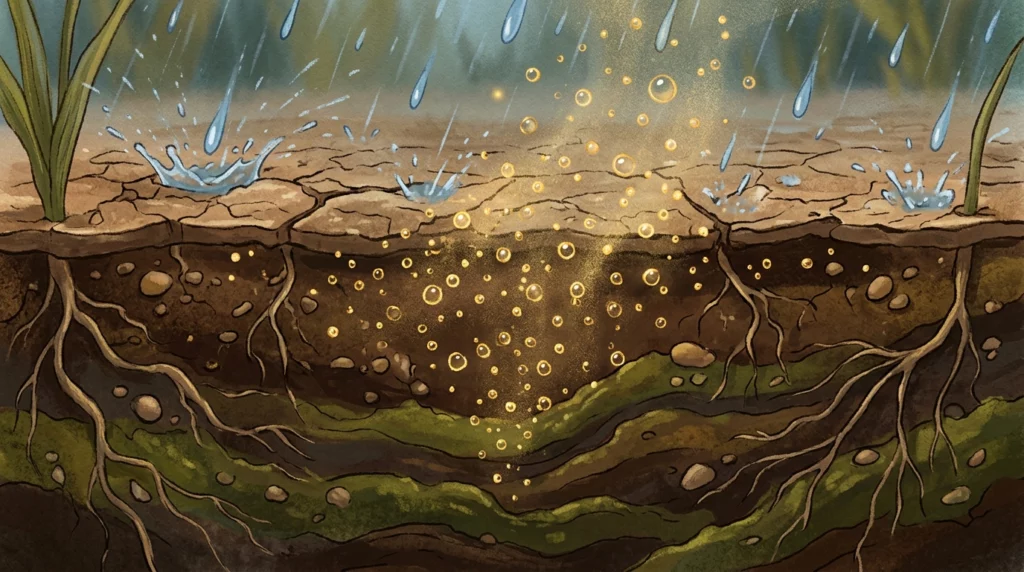
To understand how dogs smell rain, we first have to understand what rain actually smells like. When a storm is on the way, the air fills with a distinct, earthy scent. Scientists have a wonderfully fancy name for this: petrichor. Coined in the 1960s, the term describes the pleasant odor that accompanies the first rain after a dry spell.
This scent isn’t just water falling from the sky; it’s a complex chemical cocktail. According to an educational infographic by the American Chemical Society, petrichor is primarily made up of plant oils absorbed by the soil and a compound called geosmin. Geosmin is an organic compound produced by soil-dwelling bacteria called Streptomyces. When raindrops hit the ground, they trap tiny air bubbles at the surface, which then burst upward, releasing these microscopic scent compounds into the air as aerosols.
Humans are surprisingly good at detecting this scent. In fact, as highlighted in a fascinating discussion on Reddit’s biology community, humans are incredibly sensitive to geosmin—some studies suggest we can detect it at concentrations of just a few parts per trillion! It’s an evolutionary leftover from when our ancestors needed to track water sources, a sentiment echoed by historians on Jenie Yolland’s history of petrichor. But while humans might think “oh, it smells like rain is coming,” a dog’s experience is on an entirely different level.
The Canine Super-Snoot: 300 Million Receptors at Work
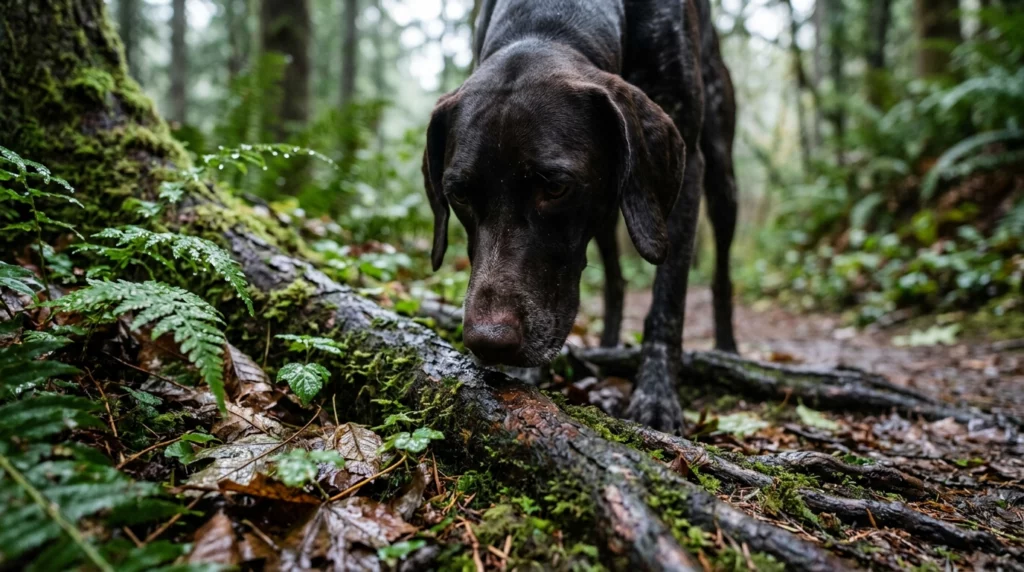
While humans have about 5 to 6 million olfactory receptors in our noses, dogs possess up to 300 million. According to a detailed study on canine olfaction published on NIH.gov, a dog’s brain devotes about 40 times more space to analyzing smells than ours does.
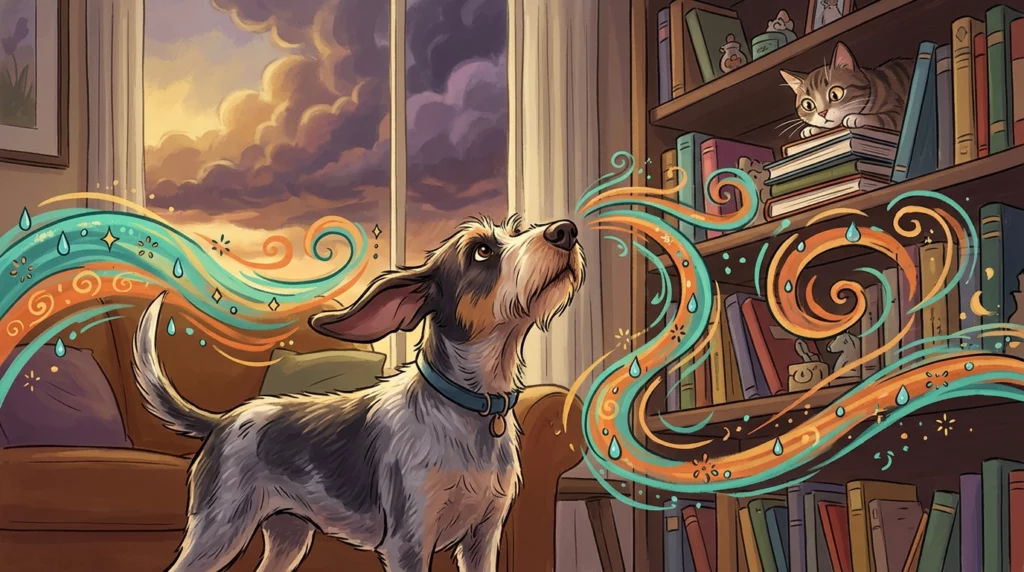
When the wind picks up before a storm, it carries those tiny geosmin aerosols and plant oils from miles away. To Blu, this isn’t just a single “rainy” smell; it’s a high-definition, multi-layered map of the incoming weather. He can smell the dampness of the soil miles to the west, the scent of wet pine needles from the next town over, and the distinct aroma of wet pavement heading our way.
Sniffing the Sky: The Smell of Ozone
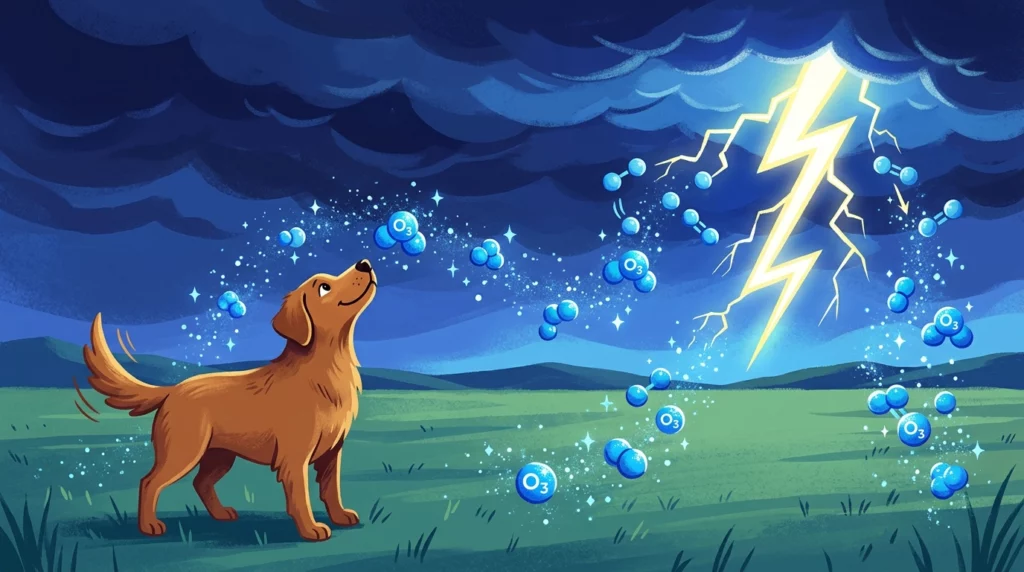
It’s not just the soil that gives the game away. Before a single drop of rain hits the dry earth, the atmosphere itself undergoes a massive chemical transformation.
During a thunderstorm, lightning strikes split atmospheric nitrogen and oxygen molecules. These molecules often recombine to form ozone (O3). Ozone has a sharp, slightly sweet, chemical-like scent. As the storm’s downdrafts push air from high altitudes down to the ground, this ozone is carried forward like a giant, invisible warning flag.
As detailed by ENT and Allergy Associates, ozone has a very clean, almost chlorine-like smell that humans can sometimes detect right before a heavy storm. But because of their super-snoots, dogs can smell this electric shift in the air hours before we do. As scientists noted in a report by MPR News, these chemical signals travel fast and far, essentially giving animals a highly advanced early warning system.
More Than Just Smell: The Physical Sensation of Storms
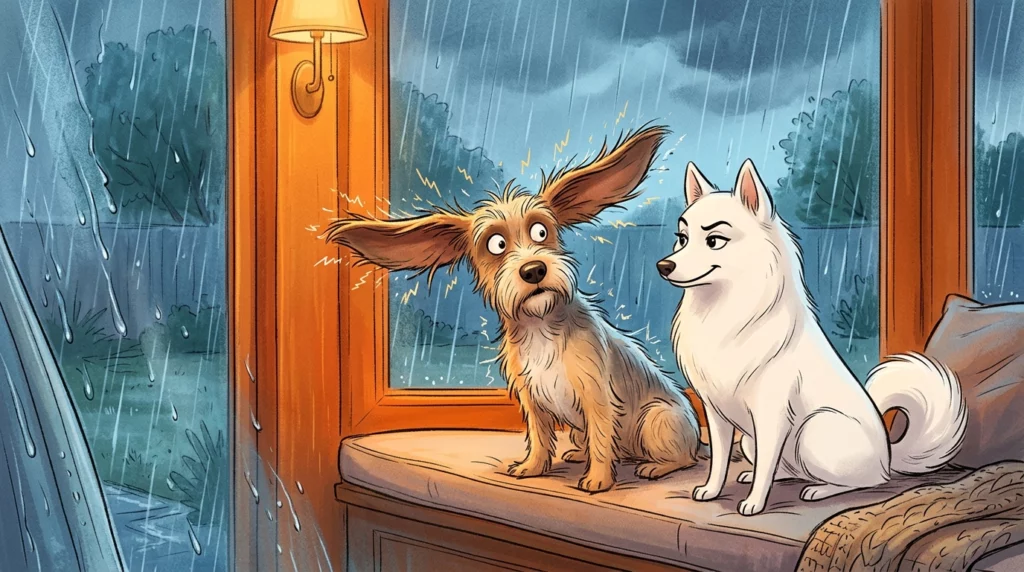
While the scent of ozone and petrichor is the primary way dogs “smell” the rain, they are also reacting to other environmental changes that occur simultaneously. A dog is essentially a walking, barking meteorological station.
- Barometric Pressure Drops: When a storm system approaches, the atmospheric pressure drops rapidly. Dogs can feel this pressure change in their inner ears and even in their joints.
- Static Electricity: As storm clouds build, static electricity accumulates in the air. Dogs, with their double coats or long fur, can actually feel this static build-up as a mild, annoying tingling sensation.
This explains why some dogs act anxious or look for safe havens before a storm. According to Outdoor Dog Adventures, dogs will often seek out tiled bathrooms, bathtubs, or basement corners because these areas are naturally grounded, helping to minimize the static electricity building up in their fur. So if your dog suddenly decides the bathtub is their new best friend, they aren’t just being silly—they are looking for an electrical escape!
Yuna’s Final Verdict
As a cat, I must admit: dogs might be loud, drooly, and prone to chasing tennis balls that clearly have no survival value, but their noses are undeniably cool. The next time you see your pup sniffing the air with sudden, intense curiosity, don’t ignore them. They aren’t just daydreaming; they are reading the atmospheric news, tracking petrichor, and feeling the ozone roll in.
So, grab an umbrella, give your local canine meteorologist a treat, and maybe—if you want to be as smart as me—find a cozy, high shelf to cuddle up on until the storm passes. Stay dry out there, adventurers!