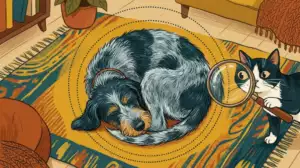
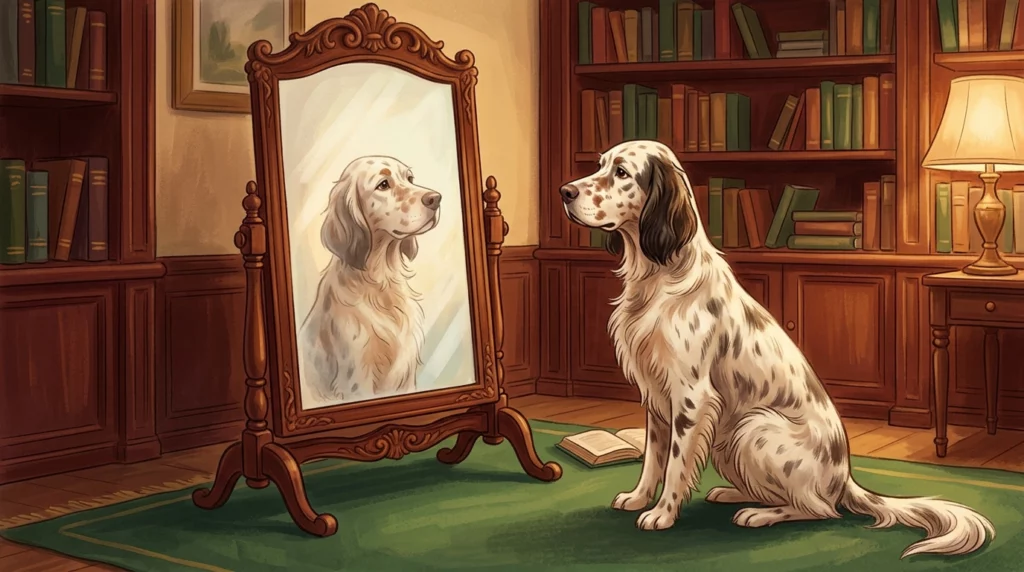
Hello, dear readers. Niki here. As a five-and-a-half-year-old English Setter, I pride myself on maintaining the highest standards of intellectual curiosity here at SnoutScoop. While my esteemed companion Blu—a lovely but rather chaotic Griffon Bleu de Gascogne—spends his afternoons barking enthusiastically at the “other dog” living inside the hallway mirror, I prefer to take a more analytical approach to the phenomenon.
It raises a fascinating question that humans have been trying to solve for decades: Do we dogs actually know who is staring back at us in that shiny glass? Or do we simply see a flat, scentless stranger invading our living rooms?
To get to the bottom of this, we have to look past our human bias toward vision and explore how different species perceive the concept of “self.” Grab a comfortable spot on the rug, and let us dive into the science of canine self-awareness.
The Famous Mirror Test (And Why It Misses the Mark)
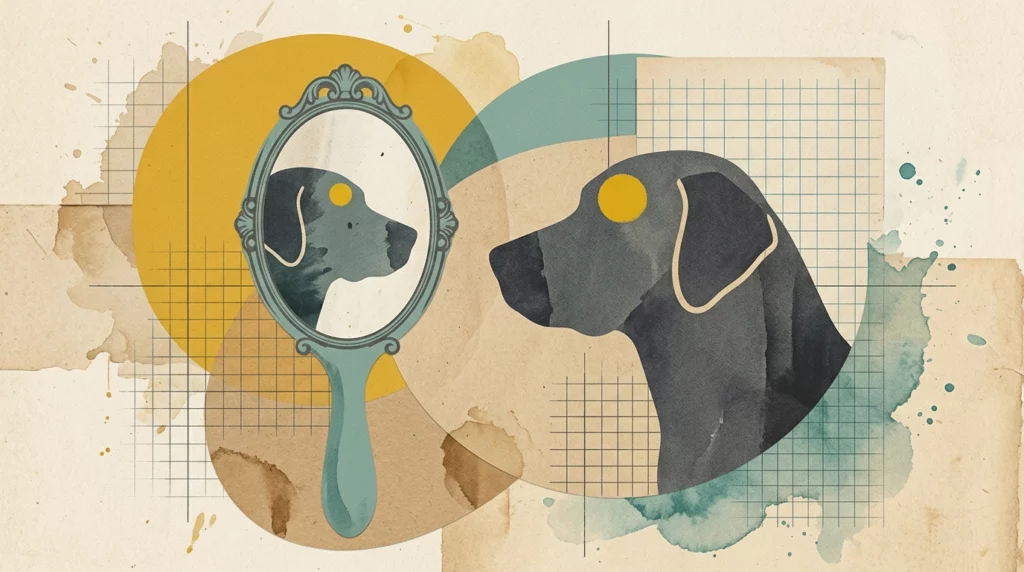
To understand how science views animal self-awareness, we must first look at the classic mirror self-recognition (MSR) test. Developed by psychologist Gordon Gallup Jr. in 1970, this test is quite straightforward. Researchers place a harmless, odorless dye or sticker on an animal’s body in a spot they can only see by looking in a mirror (like their forehead or ear). If the animal notices the mark in the mirror and reaches for their own body to touch or remove it, they pass.
Over the years, a very exclusive club of animals that have passed the mirror test has emerged. This elite group includes chimpanzees, orangutans, bottlenose dolphins, Asian elephants, and even Eurasian magpies.
And where do dogs fit into this club? Well, we don’t. Historically, dogs fail the visual mirror test. When we look in a mirror, we might bark, attempt to play, or—as I prefer to do—simply ignore the reflection entirely after realizing it has absolutely nothing useful to offer. But we do not try to scrape imaginary stickers off our faces.
Does this mean we lack self-awareness? Absolutely not. To judge a dog’s intelligence solely by a visual test is like judging a dolphin by its ability to climb an oak tree. As any discerning dog knows, the world is not made of sights; it is made of scents.
The Sniff Test: Self-Awareness Through the Nose
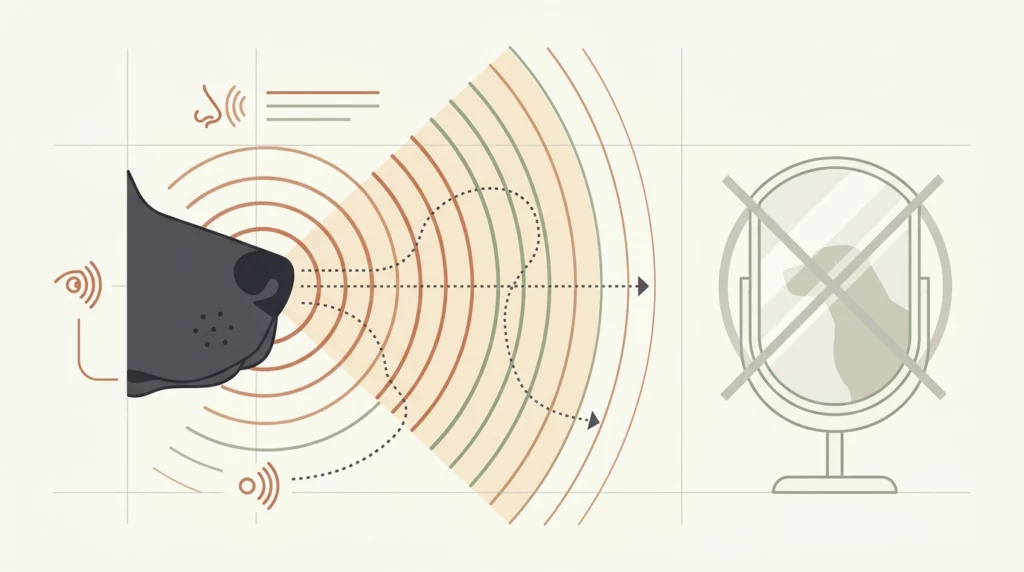
Fortunately, some brilliant researchers realized that a visual mirror is a rather unfair way to test a species that experiences the world through olfactory processing. This led to the development of the “Yellow Snow Test”—or, more formally, the olfactory test of self-recognition.
A pioneering study by biologist Dr. Roberto Cazzolla Gatti sought to adapt the mirror test to a dog’s primary sense. In his groundbreaking research, Self-consciousness beyond the looking-glass and what dogs found there, Dr. Gatti presented dogs with a series of scent containers. These containers held either the dog’s own urine, the urine of other dogs, or their own urine modified with an additional scent cue.
The results, which were also published in a study featured on PubMed, were remarkable. The dogs spent significantly more time investigating the modified samples and the samples of other dogs than they did sniffing their own unmodified scent.
As highlighted by Anthropocene Magazine, this behavior mirrors the exact cognitive pattern of the classic visual mirror test. When a chimp sees a strange mark on its reflection, it stares longer because something is “wrong” with its image. Similarly, when a dog smells its own scent modified with an unfamiliar odor, it sniffs longer because its “olfactory reflection” has changed. This proves we possess a clear, sophisticated sense of olfactory self-awareness. We know exactly what “I” smell like, and we know when “I” have been modified.
“I-the-Obstacle”: Understanding Our Own Bodies
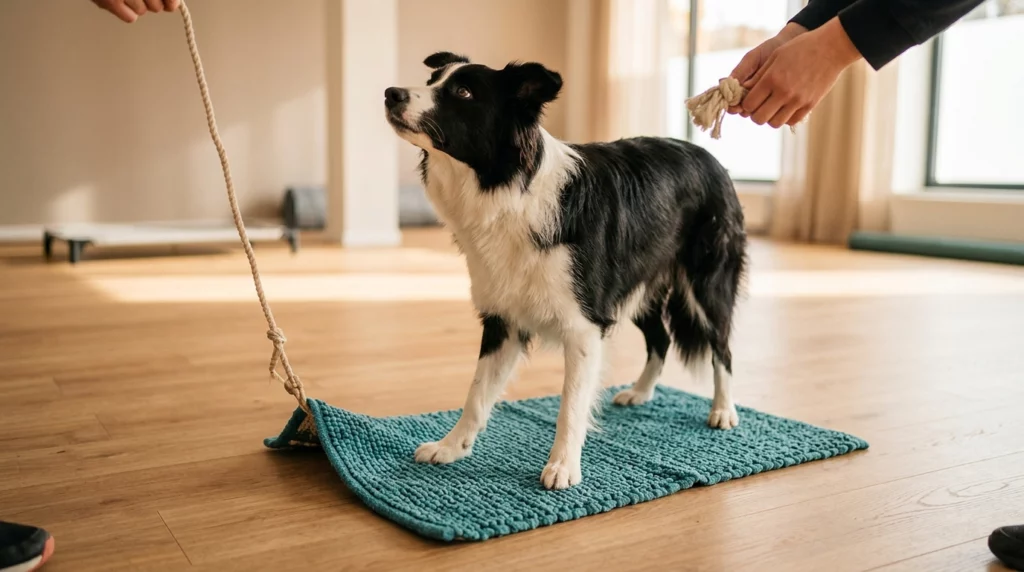
Our self-awareness doesn’t stop at our noses. We also possess a keen understanding of our physical bodies in space—something scientists call body awareness.
To prove this, researchers at Eötvös Loránd University (ELTE) in Budapest designed an elegant experiment called the “body as an obstacle” task. In this test, dogs were asked to pick up a toy and hand it to their owner. However, the toy was attached to a mat that the dog was currently standing on.
To successfully lift the toy and pass it over, the dog had to understand that its own body weight was anchoring the mat to the floor. The researchers found that dogs quickly and systematically stepped off the mat to complete the task. They understood their own body as a physical obstacle in the environment. Human children typically do not pass similar body-awareness milestones until they are about two years old, yet we dogs navigate these physical puzzles with intuitive grace.
Why Do Pets React to Mirrors Anyway?
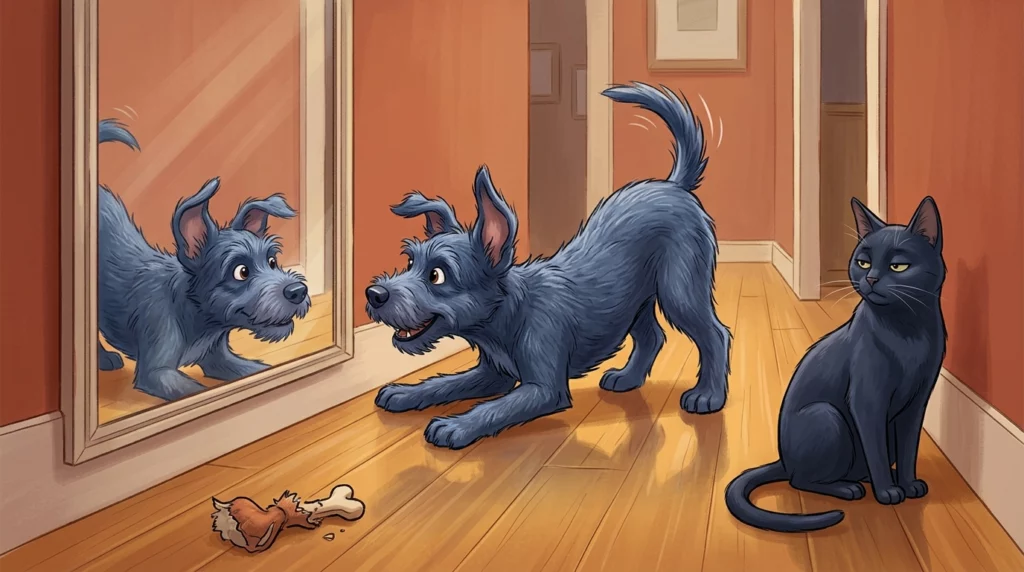
If we are so self-aware, why does Blu still bark at his reflection, and why do so many cats hiss at their mirror images?
According to veterinary experts explaining how pets recognize themselves in mirrors, a mirror image is highly confusing to an animal’s sensory systems. When Blu looks into the glass, he sees a perfect, high-definition dog mimicking his movements. However, this “dog” has absolutely no smell, makes no sound, and leaves no chemical footprint in the room.
For a young, high-energy dog, this sensory disconnect can trigger a play response or a protective bark. For older, more discerning dogs (if I do say so myself), we quickly realize that this visual phantom is a boring, useless illusion. It doesn’t tell us what the “other dog” ate for breakfast, how old they are, or if they are friendly. Once we realize the reflection has no olfactory data, we simply lose interest and walk away.
The Discerning Dog’s Conclusion
In short, dear humans, do not judge our cognitive abilities by your own visual standards. We may not spend hours grooming our coats in front of the vanity mirror, nor do we care about a smudge of dirt on our foreheads. But our sense of self is incredibly strong, deeply rooted in the rich, invisible world of scents and physical coordination.
The next time you see your dog glance at a mirror and calmly walk away, know that they aren’t failing a test. They have simply evaluated the reflection, found it lacking in any useful smell, and decided their time is far too valuable to waste on a flat piece of glass. Now, if you’ll excuse me, I must go explain this to Blu. He has been growling at the microwave door reflection for the last ten minutes.