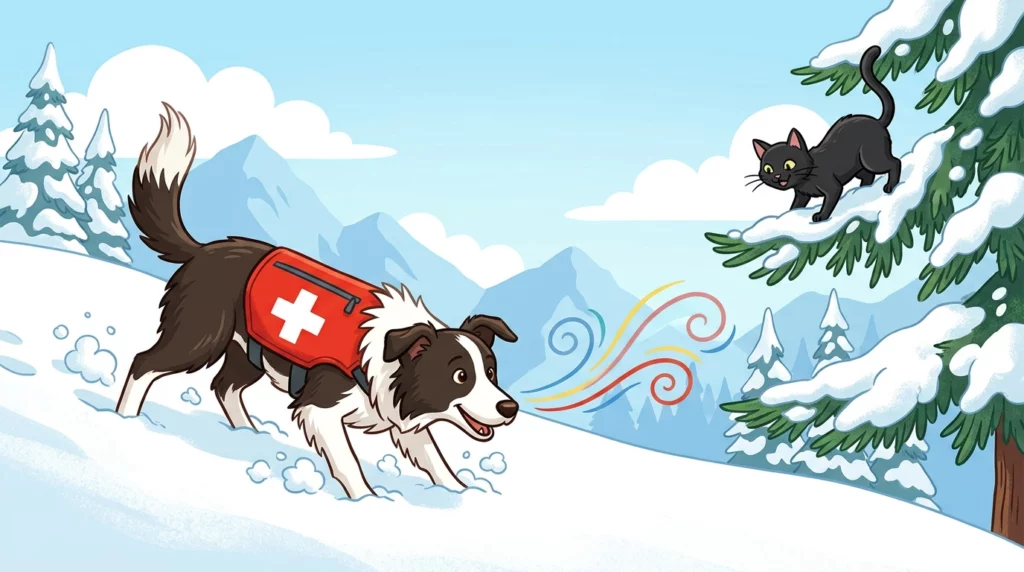
Hello, curious humans and fellow adventure-seekers! Yuna here. Usually, you can find me exploring the highest shelves in the living room or hunting down mysterious dust bunnies. But today, I am turning my investigative nose toward something truly epic. It involves cold white stuff (which I personally prefer to watch from a warm window sill), high altitudes, and some incredibly hardworking dogs.
Now, I am a cat of refined tastes, and while I think dogs can be a bit… loud, I have to give credit where credit is due. When mountains decide to slide, and skiers get buried under tons of heavy snow, human technology often takes a backseat to the ultimate rescue tool: the canine nose. Let’s dive into the fascinating, chaotic, and heartwarming science of how these avalanche rescue dogs pull off real-life miracles in the deep freeze.
The Mystery of the Scent Chimney
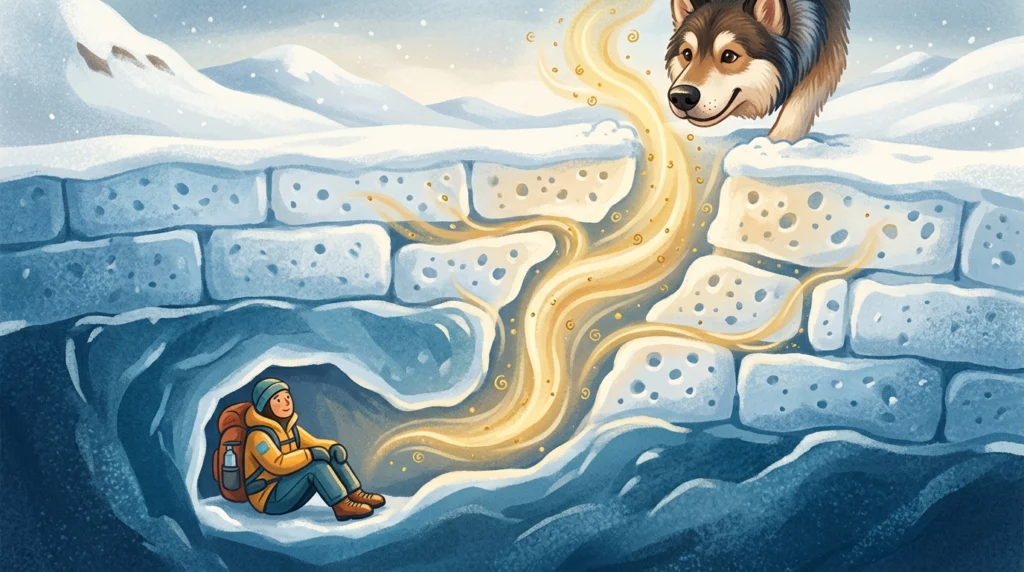
When you look at a massive drift of snow, it looks like a solid, impenetrable wall of ice and cold. But here is a little secret I discovered while knocking things off countertops: most things are much more porous than they look. Snow is actually filled with tiny pockets of air—sometimes up to 90% air when it is fresh and fluffy!
Because snow is porous, it doesn't completely trap a buried person's scent. Humans are constantly shedding skin cells (known as rafts), breathing out warm air, and sweating (especially when panicked). According to the experts at Avy Dog Henry, this warm air and body heat rise naturally, creating a “scent chimney.”
The scent travels upward through the tiny gaps between the snow crystals, escaping into the open mountain air. Once it hits the surface, the wind carries it across the snowpack. To a human, it just smells like cold wind. But to a highly trained avalanche dog? It smells like a beacon.
A Nose Built for the Job
To understand why these dogs are so good at this, we have to talk about olfactory power. While humans have a measly 5 million scent receptors in their noses, a dog has up to 300 million. Their brains are also hardwired for sniffing; the part of a dog's brain devoted to analyzing smells is about 40 times larger than ours!
As highlighted by SnowBrains, a dog doesn't just smell a general “human” scent; they can pinpoint the microscopic differences in the air currents. They use “3D sniffing,” meaning each nostril can smell independently, helping them determine exactly which direction the scent is coming from. They can smell someone buried fifteen feet deep under packed snow. I can barely find my favorite toy mouse when it slides under the sofa, so this is seriously impressive stuff.
The Ultimate Race Against the Clock
When an avalanche happens, time is the ultimate enemy. The survival rate for someone buried in an avalanche drops dramatically after 15 to 30 minutes. This is where the sheer speed of a rescue dog becomes a literal lifesaver.
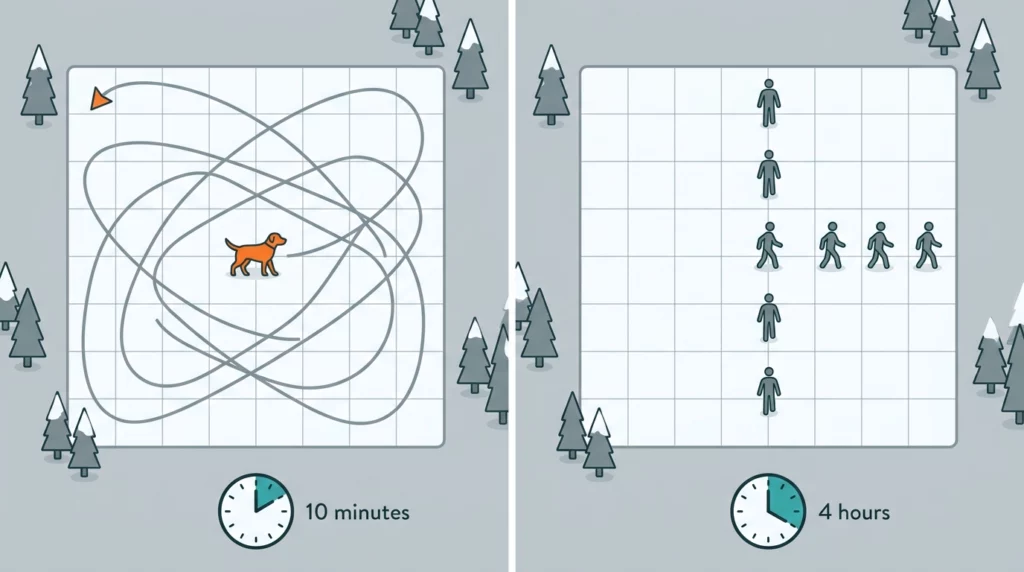
Consider the math: a human rescue team using avalanche probes has to stand in a line and systematically poke the snow over and over again. It is slow, tedious, and exhausting work. According to rescue statistics shared by 1SRG and Rick Gibson, a single avalanche rescue dog can search a one-hectare area (about 2.5 acres) in approximately 30 minutes. To search that same area with a human probe line of 20 people would take up to four hours or more.
By covering ground quickly, the dog acts as a rapid-detection unit, narrowing down the search area to a specific spot so handlers can dig the victim out before it is too late.
It All Starts with a Game of Hide-and-Seek
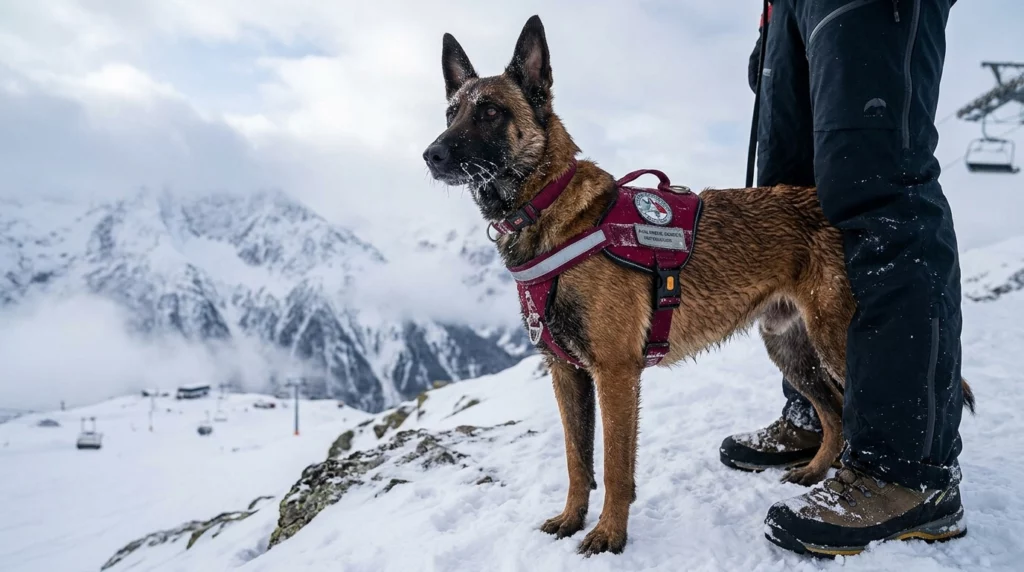
How do you get a dog to brave freezing temperatures, roaring helicopters, and chaotic rescue scenes? You turn it into the best game of hide-and-seek they have ever played.
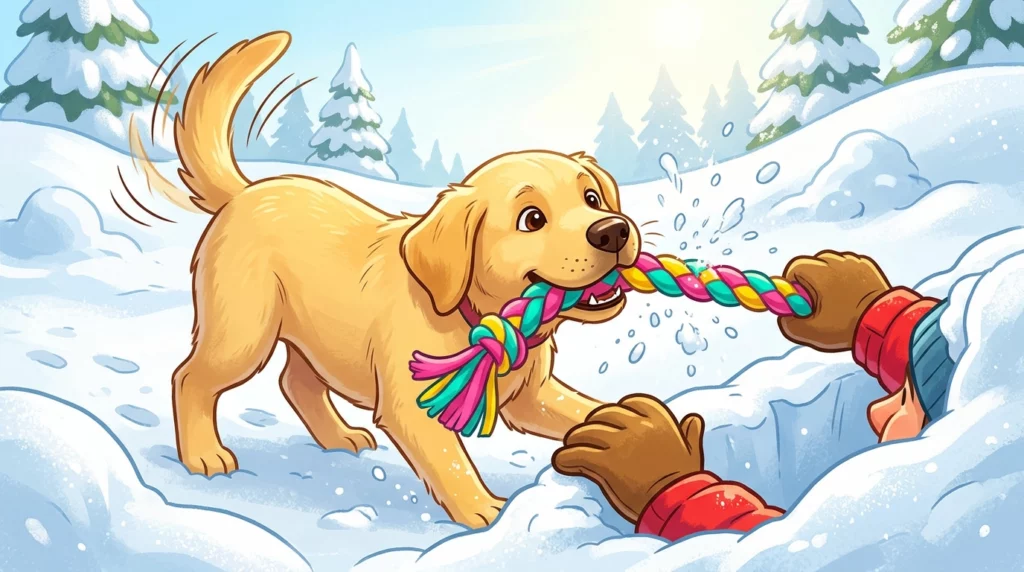
Training an avalanche dog starts when they are just clumsy, energetic puppies. As detailed by Avy Dog Henry’s training guide, handlers build on a dog's natural prey and play drives. They start with simple runaway games, where a favorite handler runs away and hides behind a tree or in a shallow snow pit. When the puppy finds them, there is an absolute party—lots of praise, treats, and their absolute favorite toy (usually a sturdy tug-toy).
Gradually, the game gets harder. The “stranger” hides in a snow cave with a small air hole, and eventually, the cave is completely blocked. The dog learns that the smell of a human under the snow means “if I find this smell and dig it up, I get to play my favorite game of tug-of-war!”
The Rozzie May Animal Alliance points out that this positive reinforcement is crucial. These dogs aren't working out of fear or sheer duty; they are working because they absolutely love the game. To them, saving a life is the ultimate playdate.
What Breeds Make the Best Snow Heroes?
Not just any dog can handle the demanding conditions of a ski resort rescue team. You need a mix of physical stamina, weather-resistant coats, and high work drive. The unsung heroes featured by Crystal Mountain Resort are typically:
- Golden Retrievers & Labrador Retrievers: Friendly, highly motivated by toys and food, and possessing a dense double coat that keeps them warm in freezing conditions.
- German Shepherds & Belgian Malinois: Incredibly focused, athletic, and possessing an intense work ethic.
- Border Collies: Brainy, fast, and agile enough to navigate uneven, debris-filled avalanche paths.
These dogs live with their handlers, forming an unbreakable bond. When they aren't saving lives, they are often riding on chairlifts, snowmobiles, and even in helicopters to get to rescue scenes as fast as possible. (Personally, a helicopter ride sounds like a nightmare for my whiskers, but these dogs absolutely live for the rush!)
A Purr-fect Respect for Our Canine Cousins
While I will gladly remain indoors where the blankets are warm and the kibble is served on a predictable schedule, I have to tip my imaginary hat to these incredible avalanche rescue dogs. Their sharp noses, combined with their boundless energy and the dedication of their human handlers, make the mountains a much safer place for winter adventurers.
So, the next time you hit the slopes and spot a dog wearing a red rescue vest, give them a wave (and maybe a quiet cheer of appreciation). They are true snow heroes, nose-first and always ready to play the ultimate game of hide-and-seek.