
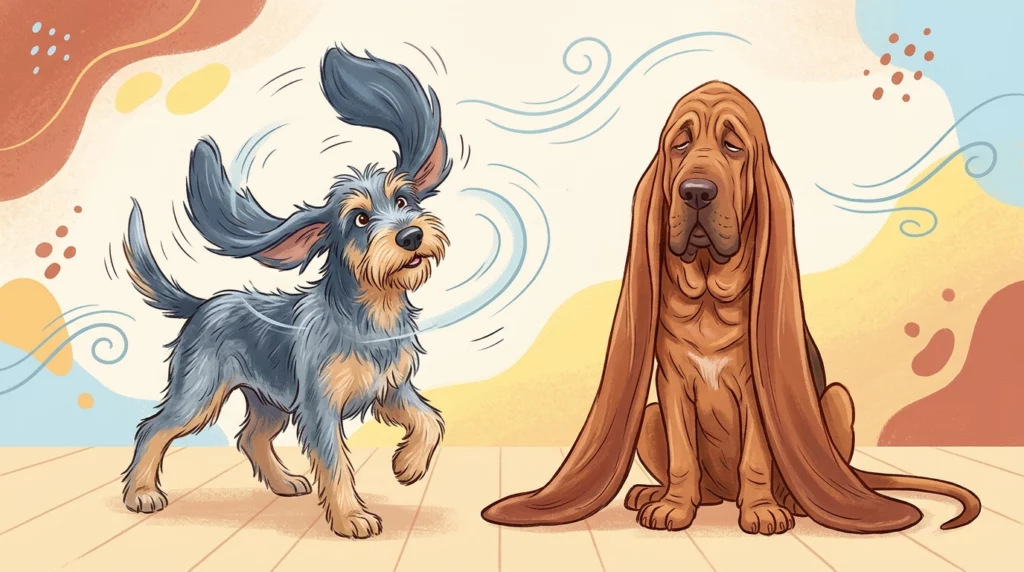
Hello, friends! Blu here, your resident Griffon Bleu de Gascogne and professional ear-shaking enthusiast. If there is one thing I know inside and out, it is the sheer joy of a good, full-body shake. When I get going, my ears make a sound like a helicopter taking off. It is glorious. My human tells me I have beautiful, velvety flaps, but compared to some of the absolute legends in the animal kingdom, my ears are practically pocket-sized.
Have you ever wondered why some of us dogs—and other wild creatures—are blessed with ears that drag on the ground, get dipped in water bowls, and catch the wind like sails? Today, we are diving nose-first into the science of long ears. Grab a treat, get comfortable, and let’s talk about the physics, biology, and records behind the world’s finest flaps!
The Heavyweight Champions of the Dog World

First, we must pay tribute to the royalty of the floppy-ear kingdom. As a hound, I feel a deep, soulful connection to these champions. I might have long ears, but some dogs have basically turned theirs into long-range radar dishes.
According to the official Guinness World Records, the title for the longest ears on a dog ever belongs to a Bloodhound named Tigger from Illinois. Tigger’s right ear measured an astonishing 34.9 cm (13.75 inches), and his left ear was 34.2 cm (13.5 inches)! He passed away in 2009, but his legacy lives on as the ultimate ear icon. I can only imagine how many times he accidentally stepped on his own ears while tracking a scent.
On the living side of history, we have the lovely Lou, a black and tan Coonhound with ears measuring 34 cm (13.38 inches) each. Her human, Paige Olsen, told Guinness World Records that Lou’s ears don’t require as much maintenance as you’d think, though they do get checked for cleanliness and wrapped up in a snood in the winter to keep them out of the snow. As someone who routinely dips his ears in muddy puddles, I highly respect the snood life.
The Scientific Secret: Why Do Hounds Have Long Ears?
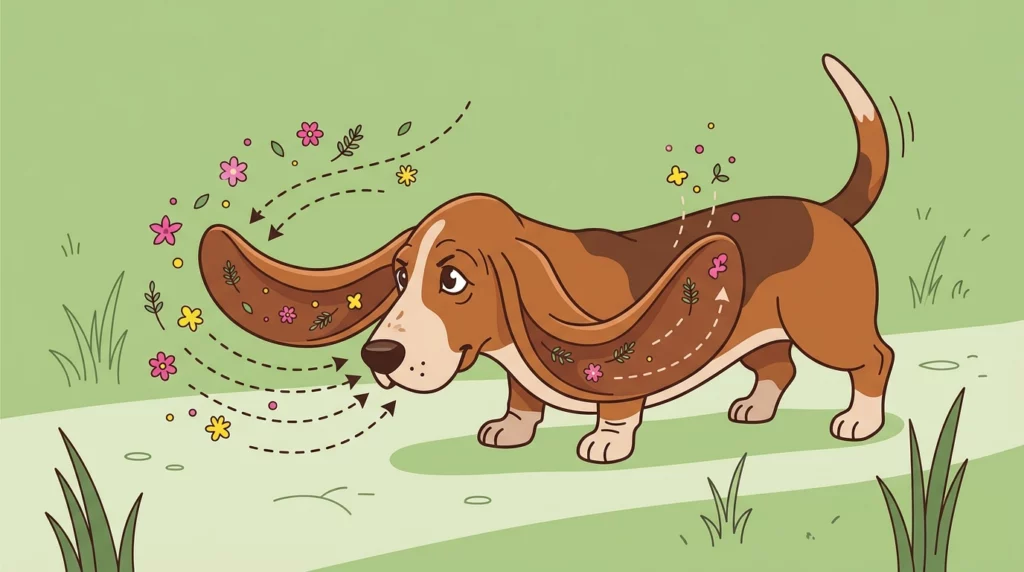
You might think our long ears are just there to look cute and velvety (which they do, let’s be honest). But nature is incredibly smart. Those long, sweeping flaps serve a very specific, highly scientific purpose: they help us smell better!
When scent hounds like Bloodhounds, Coonhounds, or my fellow Griffon Bleus put our noses to the ground, our ears droop down and sweep the grass. According to research on canine olfaction and anatomy shared by the National Institutes of Health (NIH), this sweeping motion acts like a funnel. As we run with our heads low, our ears stir up microscopic scent molecules from the ground and guide them directly upward toward our incredibly sensitive noses.
Essentially, our ears are built-in brooms that sweep the world’s best smells right into our nostrils. How cool is that? It’s why we can track a scent trail that is days old, even if other dogs just smell dirt.
Nature’s Air Conditioners: Allen’s Rule

Dogs aren’t the only ones rocking impressive head-wings. If we look beyond the backyard, we find some truly mind-boggling ears in the wild. But why do desert animals, in particular, have such massive ears?
This comes down to a neat ecological principle called Allen’s Rule, which you can read all about on Wikipedia. Formulated by Joel Asaph Allen in 1877, this rule states that animals adapted to cold climates tend to have shorter limbs and appendages (like ears and tails) to prevent heat loss. Conversely, animals adapted to hot climates have longer limbs and ears to help them release body heat and stay cool.
Think about it like this: ears are filled with lots of tiny, thin blood vessels. When an animal is hot, warm blood flows into the ears. The air moving across the surface of the ears cools the blood down before it pumps back into the rest of the body. It’s a natural, built-in radiator!
Here are some of the wild animals that put this cooling system to excellent use:
- The African Elephant: According to Jagran Josh, African elephants have the largest ears of any living animal, measuring up to 6 feet long! When they flap them, they can reduce their body temperature significantly.
- The Fennec Fox: This tiny, adorable desert fox has ears that make up a massive portion of its body. They use them to stay cool in the scorching Sahara and to hear the tiny footsteps of insects moving deep under the sand.
The Champion of Relativity: The Long-Eared Jerboa

While the African Elephant has the *largest* ears overall, they do not win the prize for the largest ears relative to body size. That prestigious title belongs to a tiny, hopping rodent called the Long-eared Jerboa (Euchoreutes naso).
As detailed by Live Science, this little creature’s ears are about two-thirds as long as its entire body! Imagine if a human had ears that were four feet long. According to the Animal Diversity Web, these giant ears help the nocturnal jerboa hear predators in the quiet desert night while helping them dissipate heat during the day. They look like tiny, furry, hopping satellite dishes, and honestly, I think we would be great friends.
And if you want a domestic comparison, we can’t forget rabbits! The Guinness World Record for longest rabbit ears belongs to Nipper’s Geronimo, an English Lop whose ears measured a stunning 79 cm (31.125 inches) in 2003. That is more than double the length of even the longest dog ears!
The Daily Struggles of Having Magnificent Flaps
While having long ears is a scientific superpower, I must admit it comes with a few daily challenges. My buddy Niki (our very precise English Setter) always laughs when my ears land directly inside my food bowl. It is a tough life when your ears taste like your dinner.
If your dog has long ears, here are a few tips to keep them healthy, clean, and fabulous:
- Keep Them Dry: Because long ears fold over the ear canal, they trap moisture easily. Always dry your pup’s ears gently after a swim or a bath to prevent pesky yeast infections.
- Check for Hitchhikers: When I run through the brush, my ears act like nets for burrs, twigs, and ticks. Give those ears a quick inspection after every outdoor adventure.
- Use Elevated Bowls: If your dog’s ears are constantly dipping into their water, narrow, deep bowls (often called spaniel bowls) can help keep those flaps dry.
Whether your dog has tiny, pointy triangle ears, perky ears that stand straight up, or magnificent, sweeping floor-draggers like mine, every ear shape is a masterpiece of evolutionary design. Now, if you will excuse me, all this talk of ears has made me want to go shake my head in the kitchen and see if I can get my human to drop a piece of cheese.
Keep flapping, friends!