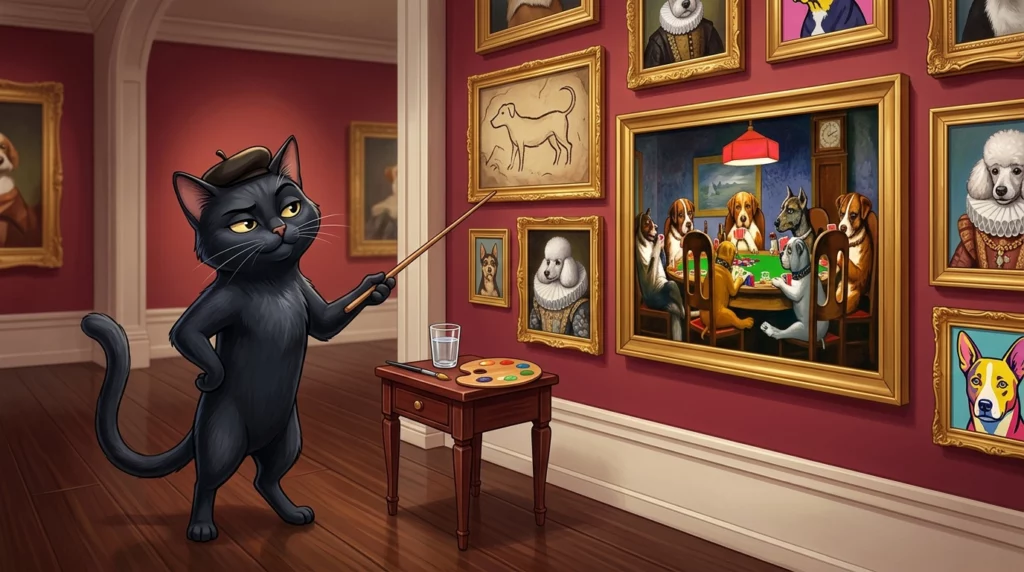
Hello, intellectual elites and casual scroll-readers alike. I am Pisino, chief of the SnoutScoop pack. While my canine subordinates—namely Blu, who is currently trying to bite a stray beam of sunlight, and Niki, who is fastidiously arranging her plush toys—focus on the mundane, I prefer to lift my gaze to the higher planes of culture. Today, we are discussing art history.
As a cat, I understand the concept of being a masterpiece. We are born self-contained, sculpted, and aesthetically flawless. Canines, however, require a bit more work to look presentable on canvas. Yet, for over 15,000 years, humanity has harbored an absolute obsession with painting, sculpting, and mosaic-tiling these drooly, high-energy beasts. Let us embark on a curated, slightly skeptical tour of how the dog leaped off the dirt path and onto the gallery walls.
1. The Dawn of Dog Art: Cave Walls and Ancient Protectors
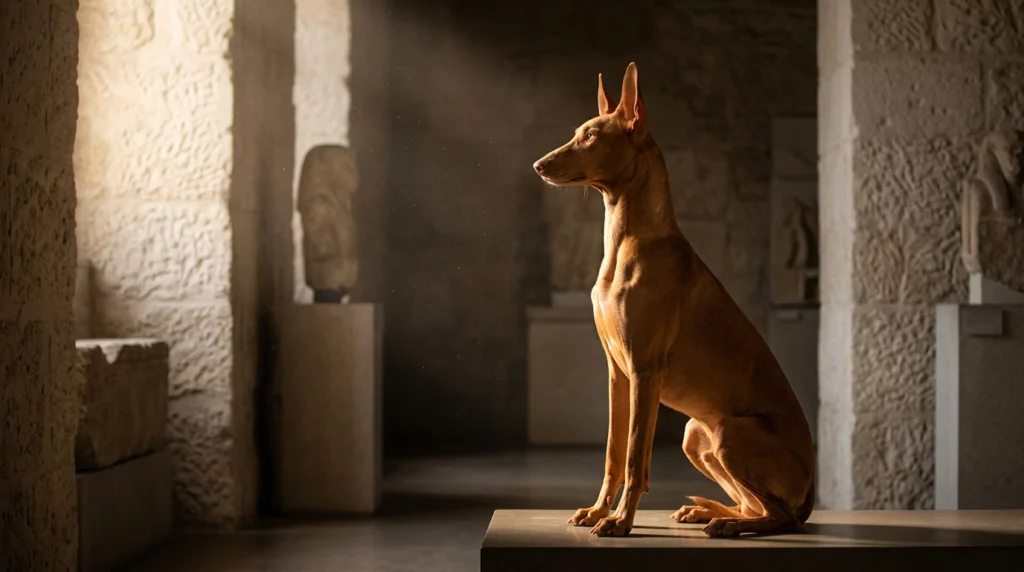
Before there were gilded frames and climate-controlled museums, there were damp, dark cave walls. And what did early humans decide to scratch into the stone? Not the elegant, silent silhouette of a feline deity, but their hunting partners. In rock art sites across the globe, from the Sahara to Saudi Arabia, we find some of the earliest depictions of dogs assisting humans with the hunt, occasionally shown on leashes dating back thousands of years.
In ancient Egypt, dogs transitioned from mere survival partners to sacred protectors. While we cats held a monopoly on divine worship (as was only fair), dogs were revered for their loyalty. Anubis, the god of the underworld, sported the head of a jackal or an elegant wild dog. Noble Egyptians went so far as to mummify their favorite hounds so they could enjoy the afterlife together. Truly, a level of codependency that has persisted for millennia.
By the time of the Roman Empire, dogs were firmly embedded in domestic life. If you visited Pompeii before Vesuvius ruined the real estate market, you would have seen the famous ‘Cave Canem’ (Beware of the Dog) mosaic in the entryway of the House of the Tragic Poet. This mosaic, depicting a chained, alert dog, served as a ancient, pictorial security alarm. It is precise, functional, and frankly, a bit dramatic—qualities I can highly appreciate.
2. Renaissance Royalty: The Ultimate Status Symbol
As we slide gracefully into the Renaissance, dogs underwent a massive rebranding. They were no longer just tools for hunting or guard duty; they became the ultimate luxury accessory. If you were a European royal or a wealthy merchant, you simply did not sit for a portrait without a pampered pooch tucked under your arm or lounging at your velvet-slippered feet.
These were not just random pets; they were living proof of your wealth and status. Toy spaniels and lapdogs were meticulously bred for the nobility. They served as fashion statements, conversation starters, and, quite practically, living hand-warmers in drafty stone castles. Artists like Titian and Veronese frequently included these elegant little beasts in their grand courtly scenes. In these works, the dogs are always pristine, groomed, and miraculously not chewing on the priceless Persian rugs. A highly idealized depiction, if you ask me.
3. The Iconography of Fidelity: The Arnolfini Portrait
In the world of art history, a dog is rarely just a dog. Painters loved to use animals as symbols, a practice known as iconography. And what does a dog symbolize? You guessed it: loyalty, fidelity, and unquestioning devotion.
Let us analyze one of the most famous examples in Western art: Jan van Eyck’s The Arnolfini Portrait (1434). This masterpiece depicts a wealthy merchant and his bride in a highly detailed room. Right there, at the bottom-center of the painting, stands a tiny, furry Brussels Griffon-type terrier.
According to the National Gallery of Art, the presence of the dog in marriage portraits during this era was a direct symbol of marital faith and devotion (the very name “Fido” comes from the Latin fidere, meaning “to trust”). Had Van Eyck painted a cat in that exact spot, it would have symbolized independent chaos, or perhaps we would have simply knocked the bride’s expensive clogs out of the frame. But the dog stands there, staring directly at the viewer, representing steadfast, unwavering obedience.
4. The Modern Mutt: From Velázquez to Poker Tables
As art moved away from rigid religious and royal commissions, painters began to capture dogs with a deeper sense of individual personality. In Diego Velázquez’s 1656 masterpiece, Las Meninas, a massive Spanish Mastiff lies peacefully in the foreground while the royal family swarms around him. The dog’s sleepy, tolerant expression perfectly captures the quiet patience of a family pet enduring a chaotic household—a look I often give Blu when he forgets how stairs work.
By the 19th and 20th centuries, dogs had fully transitioned into the domestic sphere, as documented by JSTOR. They became subjects of intense affection rather than just status symbols. We see this evolution reach its popular culture peak with Cassius Marcellus Coolidge’s infamous Dogs Playing Poker series (painted between 1894 and 1910). While art snobs may turn up their noses at these kitschy advertisements for cigars, they are brilliant character studies. They project human vices—bluffing, cheating, and camaraderie—onto various breeds, from Saint Bernards to Bulldogs.
Later, modern masters like Andy Warhol celebrated the canine form through vibrant pop art, capturing his own beloved dachshund, Archie, in bold silk-screens. The sheer variety of how dogs have been portrayed throughout history was even celebrated in a dedicated exhibition at the Wallace Collection, highlighting portraits of dogs from Gainsborough to Hockney, proving that our fascination with these creatures shows no signs of fading.
A Reluctant Feline Admission
Having surveyed the grand sweep of human art, I must begrudgingly admit something: dogs do make incredibly versatile artistic subjects. They offer artists a rich palette of emotions—from the deep, mournful eyes of a hunting hound to the absurd, joy-filled leap of a puppy in a meadow. They represent the qualities humans strive for but often struggle to maintain: loyalty, unvarnished joy, and an absolute lack of pretense.
So, the next time you walk through a museum, look past the stoic faces of the royalty and the dramatic landscapes. Look down. You will almost certainly find a four-legged companion looking back at you from the brushstrokes, waiting patiently for their human to finish posing and throw the ball.
Now, if you will excuse me, I must go knock a pen off the desk to remind my humans that while dogs may dominate the museum walls, cats still rule the living room.