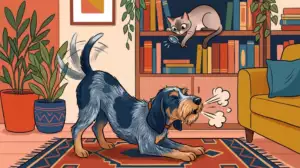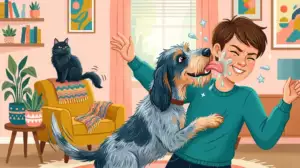
Hello, humans! Yuna here—your resident feline adventurer, chaos coordinator, and professional shelf-scaling enthusiast. While my canine housemate Blu is currently busy chasing his own tail, and Niki is fastidiously organizing his toy bin, I have slipped away to use the keyboard. Today, we need to talk about a highly amusing human phenomenon that I observe daily in our living room: the infamous “guilty dog” face.
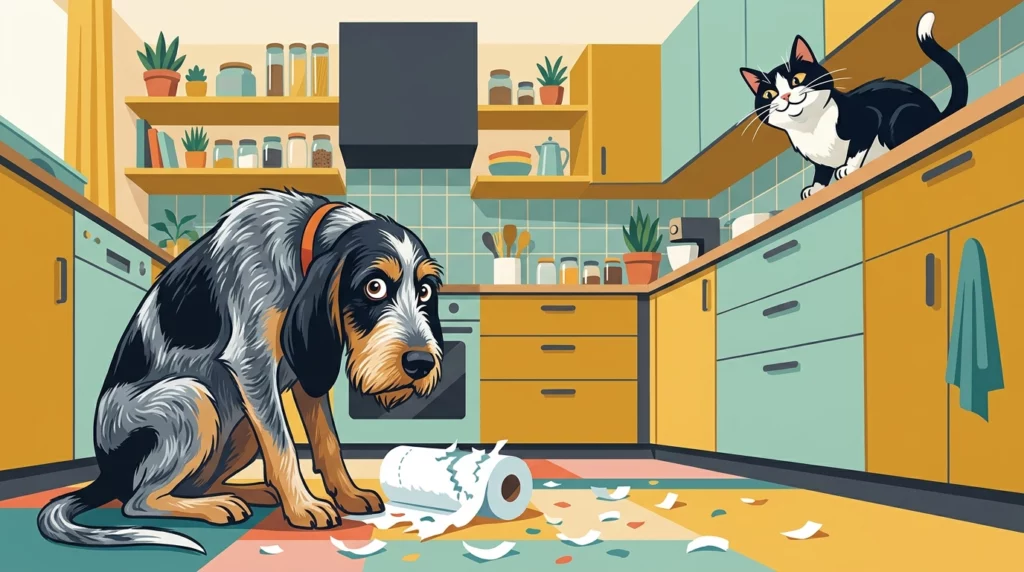
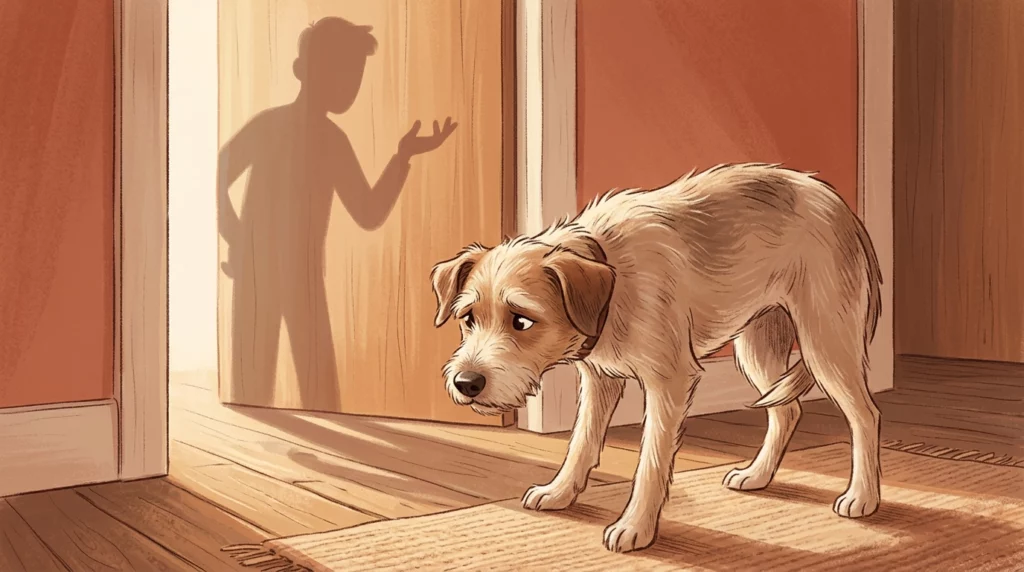
You know the look. You walk into the kitchen, discover a shredded paper towel roll scattered like snow across the tile, and look at your dog. Instantly, Blu’s ears flatten against his head. His eyes widen, showing that dramatic crescent of white (what you humans call “whale eyes”). He lowers his body, tucks his tail, and slowly slinks away as if he is carrying the weight of the entire world on his furry shoulders. “Aha!” you cry. “He knows he did something wrong! Look how guilty he feels!”
Well, as a cat who regularly knocks drinking glasses off counters just to watch gravity do its thing—and feels absolutely zero remorse for it—I hate to burst your bubble. But science has proven that your dog’s “guilty” face has absolutely nothing to do with guilt. In fact, it is a masterclass in human manipulation, and you are falling for it every single time.
The Science Behind the Slouch
For years, animal behaviorists have been investigating whether dogs actually experience complex secondary emotions like guilt, shame, or pride. While dogs certainly feel primary emotions like joy, fear, anger, and excitement, guilt requires a sophisticated level of self-awareness and an understanding of abstract moral codes.
According to research highlighted by ScienceAlert, the classic “guilty look” is actually a collection of fear and appeasement behaviors. When a dog displays flat ears, a tucked tail, and a lowered head, they aren’t thinking, “Oh dear, I have violated the sacred rules of household cleanliness.” Instead, they are saying, “Please don’t be mad at me! You look scary right now!”
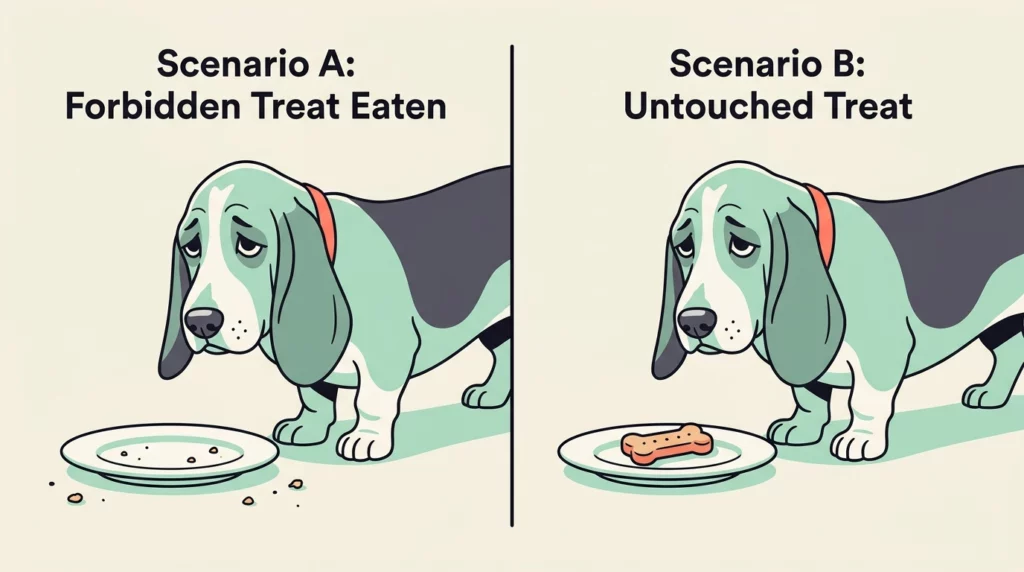
A famous study conducted by canine cognitive scientist Dr. Alexandra Horowitz, and referenced by StudyFinds, put this to the test. Researchers had owners forbid their dogs from eating a tasty treat before leaving the room. While the owners were gone, some dogs ate the treat, while others were obedient. Before the owners returned, the researchers either gave the dog the treat or removed it, and then told the owners a truth or a lie about what their dog did.
The results were eye-opening: the dogs’ “guilty” expressions did not correlate with whether they had actually eaten the forbidden treat. Instead, the intensity of the guilty look depended entirely on how the owner behaved when they walked back in. If the owner *believed* the dog was guilty and scolded them, the dog showed the guilty face—even if they had been completely obedient! Conversely, guilty dogs whose owners thought they were innocent didn’t show the guilty look at all.
The Lie-Detection Delusion
So why do humans insist on reading guilt into their dogs’ faces? It turns out that humans are incredibly bad at reading body language in general, whether they are looking at dogs or other humans. We love to think of ourselves as natural-born lie detectors, but psychological science tells a very different story.
According to an analysis on the pseudoscience of lie detection by Salon, humans are incredibly prone to confirmation bias. We make up our minds about someone’s guilt based on our own emotional state or expectations, and then we interpret their body language to fit our narrative. This isn’t just a harmless mistake we make with our pets; it is a deeply ingrained human flaw.
In fact, as reported by Criminal Legal News, even trained professionals like law enforcement officers consistently fail to accurately spot deception based on nonverbal cues, yet many continue to rely on these flawed behavioral analyses. The American Psychological Association notes that decades of research show humans are only about 54% accurate at detecting lies—which is barely better than flipping a coin.
We believe in body language myths because they give us a false sense of control. We think we can spot “shifty eyes,” “fidgeting,” or “avoiding eye contact” as definitive signs of guilt, but as debunked by LieDetectorTest.com, these behaviors are actually just signs of stress, discomfort, or anxiety. Similarly, articles on body language myths from Medium and the EIA Group emphasize that there is no universal “pinocchio nose” behavior. When a dog looks “guilty,” they are simply reacting to your tense shoulders, pointed finger, and angry tone of voice. They are trying to de-escalate the tension with natural appeasement gestures.
The Feline Verdict: Who Is Manipulating Who?
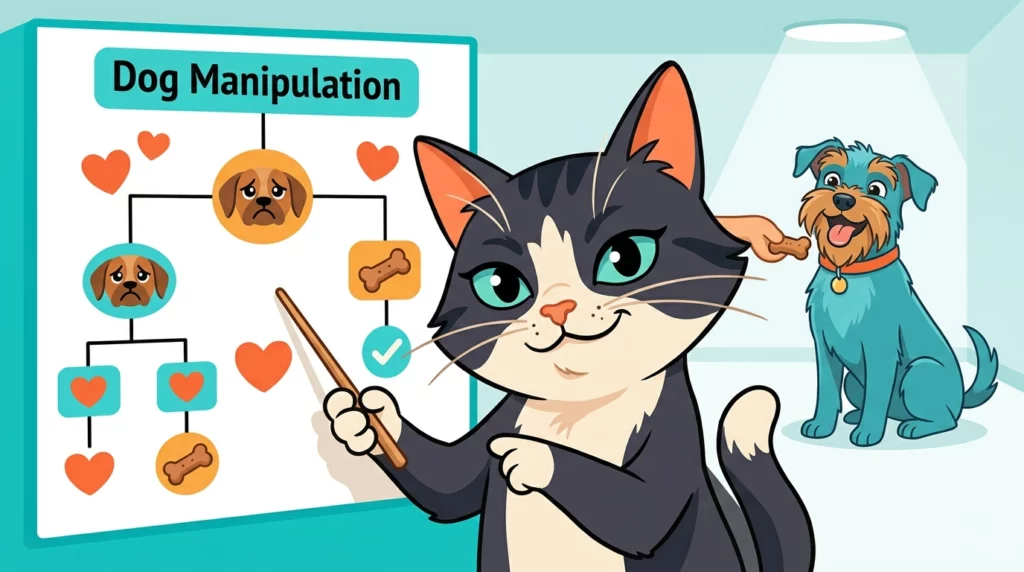
As a cat, I find this entire dynamic hilarious. When I push a flower pot off the windowsill, I don’t crouch or tuck my tail. I sit there, lick my paw, and look at my humans as if to say, “You’re welcome for the gardening assistance.” Because I don’t offer appeasement gestures, humans think cats are snobbish (okay, maybe we are a little).
But dogs? Dogs are social geniuses. They have spent thousands of years studying human emotions. They know that when you get loud and scary, offering a submissive, wide-eyed, floppy-eared posture magically disarms you. It makes you squeal, take a picture for Instagram, and say, “Oh, I can’t stay mad at that face!”
So, who is really the mastermind here? The dog who “knows they did wrong,” or the dog who knows exactly how to look pathetic enough to get you to stop scolding them?
How to Handle the “Guilty” Look
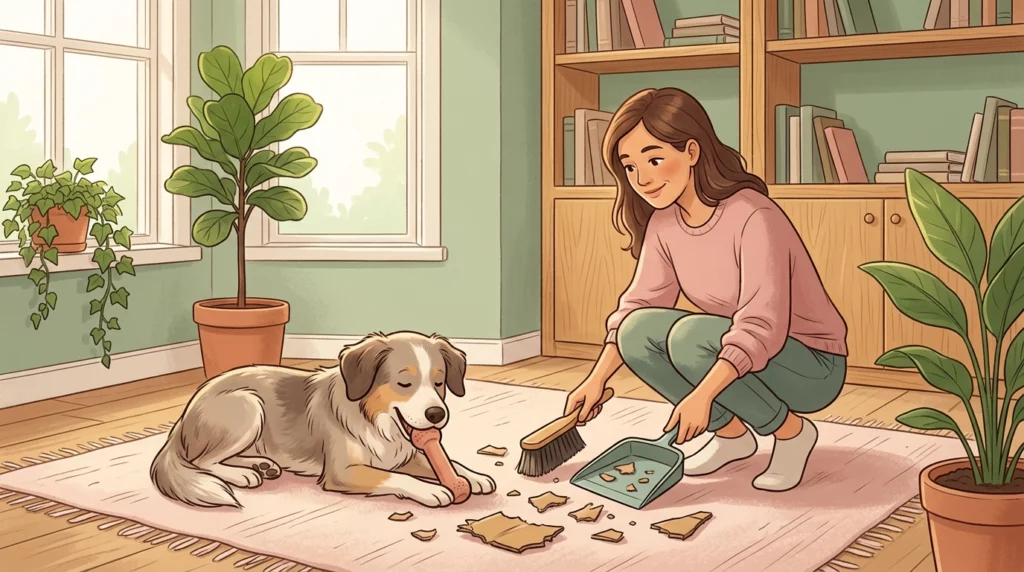
Now that you know the science, how should you react the next time you find a chewed-up shoe and a dog looking like they are on trial for their crimes? Here are a few tips from a very smart cat:
- Skip the scolding: Dogs live in the present moment. If you scold them for something they did hours ago, they won’t connect the punishment to the action. They will only connect your anger to their current presence, which creates anxiety.
- Address the root cause: Boredom and excess energy are the real culprits behind destructive behavior. If Blu shreds a box, it’s because he has boundless energy and needed a job. Try puzzle toys or longer walks!
- Manage the environment: If you don’t want your dog to eat your shoes, put the shoes in a closet. (And if you don’t want me to knock over your water glass… well, stop putting it on the edge of the table).
The next time your pup gives you those big, sad, whale eyes, give them a gentle pat instead of a lecture. They aren’t trying to trick you with lies—they are just asking for a little bit of peace, love, and maybe a chew toy that isn’t your favorite slipper.
Now, if you’ll excuse me, I hear the sound of a rustling treat bag, and I must go investigate. Stay curious, friends!