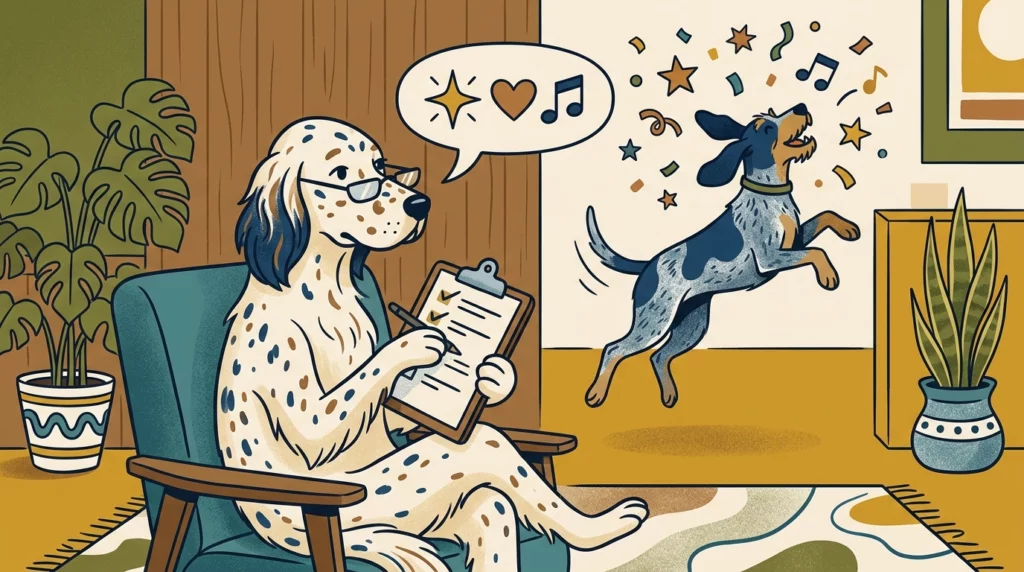
As a five-and-a-half-year-old English Setter, I pride myself on maintaining exceptionally high standards. Whether I am pointing out a hidden pheasant, keeping the SnoutScoop editorial calendar meticulously organized, or judging the quality of my human’s tennis-ball-throwing arm, I believe that details matter. So, you can imagine my intellectual curiosity when it comes to the phrases humans throw at us daily. Specifically, that ubiquitous, holy grail of human compliments: “Good girl!” (or, if you must, “Good boy!”).
My housemate Blu, a delightful but chaotic two-year-old Griffon Bleu de Gascogne, will do backflips for a muttered “good job” if it is accompanied by even a molecule of cheddar cheese. But for a discerning canine like myself, I often wonder: what is actually happening in our elegant brains when you praise us? Is it the specific words you say, the ridiculous baby voice you use, or the physical affection that follows?
Let’s look at the actual science of how we dogs process your praise, and how you can optimize your “good boy” delivery to keep our standards—and our tails—high.
The Brain Chemistry of Praise: Words vs. Tone
Humans often assume we are simply reacting to the pitch of their voices. While it is true that we adore high-pitched enthusiasm, we are far more linguistically sophisticated than you might think.
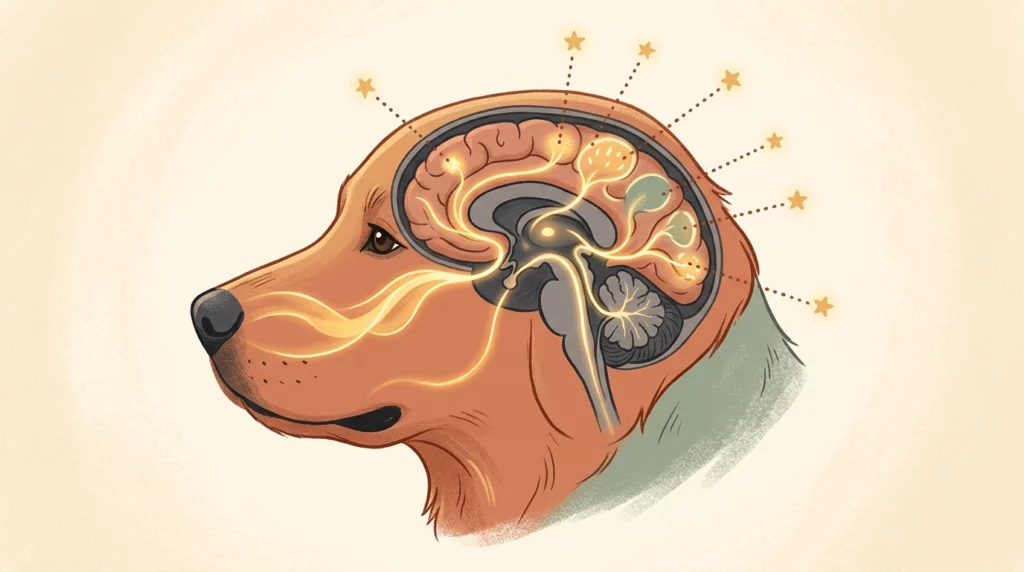
A groundbreaking study conducted by researchers at Eötvös Loránd University in Budapest, which you can read about in The Guardian, analyzed how dog brains process vocabulary and intonation. Using functional MRI (fMRI) scanners on awake, cooperative dogs, scientists discovered that we process words with our left brain hemisphere (just like humans do) and intonation with our right hemisphere.
Here is the fascinating part: the reward centers in our brains only fully lit up when we heard praising words spoken in an encouraging tone. If the researchers said “good boy” in a flat, neutral tone, or if they said a random, meaningless word like “however” in a happy, excited tone, our brains didn’t register the same level of joy. As further explored by Smithsonian Magazine, this means we aren’t just reacting to your high-pitched babbling; we are actually integrating both what you say and how you say it. So, if you are telling us we are good while secretly thinking about your grocery list in a monotone voice, we know. We demand authenticity!
Why “Dog-Directed Speech” is Essential for Bonding

Have you ever had a friend catch you talking to your dog in a high-pitched, exaggerated baby voice? Did you feel embarrassed? Well, don’t be. Science is entirely on your side.
Researchers at the University of York investigated this exact phenomenon, known as “dog-directed speech” (DDS). In a study highlighted by the University of York, scientists compared how dogs responded to adult-directed speech (e.g., “I went to the cinema last night” spoken in a normal voice) versus dog-directed speech (e.g., “You’re a good dog! Shall we go for a walk?” spoken in a high-pitched, emotional tone).
The results were clear: dogs significantly preferred to interact with humans who used high-pitched, dog-centric speech. This specialized way of speaking isn’t just silly human behavior; it is a crucial tool for social bonding and capturing our attention, helping us understand that the message is specifically meant for us. It keeps our active minds focused on you, which is no small feat when there are squirrels to look at.
The Great Debate: Praise vs. Hot Dogs
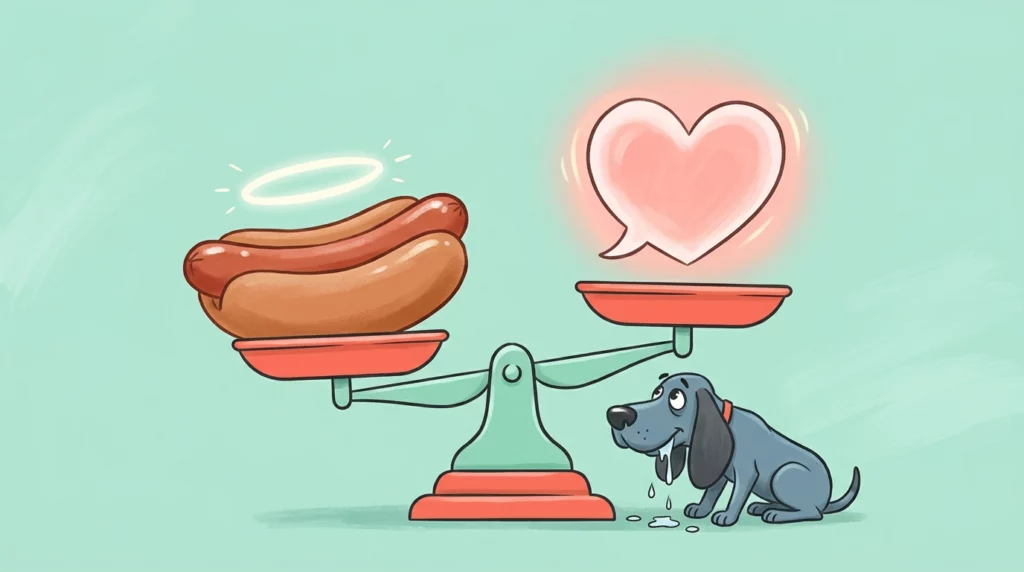
If you ask Blu, he will tell you that a piece of liver sausage is worth more than a thousand verbal compliments. But as a refined English Setter, I beg to differ. And once again, neuroimaging back me up.
Dr. Gregory Berns, a neuroscientist at Emory University, conducted a fascinating study on canine motivation. As detailed in the Emory University Magazine and published on PMC, researchers trained dogs to associate different symbols with different outcomes: a pink toy truck meant a hot dog treat, a blue toy knight meant verbal praise from their owner, and a hairbrush meant no reward.
When looking at the dogs’ neural responses, the researchers found that for 13 out of the 15 dogs tested, the brain’s reward center showed equal or greater activation when they received praise compared to when they received food. A few food-motivated outliers (probably related to Blu, I suspect) preferred the hot dog, but the vast majority of us genuinely value your social approval just as much as—or more than—a edible snack. Your happiness is our reward.
The Power of Touch: Don’t Forget the Scratches

While vocal praise is wonderful, it shouldn’t stand alone. If you truly want to supercharge your “good boy” routine, you need to add physical touch.
According to research reviewed by the American Veterinary Society of Animal Behavior (AVSAB), dogs actually prefer physical petting to vocal praise when given a choice. When a human sits near a dog and offers vocal praise versus physical petting, we consistently seek out the physical contact.
Furthermore, an investigation by Eötvös Loránd University (ELTE) demonstrated that combining vocal praise with petting helps us learn new tasks much more efficiently. It lowers our heart rates, reduces stress, and reinforces that we are safe, loved, and on the right track.
Niki’s Editorial Guide to Perfect Praise
Now that we have reviewed the scientific literature, let us establish a high-quality standard for your daily praise routine. To make your “good boy” or “good girl” truly meaningful, follow these three rules:
- Match your words with your tone: Do not say “good dog” in a flat, tired voice while looking at your phone. Look us in the eyes, channel your inner enthusiast, and mean it!
- Keep using the “baby voice”: Do not let anyone shame you for using dog-directed speech. It builds our social bond and tells our brains that we are the center of your world (which, let’s be honest, we should be).
- Pair praise with petting: A vocal “good job” is nice, but a vocal “good job” accompanied by a gentle scratch behind the ears or a chest massage is the absolute gold standard of canine motivation.
Now, if you will excuse me, I hear my human walking toward the leash drawer. I must prepare myself to receive some high-quality, scientifically optimized praise. Happy training, everyone!