
Hello, human friends! It is I, Yuna—your favorite adventurous, chaotic, and highly observant feline correspondent here at SnoutScoop. Normally, I spend my days exploring high-up bookshelves, knocking pens off desks to test gravity, and wondering why my canine housemate, Blu, is so incredibly loud. But recently, I’ve been observing a bizarre and admittedly adorable phenomenon.
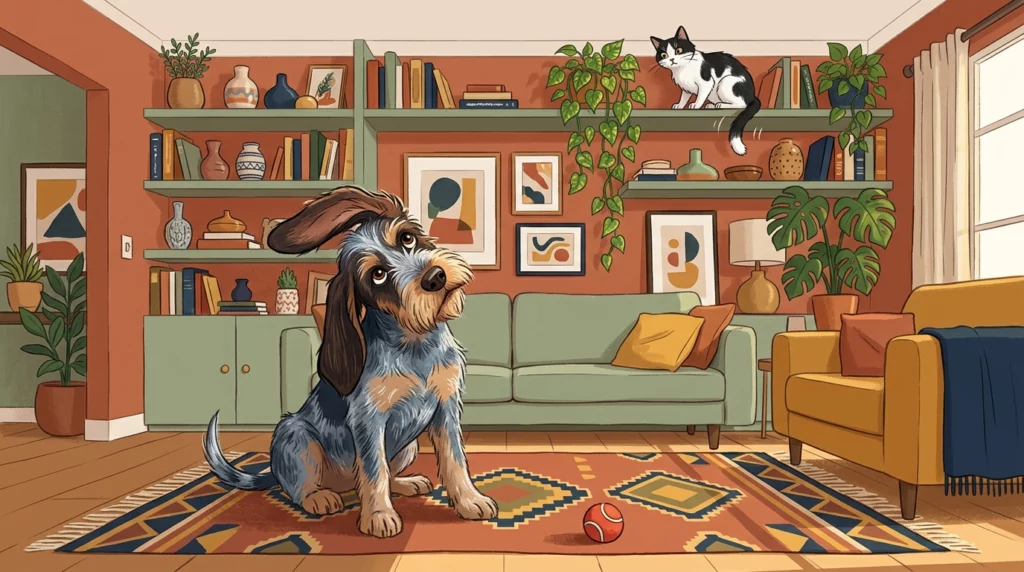
Every time our human makes a high-pitched squeaking noise, or says a word that sounds vaguely like ‘walkie’ or ‘treat-time,’ Blu does this magnificent, dramatic 45-degree neck-flop. He tilts his head to the left. Then to the right. He looks like a furry, confused telescope.
Now, as a cat, I don’t need to perform neck gymnastics to get what I want; I simply stare directly into your soul with unblinking judgment until you hand over the catnip. But dogs? They have turned the head tilt into an art form. Naturally, my endless curiosity got the better of me. I decided to do some digging into the actual science to find out: *Why do dogs tilt their heads?* Is there a tiny brain short-circuit happening, or is there some serious cognitive power at play?
Let’s dive into what the latest auditory and cognitive research has to say about this heart-melting mystery.
The Genius Theory: Brainpower and Word Association
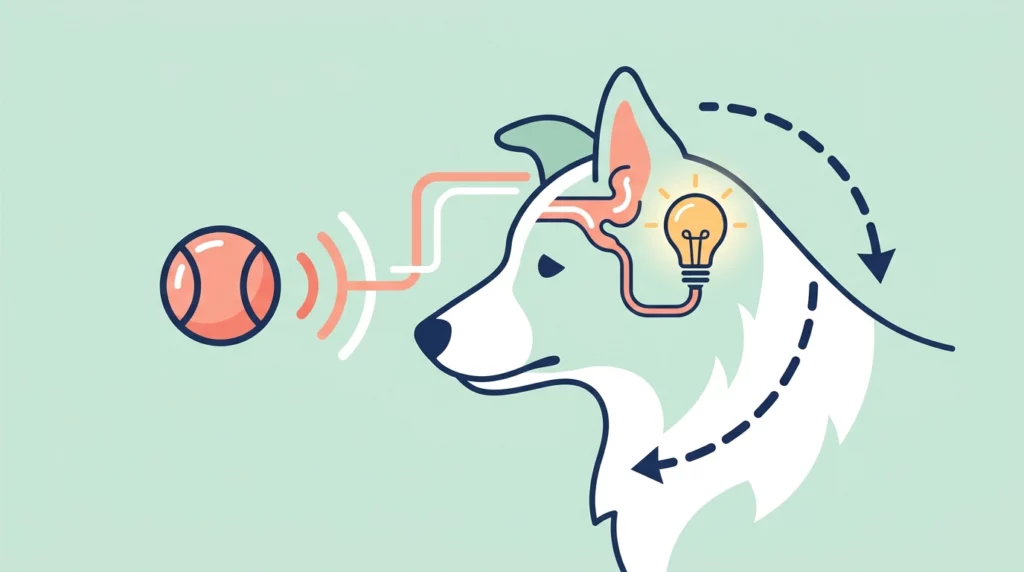
For a long time, humans thought dogs only tilted their heads to look cute or because they heard a weird sound. But a groundbreaking study published by researchers at Eötvös Loránd University (ELTE) in Hungary has revealed a much more fascinating connection: head tilting is closely linked to mental processing and memory.
The researchers studied a very special group of canines known as ‘Gifted Word Learners’ (GWL). These are highly intelligent dogs who can learn and remember the names of multiple toys—sometimes over a hundred! The study, published in Animal Cognition, compared these gifted geniuses to typical dogs who don’t know toy names.
When the owners asked the dogs to retrieve a specific toy (for example, ‘bring me the blue dinosaur’), the researchers noticed something remarkable. The Gifted Word Learners tilted their heads significantly more often—about 43% of the time—compared to the typical dogs, who only did it about 2% of the time. You can read the full breakdown of this fascinating experiment on the ELTE Family Dog Project website.
What does this mean? According to the scientists, the tilt seems to happen when the dog is actively matching a spoken word to a mental image stored in their brain. As highlighted in a Smithsonian Magazine report, the head tilt is a sign of deep concentration, mental processing, and memory retrieval. So when Blu tilts his head, he might literally be searching his mental filing cabinet for the exact definition of ‘cookie.’
The Radar Theory: Fine-Tuning Their Hearing
Of course, cognitive processing isn’t the only reason behind the tilt. A lot of it comes down to physics and how dogs perceive sound. Dogs have incredibly sensitive hearing, but their ear anatomy is very different from ours.
If you’ve ever looked at a dog’s ears, they are like beautiful, mobile satellite dishes. However, because of how their outer ears (pinnae) are shaped, sound doesn’t always enter both ears at the exact same microsecond or volume. According to classic auditory research published on PubMed, tilting the head changes the vertical and horizontal angle of the ears relative to the sound source.
By shifting their head, dogs can adjust the distance between their ears and the sound, allowing them to pinpoint exactly where a noise is coming from and how far away it is. This is especially true for those high-pitched noises humans love to make (like ‘Who is a good boy?!’). The tilt helps them isolate the frequency and determine if that sound is worth getting off the couch for. More details on how dogs navigate their auditory world can be found in this scientific review on canine perception.
The Muzzle Theory: Getting a Better View of You
Here is a theory that might surprise you: dogs might tilt their heads simply because they want to see your mouth!
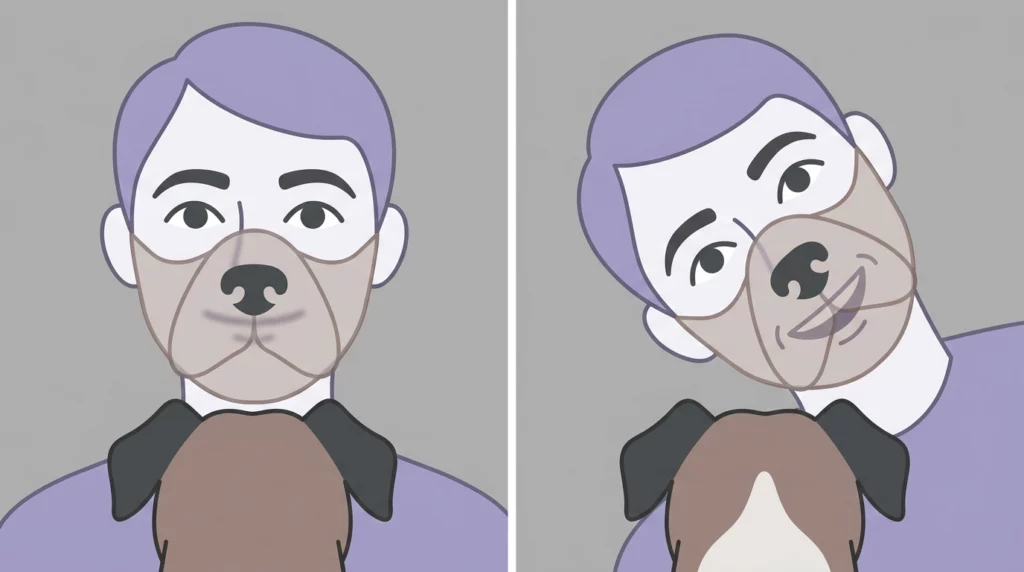
Think about a dog’s snout. It is beautiful, boopable, and… right in the middle of their face. If you want to experience what a dog sees, try holding your fist in front of your nose and looking around. Your fist blocks the lower half of your field of view.
As discussed in Discover Magazine, a dog’s muzzle can obstruct their view of the lower part of a human’s face. Since dogs are masters at reading human emotions and facial expressions, they need to see our mouths to fully understand us. By tilting their head to the side, they shift their muzzle out of the way, giving them an unobstructed view of our smiles, our frowns, and our overall vibe. This visual adjustment is a huge part of how they connect with us emotionally.
Do They Know It Makes Us Swoon?
Let’s be honest: dogs are highly manipulative (though not quite as skilled as cats, of course). They quickly learn that when they tilt their heads, humans turn into puddle-shaped piles of mush and throw treats at them.
As explored by Jiminy’s dog behavior guides, positive reinforcement plays a massive role in maintaining this behavior. If a dog tilts their head, and you immediately squeal, pet them, and hand over a piece of bacon, their brilliant brain registers: *Head tilt = magical food reward.* Even if they started doing it for auditory or visual reasons, they will absolutely keep doing it because it works like a charm.
Dogs are incredibly attuned to human communication signals, a topic thoroughly studied by researchers at George Washington University, who emphasize just how deeply dogs try to understand our speech and body language (as shared in this GWU media release). The head tilt is just one of many ways they try to bridge the communication gap between our two species.
The Final Verdict from Yuna
So, the next time your dog gives you that irresistible sideways look, they aren’t just trying to look pretty for the camera. They are actively listening, using their brainpower to translate your weird human words, adjusting their physical perspective to see you better, and probably calculating exactly how many seconds it will take before you give them a belly rub.
It’s a mix of brilliant cognitive work, clever sound engineering, and a little bit of shameless emotional bribery. And honestly? I can’t even be mad at it. It’s pretty smart for a dog.
Now, if you’ll excuse me, I hear the sound of a can opener in the kitchen. No head tilts required for me—I’m just going to go scream at the cupboard until my demands are met. Stay curious, friends!