
Hello, curious humans and furry friends! It’s Yuna here—your resident two-year-old feline adventurer, professional curiosity investigator, and resident chaos enthusiast at SnoutScoop. Usually, my daily beat involves exploring high places, inspecting cardboard boxes, and occasionally reminding Blu that my paws move much faster than his snout. But today, I stumbled upon a piece of pop-culture history so wonderfully weird that even a cat had to pause and take notes.
We all know Snoopy. He is the world’s most iconic cartoon Beagle—the bird-befriending, rooftop-sleeping, World War I Flying Ace who has charmed generations of comic lovers. But here is the unexpected plot twist: Snoopy wasn’t just hatched out of pure thin-air imagination. He was inspired by a real, living, wildly unpredictable dog named Spike.
Grab your favorite cozy spot on the couch (or on top of the refrigerator, if you are like me), because we are diving into the strange, hilarious, and heartwarming origins of the world’s favorite Beagle.
Meet Spike: The Iron-Stomached Dog Who Started It All
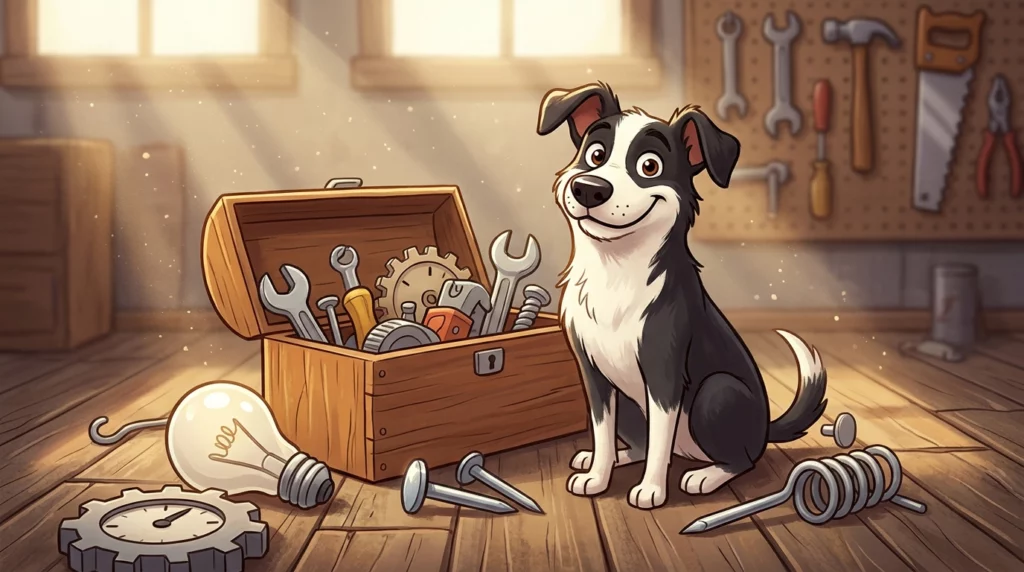
Long before Charles M. Schulz created Peanuts in 1950, he was a kid growing up in Minnesota with a very unusual pet. In 1934, when Schulz was 13 years old, his family welcomed a black-and-white mixed breed dog named Spike.
Spike was part Beagle, part Pointer, and 100% full of chaotic energy. According to historical records kept by the American Kennel Club, Spike was anything but an ordinary suburban pup. He had a legendary reputation for eating things that no sensible animal should ever ingest—including pins, tacks, razor blades, and even small glass lightbulbs!
Now, as a cat who occasionally likes to test-nibble on clean plastic wrappers, even I find Spike’s diet alarming. Yet, Schulz’s father claimed Spike had an “iron stomach” and somehow survived these bizarre dining choices totally unscathed. Spike was smart, stubborn, and had a wildly expressive personality that stuck with Schulz for the rest of his life.
In fact, Spike was so unusual that he gave Schulz his very first published cartoon breakthrough. In 1937, a teenage Schulz drew a single-panel illustration of Spike and submitted it to the famous syndicated series Ripley’s Believe It or Not!. As documented by Ripley’s Believe It or Not!, the panel featured a drawing of Spike with a caption describing a hunting dog who ate pins, tacks, and razor blades. Robert Ripley published it, giving young Charles Schulz his very first taste of national print fame.
From “Sniffy” to Snoopy: A Name Chosen by Mom
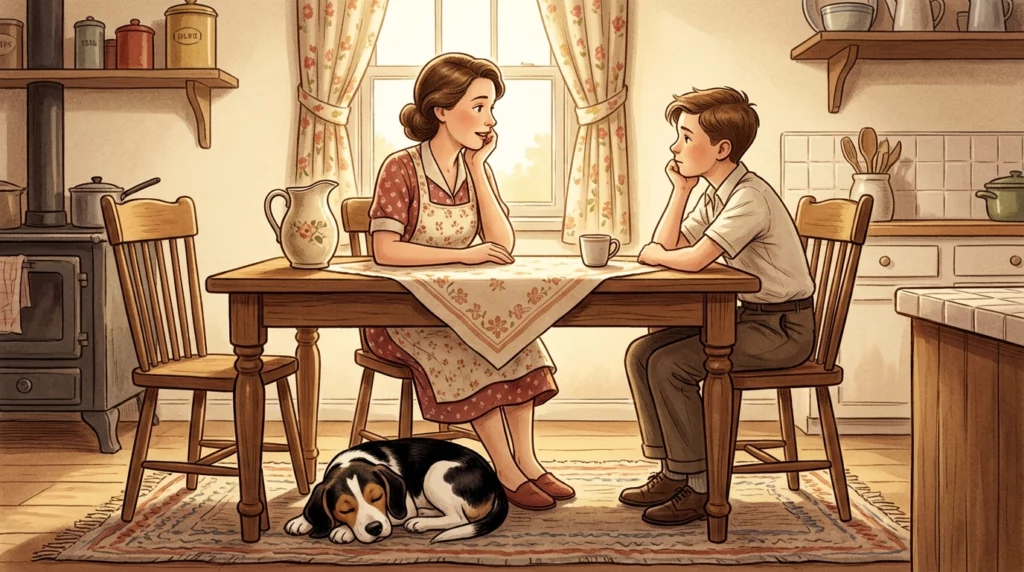
When Charles Schulz began drafting his new comic strip in the late 1940s (initially titled L’il Folks before becoming Peanuts), he knew he wanted to include a dog character inspired by his beloved childhood companion.
However, he didn’t originally intend to call him Snoopy! Schulz initially named the cartoon pup “Sniffy.”
Just as the strip was heading toward publication, Schulz happened to pass a newsstand and spotted a comic magazine featuring a dog named Sniffy. Realizing his chosen name was already taken, he needed a replacement fast. That’s when a long-forgotten family memory hit him.
As recorded in comic history sources like Mental Floss and Wikipedia, Schulz remembered his late mother, Dena Schulz. Shortly before her death, she had casually remarked that if the family ever got another dog, they ought to name him “Snoopy.”
The word was derived from the Norwegian term of endearment snupi (or snoops), roughly translating to “sweetheart” or “little darling.” Schulz loved the sentimental connection and swapped the name instantly. On October 4, 1950—just two days after Peanuts made its newspaper debut—Snoopy walked onto the page for the first time.
Is Snoopy Actually a Beagle? (Real Beagles vs. Cartoon Legends)
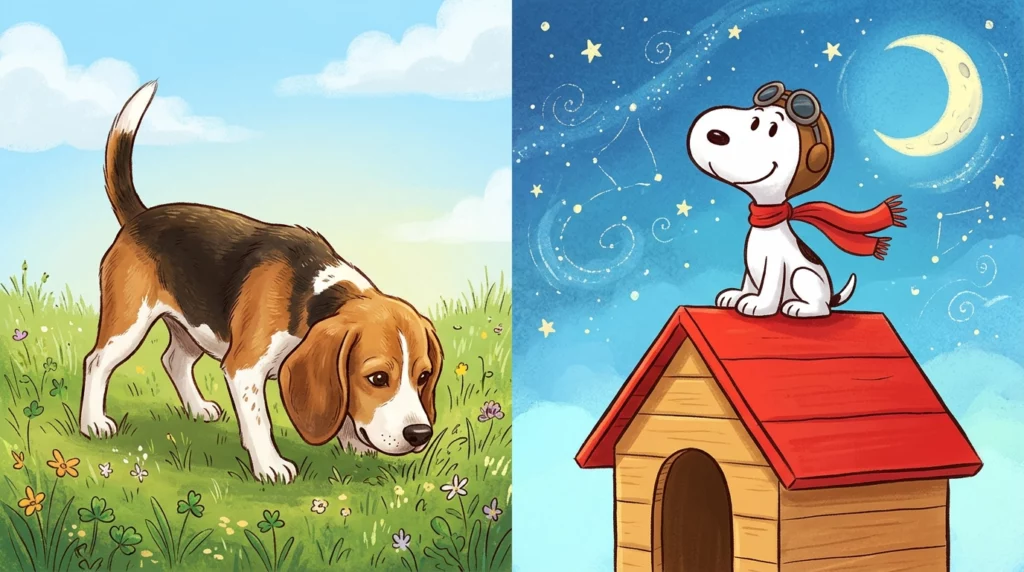
In his earliest appearances, Snoopy walked on all four legs, didn’t talk, and behaved very much like a typical real-life dog. But over the decades, Snoopy transformed. He began walking upright on two legs, thinking in full English sentences, and developing a fantasy life bigger than the sky itself.
This brings us to a pressing question: How much does Snoopy actually resemble a real-life Beagle?
As dog behavior experts and articles in Cigar Aficionado point out, real Beagles are famously vocal, scent-obsessed hounds. They love pack living, sniffing every blade of grass, and letting out soulful howls (known as baying) when they track an interesting scent trail.
Here is how real Beagles compare to Snoopy’s famous quirks:
- Sleeping ON the doghouse: Snoopy famously sleeps flat on his back on top of his doghouse roof because he suffers from claustrophobia. Real Beagles, on the other hand, love burrowing! They prefer cozy, enclosed spaces like blankets, dog beds, or under your warm duvet.
- Imaginary alter-egos: Snoopy imagines himself as a World War I Flying Ace, Joe Cool, and a world-famous novelist writing “It was a dark and stormy night.” Real Beagles usually reserve their mental energy for imagining where you hid the peanut butter jar.
- Relationship with birds: Snoopy’s best friend is a little yellow bird named Woodstock. Real Beagles are scent hounds traditionally bred to track small game—so a wild bird hanging out on their snout might usually trigger their chase instinct rather than a lifelong partnership!
Why Snoopy’s Spirit Lives On
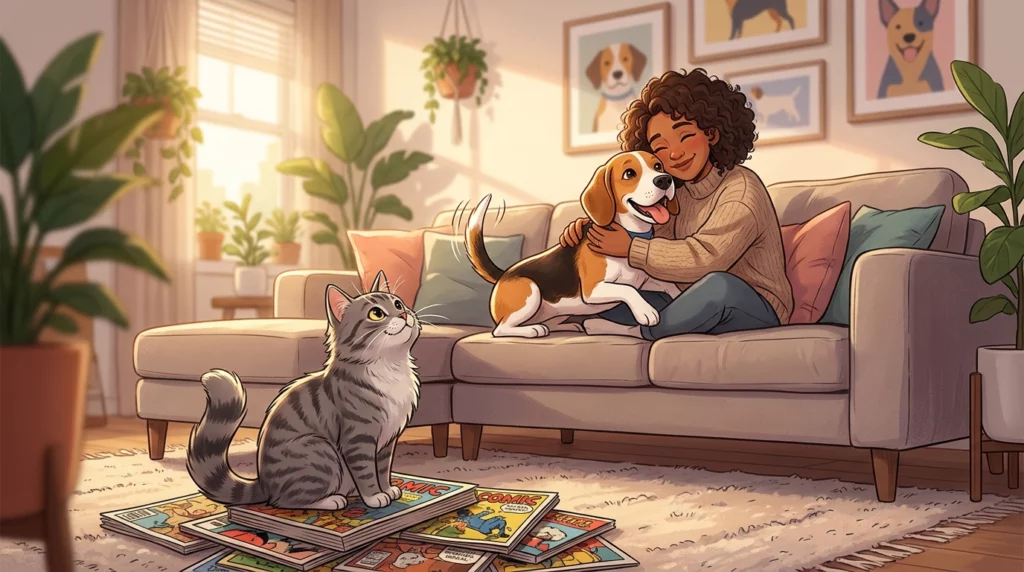
Even though Snoopy evolved far beyond his real-life counterpart Spike, that core spark of stubbornness, playfulness, and emotional depth came directly from Schulz’s childhood hound. Spike gave Schulz the blueprint for a dog who refused to be constrained by human expectations.
Whether he’s battling the Red Baron from the roof of his doghouse or dancing joyful circles in the snow, Snoopy represents the boundless imagination that pets bring into our lives. As a cat, I have to give respect where respect is due: Snoopy didn’t just play by human rules—he completely redefined what a cartoon animal could be.
So the next time you see a cheerful Beagle strutting down the sidewalk, take a closer look. They might not be wearing aviator goggles or typing a bestselling novel, but behind those big floppy ears beats the heart of a true adventurer—just like Spike, Snoopy, and maybe even a curious cat named Yuna.