
Understanding play between dogs

Look beyond the excitement of dogs playing together. Learn to follow a changing interaction, consider each partner's comfort and preferences, and organise meaningful breaks. Explore how toys, group settings and rest opportunities can change whether an activity suits an individual dog.

Training mode

Understanding play between dogs

0 / 20 answered

  1. 1. A small puppy seems overwhelmed by a larger dog's bouncing. Which response fits?

    A small puppy seems overwhelmed by a larger dog's bouncing. Which response fits?
  2. 2. A puppy learns very rough games with a tolerant companion. What should not be assumed?

    A puppy learns very rough games with a tolerant companion. What should not be assumed?
  3. 3. After a play break, one dog chooses to stay with its owner. What is appropriate?

    After a play break, one dog chooses to stay with its owner. What is appropriate?
  4. 4. What is a useful way to prepare ordinary play breaks before games become too intense?

    What is a useful way to prepare ordinary play breaks before games become too intense?
  5. 5. During a chase, one dog becomes tense and repeatedly seeks an exit. What should guide the response?

    During a chase, one dog becomes tense and repeatedly seeks an exit. What should guide the response?
  6. 6. Which information is more useful when matching play partners?

    Which information is more useful when matching play partners?
  7. 7. A group game becomes increasingly frantic after repeated throws. What is sensible?

    A group game becomes increasingly frantic after repeated throws. What is sensible?
  8. 8. A dog prefers quiet walks and human company to group games. Which choice is reasonable?

    A dog prefers quiet walks and human company to group games. Which choice is reasonable?
  9. 9. Which carer report is more informative than 'they played all day'?

    Which carer report is more informative than 'they played all day'?
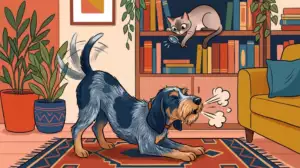
  10. 10. A dog lowers its front and raises its rear with a relaxed body. How should this be read?

    A dog lowers its front and raises its rear with a relaxed body. How should this be read?
  11. 11. A dog enjoys walks with one friend. Does that prove a large play group will suit it?

    A dog enjoys walks with one friend. Does that prove a large play group will suit it?
  12. 12. What is a useful question before choosing group day care?

    What is a useful question before choosing group day care?
  13. 13. What is missing from a single photograph of two dogs with open mouths?

    What is missing from a single photograph of two dogs with open mouths?
  14. 14. A puppy keeps returning to a resting adult with paws and teeth. What should the owner do?

    A puppy keeps returning to a resting adult with paws and teeth. What should the owner do?
  15. 15. What is a sound goal for supervised social play?
    What is a sound goal for supervised social play?

  16. 16. Two dogs walk comfortably together until a ball appears. What should be reconsidered?

    Two dogs walk comfortably together until a ball appears. What should be reconsidered?
  17. 17. An owner says a wagging tail proves a chasing dog is friendly. What is missing?

    An owner says a wagging tail proves a chasing dog is friendly. What is missing?
  18. 18. Play seemed relaxed initially, but one dog now freezes and turns away. Which information takes priority?

    Play seemed relaxed initially, but one dog now freezes and turns away. Which information takes priority?
  19. 19. Before joining a lively group outing with an older dog, what deserves attention?

    Before joining a lively group outing with an older dog, what deserves attention?
  20. 20. A dog returns exhausted from group care. What should be reviewed before calling it a success?

    A dog returns exhausted from group care. What should be reviewed before calling it a success?
Questions covered in this exam
  1. A dog lowers its front and raises its rear with a relaxed body. How should this be read?
  2. What is missing from a single photograph of two dogs with open mouths?
  3. A puppy keeps returning to a resting adult with paws and teeth. What should the owner do?
  4. A small puppy seems overwhelmed by a larger dog's bouncing. Which response fits?
  5. Which information is more useful when matching play partners?
  6. During a chase, one dog becomes tense and repeatedly seeks an exit. What should guide the response?
  7. After a play break, one dog chooses to stay with its owner. What is appropriate?
  8. Two dogs walk comfortably together until a ball appears. What should be reconsidered?
  9. A dog enjoys walks with one friend. Does that prove a large play group will suit it?
  10. What is a useful question before choosing group day care?
  11. A dog returns exhausted from group care. What should be reviewed before calling it a success?
  12. A puppy learns very rough games with a tolerant companion. What should not be assumed?
  13. An owner says a wagging tail proves a chasing dog is friendly. What is missing?
  14. A dog prefers quiet walks and human company to group games. Which choice is reasonable?
  15. Before joining a lively group outing with an older dog, what deserves attention?
  16. What is a useful way to prepare ordinary play breaks before games become too intense?
  17. A group game becomes increasingly frantic after repeated throws. What is sensible?
  18. Which carer report is more informative than 'they played all day'?
  19. Play seemed relaxed initially, but one dog now freezes and turns away. Which information takes priority?
  20. What is a sound goal for supervised social play?
Further reading

SnoutScoop Newsletter

A little more dog in your inbox

Stories, discoveries and things to learn about dogs. Get news from SnoutScoop in your preferred language.