
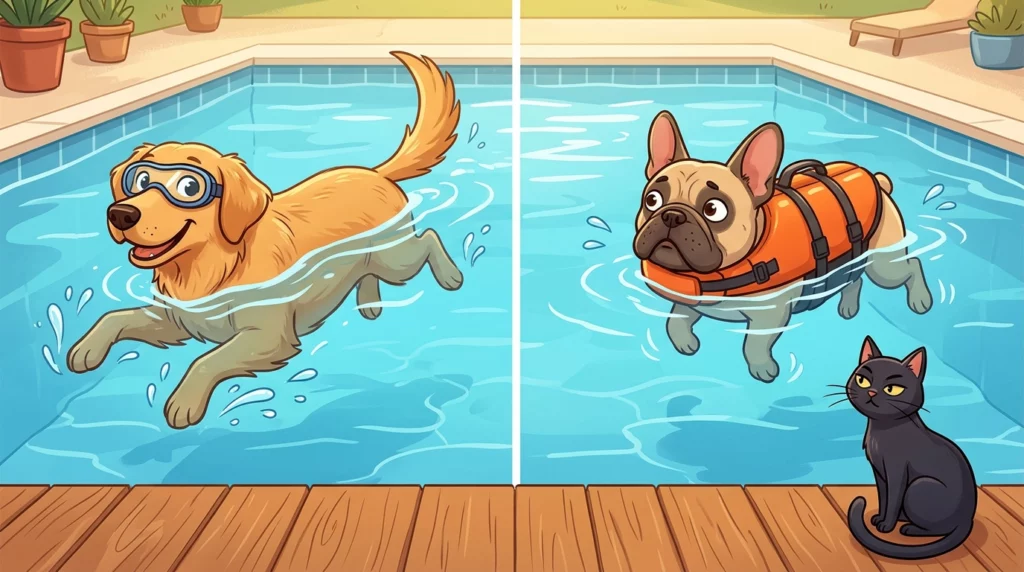
I, Pisino, the three-year-old black cat and undisputed chief of this household, am writing to you from a position of absolute superiority and perfect dryness. Water is a fascinating element. It is excellent for drinking from a freshly washed bowl, and it is highly entertaining when housing a school of oblivious golden fish. But voluntarily submerging oneself in it? Absolutely not.
Yet, our well-meaning humans seem to harbor a bizarre, romanticized notion that every single dog is a natural-born Olympic swimmer. I watch my canine subordinates—Blu, who has the enthusiasm of a runaway train, and Niki, who behaves as if she invented dignity—and I shudder to think what would happen if our humans simply tossed them into a lake assuming instinct would carry them. Let’s set the record straight: not all dogs can swim. In fact, some are built more like anchors than yachts. Let us dive into the cold, hard science of canine buoyancy, before anyone makes a splash they regret.
The Myth of the “Canine Paddle”
If you hold a dog over a bathtub, they will immediately begin frantically paddling their paws in the air. Humans see this and squeal, “Oh, look! He knows how to swim!”
Please. That is not swimming; that is a primitive survival reflex. According to Dr. Stanley Coren writing for Psychology Today, while the majority of dogs will instinctively try to paddle when they feel water beneath them, this reflexive movement does not mean they can generate enough upward thrust to keep their heads above water, let alone navigate safely. Without the right body shape, that frantic paddling is just a prelude to sinking.
The “Built-to-Float” Club
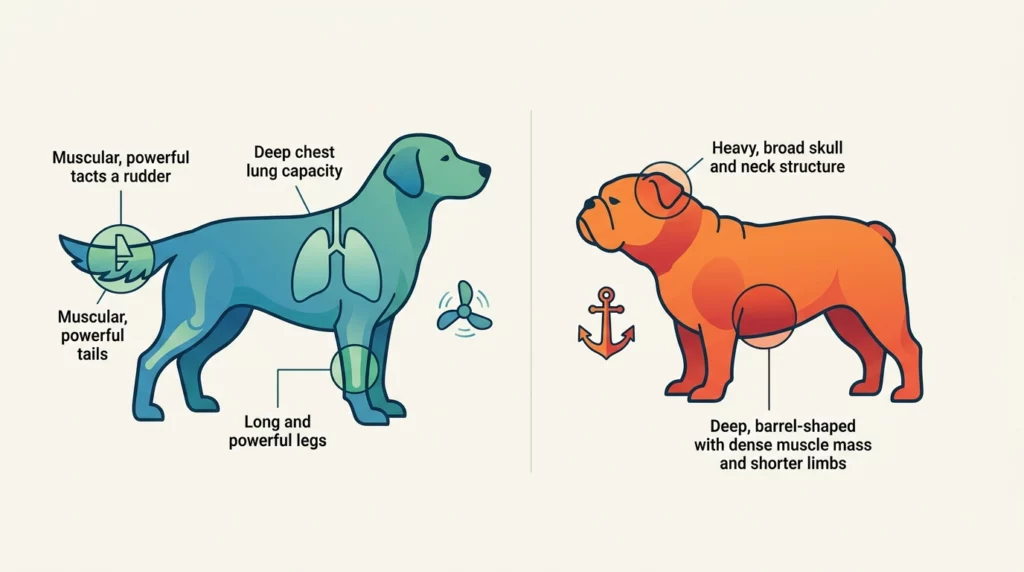
To be fair, some dogs are practically marine mammals. These are the overachievers of the canine world. Breeds like Labrador Retrievers, Golden Retrievers, Portuguese Water Dogs, and Irish Water Spaniels were practically engineered for the water.
These aquatic aristocrats possess several anatomical advantages:
- Webbed Feet: Built-in flippers that push water efficiently.
- Water-Resistant Double Coats: A natural wetsuit that insulates them and repels moisture, keeping them light and buoyant.
- Long, Athletic Limbs: Perfect for generating powerful, forward-propelling strokes.
Even Niki, our English Setter, has a proud heritage of working in wet marshlands and possesses a streamlined silhouette that makes her look quite elegant in the water. But even the best natural swimmers can tire, panic, or suffer from cramps, as veterinary experts frequently warn.
The “Anchor” Brigade: Anatomical Realities
Now we must discuss the dogs who, bless their warm hearts, have the hydrodynamic properties of a brick. If you own one of these breeds, you must discard any illusions of them frolicking in the surf without serious human intervention.
According to safety guides from Hill’s Pet and Lancaster Puppies, several popular breeds physically struggle to stay afloat due to their structural anatomy:
1. The Brachycephalic (Flat-Faced) Crew
French Bulldogs, English Bulldogs, Pugs, and Boxers face a double whammy in the pool. Because of their short snouts, they must tilt their heads incredibly far backward just to keep their noses and mouths above the water line. This awkward tilt forces their rear ends downward, causing them to adopt a vertical position in the water. A vertical dog is a sinking dog.
2. The Heavy-Chested and Short-Legged
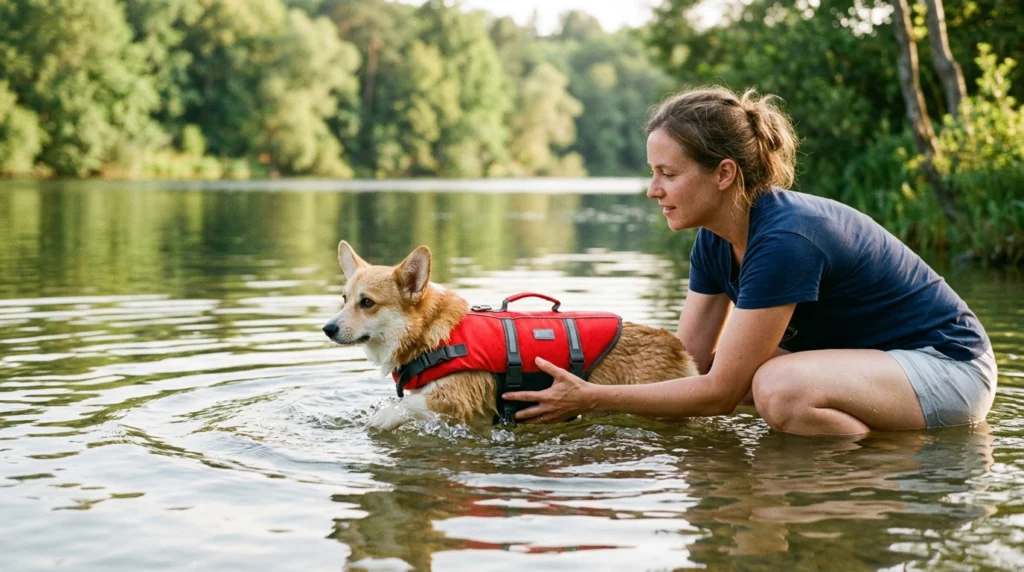
Bulldogs (again, double culprits here), Corgis, and Basset Hounds suffer from a severe center-of-gravity mismatch. They have massive, dense chests and heavy bone structures, supported by tiny, short legs. They simply cannot generate enough paddling power to keep their heavy upper bodies afloat. As noted by Vetic, these breeds will tire out within seconds, quickly succumbing to exhaustion.
Panic vs. Instinct: The Psychological Hazard
Even if a dog has the physical capacity to swim, their mental state can change everything. As noted by the experts at Agria Pet, fear and anxiety can instantly override a dog’s physical capabilities.
When a dog panics, they do not swim horizontally. They panic-paddle vertically, trying to “climb” out of the water. This causes them to swallow large amounts of water, leading to a highly dangerous condition known as water intoxication (hyponatremia), which can be fatal. Additionally, Pets4Homes warns about the silent danger of “secondary drowning,” where water enters the lungs and causes respiratory distress hours after the dog has left the pool.
Pisino’s Golden Rules of Dog Water Safety
Because I prefer my canine housemates alive and reasonably dry, I have formulated a few non-negotiable safety rules. Please take notes, humans.
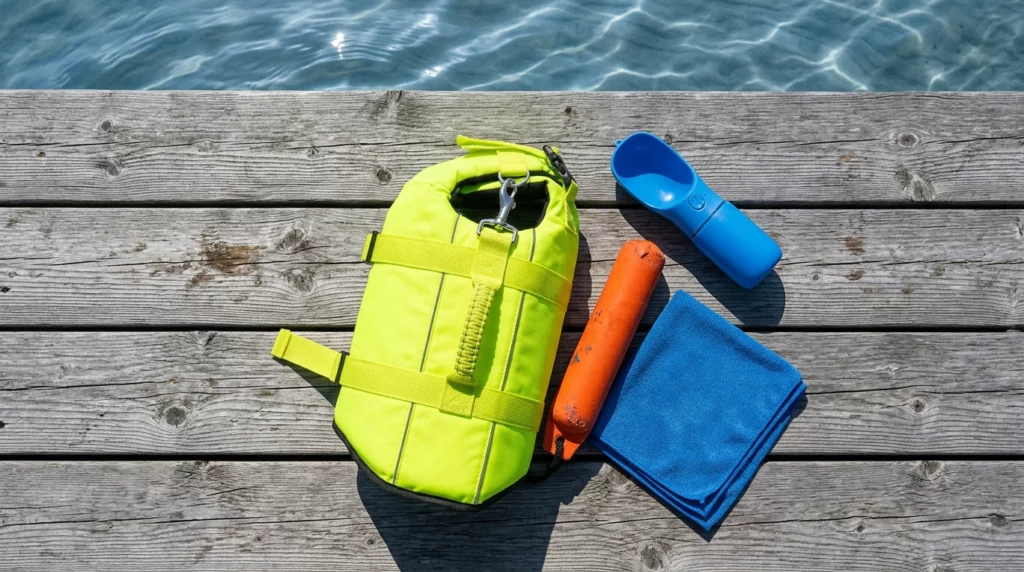
- 1. The Life Jacket is Fashionable and Mandatory: If your dog is a flat-faced breed, a heavy-bodied breed, or simply a novice, they must wear a high-quality canine personal flotation device (PFD). Choose one in a bright, obnoxious color (neon yellow suits my taste) with a sturdy handle on the back so you can pluck them out of the water like a wet purse.
- 2. Use the Graduation Method: Never, under any circumstances, throw a dog into the water. This is traumatizing and dangerous. Instead, follow the American Kennel Club (AKC) guidelines: start in shallow water, support their belly with your hands, use high-value treats, and let them get used to the sensation of buoyancy at their own pace.
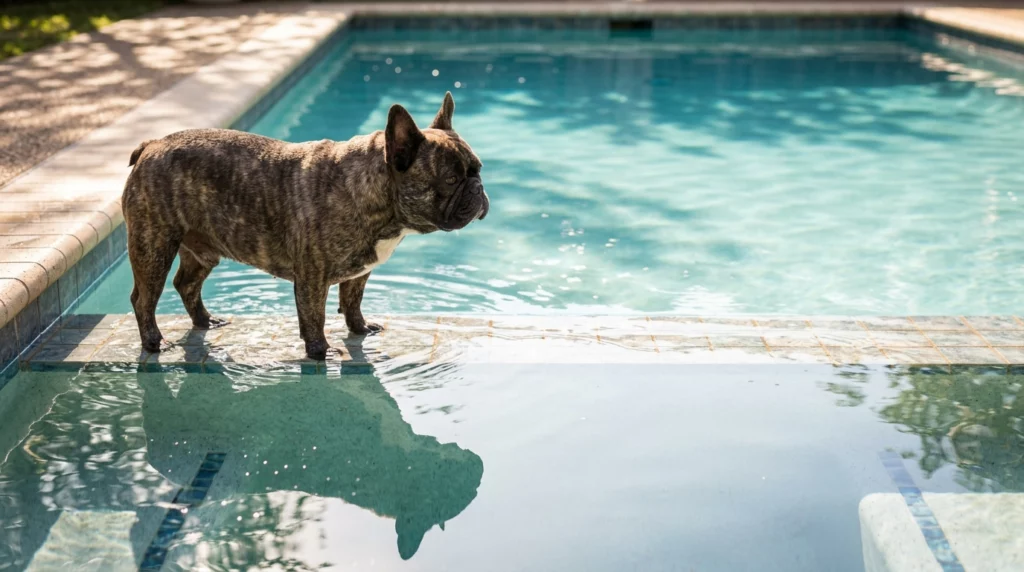
- 3. Provide a Clear Exit: Dogs often drown in backyard pools because they do not understand how to use the steps. If your dog is near a pool, show them—repeatedly—where the shallow steps are located.
- 4. Watch for the “Tired Tail”: A tired dog is a vulnerable dog. If your dog’s rear end is sinking lower or if they are splashing excessively, it is time to dry off.
Conclusion: Keeping Paws on Solid Ground is Okay
If your dog refuses to enter the water, do not force them. There is absolutely no shame in a dog who prefers to sunbathe on a lounge chair, wearing stylish sunglasses, while sipping cool water from a bowl. In fact, I highly respect that lifestyle choice. It shows a level of intelligence and self-preservation that is frankly very feline.
Keep your eyes on your pups, invest in a good life jacket, and remember that sometimes, the ultimate act of love is keeping all four paws planted firmly on dry land.