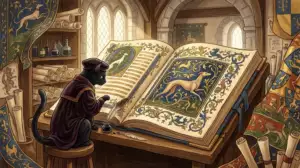
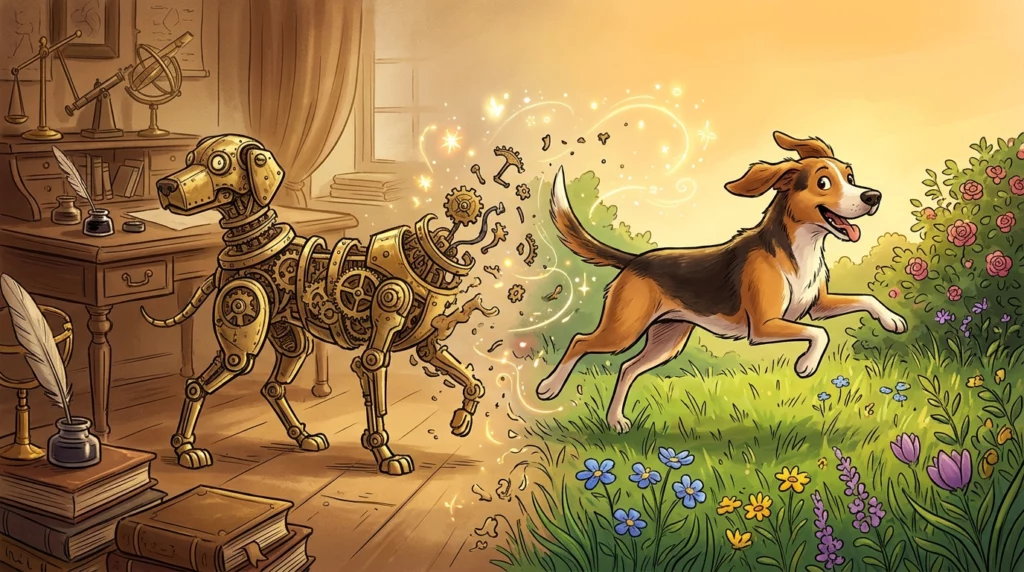
I am Pisino. As the undisputed chief of this household, my daily duties include supervising the humans, perching on high perches to survey my kingdom, and observing the bizarre behavioral quirks of my canine housemates, Blu and Niki. Watching Blu spend ten solid minutes attempting to bite a sunbeam might lead a casual observer to question the presence of high-level cognitive architecture in the dog brain. But a machine? A mindless piece of clockwork?
Please. Even I, a feline of exceptional intellect and high aesthetic standards, will defend our barking companions against that particular insult. Yet, back in the 17th century, one of history’s most famous philosophers argued precisely that.
René Descartes claimed that dogs—and all animals—were nothing more than intricate biological automatons. Fortunately for dogs everywhere, the legendary French poet Jean de La Fontaine stepped into the philosophical ring to prove him wrong. Let us dive into the great 17th-century clash over whether dogs are machines or mindful beings.
Descartes and the Cold Logic of the Bête-Machine
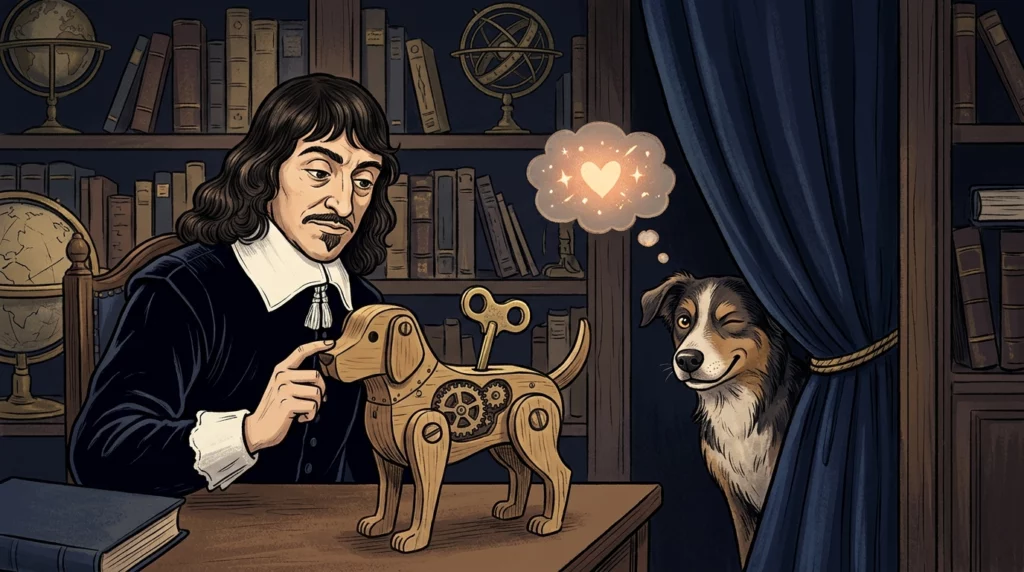
To understand why La Fontaine was so annoyed, we have to look at René Descartes. In the 1600s, Descartes introduced the theory of the bête-machine (the animal-machine). He posited that the universe was divided strictly into two substances: mind (which only humans possessed, thanks to a soul) and matter. Under this view, animals were merely complex physical mechanisms—glorified grandfather clocks made of bone, muscle, and fur.
According to Descartes, when a dog whines upon being kicked, it is not experiencing emotional distress or physical pain in the conscious sense. It is simply a spring uncoiling or a gear squeaking. As explored in philosophical analyses of Descartes’ view on animals, this mechanistic perspective served to separate human rationality completely from the rest of the natural world.
If you have ever seen Blu react with unbridled, full-body euphoria because someone picked up a leash, you know Descartes missed the mark by a wide mile.
La Fontaine Steps In: Poetic Justice for Animals

Enter Jean de La Fontaine (1621–1695). Best known for his brilliant, witty Fables, La Fontaine was far more than a storyteller for children; he was a keen observer of nature and a sharp philosophical thinker. He found Descartes’ reduction of animals to lifeless machinery absurd.
In Book IX of his Fables, specifically within the famous Discours à Madame de La Sablière, La Fontaine explicitly addressed the Cartesian debate. As detailed in scholarly reviews on La Fontaine’s philosophical critiques, he argued that animals possess memory, desire, emotion, strategic reasoning, and even moral choices. To claim a dog is an unfeeling automaton was, to La Fontaine, a total denial of obvious reality.
Exhibit A: Strategic Thinking in the Fables

La Fontaine didn’t just assert that animals think; he demonstrated it through narrative observation. Take one of his most celebrated fables, Le Loup et le Chien (The Wolf and the Dog). In this story, a starving wolf encounters a sleek, well-fed house dog. The dog boasts of his comfortable life: guaranteed food, warm shelter, and affection from his master.
The wolf is initially ready to sign up for this domestic paradise until he notices the rubbed-off fur around the dog’s neck—the mark of the collar and chain. The dog weighed security against total submission; the wolf evaluated the trade-off and chose freedom. This is not mechanical output; it is a cost-benefit analysis based on values and preferences.
Then consider Le Chien qui porte à son cou le dîner de son maître (The Dog Who Carries His Master’s Dinner Around His Neck). In this fable, a loyal dog is entrusted with delivering a basket of food. Even while hungry, the dog resists temptation out of duty. However, when attacked by street dogs trying to steal the meal, he realizes he cannot defeat them all. He makes a tactical decision: if the dinner is going to be eaten anyway, he might as well grab his share first!
La Fontaine uses this sly tale to highlight complex cognitive processes: self-control, loyalty, tactical assessment, and pragmatic self-interest. A clock does not adjust its strategy when faced with a pack of rival clocks.
Sensibility, Memory, and the Soul

The debate between Descartes and La Fontaine centered on what actually goes on inside a dog’s head. As outlined in analyses of the animal-machine controversy, Descartes believed that without an immortal human soul, true thought was impossible. Animals were simply responding to physical stimuli automatically.
La Fontaine countered by separating abstract human metaphysics from practical, physical intelligence. In articles examining La Fontaine’s stance on animal awareness, historians note how the fabulist pointed out animal memory, dreams, and adaptive learning. When a dog dreams, twitching its paws and letting out tiny muffled barks, it is drawing upon stored memories and subconscious imagination. That requires an internal mental life.
Furthermore, essays on the philosophical evolution of animal rights highlight how La Fontaine’s humane perspective laid early groundwork for modern ethology and animal welfare philosophy. He saw dogs not as tools or toys, but as fellow living creatures worthy of respect and empathy.
Pisino’s Verdict: Humans Are Finally Catching Up
Modern canine cognitive science has roundly vindicated La Fontaine. We now know dogs possess rich emotional landscapes, sophisticated social intelligence, and distinct personalities. Niki’s discerning, proud intelligence and Blu’s chaotic, heartfelt enthusiasm are not programmed script files—they are genuine expressions of unique sentient minds.
So, are dogs machines? Absolutely not. They are emotional, dramatic, loyal, and occasionally ridiculous creatures. (And while they may never achieve the quiet perfection of a black cat overseeing his empire, they certainly aren’t clockwork.)
Next time your dog looks at you with those expressive eyes, remember to thank Jean de La Fontaine for standing up to the 17th-century intellectuals and declaring what pet lovers have always known: behind those eyes lives a very real, very conscious soul.