
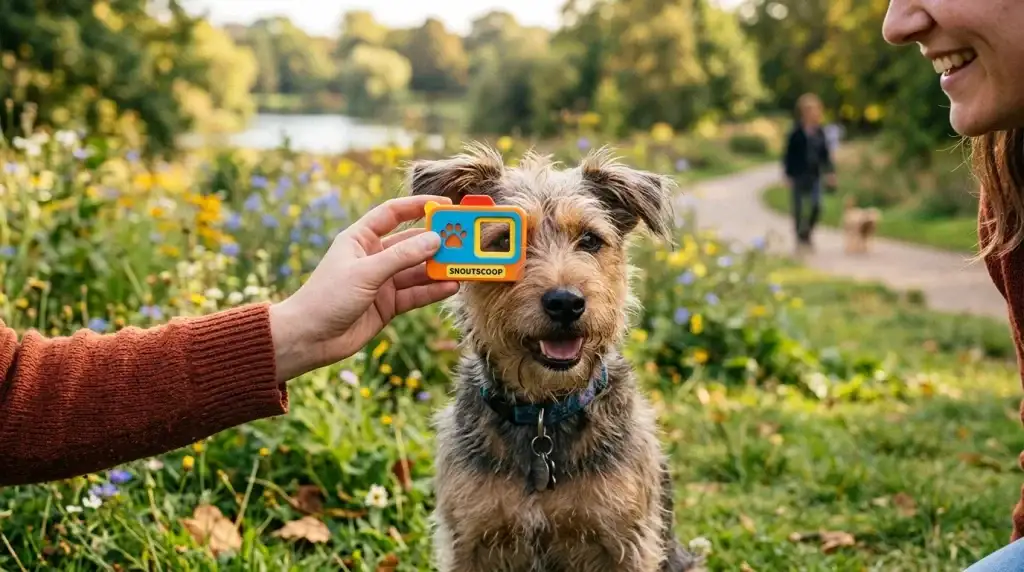
Hello, curious humans! Niki here. As the resident English Setter at SnoutScoop, I pride myself on maintaining a certain standard of intellectual rigor around here. While Blu is busy chasing his own tail and Pisino is plotting world domination from the top of the bookshelf, I prefer to ponder the deeper questions of life. Today, we are going to tackle a subject that has baffled humans for generations: how do we dogs actually see the world?
For years, human myth insisted that we dogs live in a drab, film-noir world of black, white, and endless shades of gray. I am here to tell you—with the backing of modern canine ophthalmology—that this is simply fake news. We do see color, just not the same way you do. And while we might not appreciate the subtle differences between fuchsia and magenta, we have visual superpowers that make your human eyes look downright basic.
Grab a treat, get comfortable, and let’s look at the world through our eyes.
The Great Color Debate: Blue, Yellow, and the Mystery of the Red Ball

Let’s start with the biggest revelation: dogs are not colorblind in the way humans think. Our color vision is what scientists call dichromatic. While humans have three types of color-detecting cone cells in their retinas (red, green, and blue), dogs only have two (blue and yellow). This is highly similar to a human who has red-green color blindness, scientifically known as deuteranopia.
What does this mean in daily life? According to research highlighted by BBC Science Focus, our world is painted in shades of blue, yellow, and gray.
- Blue: We see blue very clearly.
- Yellow: We see yellow beautifully.
- Red and Green: These are the troublemakers. To us, red looks like a dark brownish-gray or black, while green looks like white, gray, or a yellowish-gray.
Now, let’s apply this to a classic human mistake. You go to the pet store and buy a vibrant, neon-red toy. You throw it onto a lush green lawn, expecting us to track it instantly. In reality, to our eyes, you just threw a dark gray ball into a light gray field. We aren’t ignoring it because we are stubborn (well, sometimes we are); we literally can’t distinguish it from the grass by color alone! If you want to make our lives easier, buy us blue toys. They pop against the yellow-green grass like a neon sign.
The Night-Vision Advantage: Why We Own the Dark

While we might lose the color battle, we absolutely dominate the night. Have you ever wondered why your dog can navigate a pitch-black hallway without stubbing a toe, while you are stumbling around waving your arms like a lost ghost?
Our retinas are packed with a high concentration of light-sensitive photoreceptors called rod cells. Rods are designed to detect light levels and motion, even in near-total darkness. But our secret weapon is a brilliant anatomical feature called the tapetum lucidum, as explained by PetMD.
The tapetum lucidum is a reflective membrane situated directly behind our retina. Think of it as a mirror built into our eyes. When light enters our eye, it passes through the retina, hits this mirror, and bounces back through the retina a second time, giving our photoreceptors a second chance to absorb the light. This is why our eyes glow a spooky, eerie green or yellow when you take a photo of us with the flash on or shine a flashlight our way. It is also why we only need about a fraction of the light that humans need to see perfectly in the dark.
Visual Acuity: Why We See in “Standard Definition”

If humans have “Ultra HD 4K” vision, we dogs operate closer to “Standard Definition” or a slightly blurry retro TV. This is called visual acuity—the ability to see details clearly.
According to veterinary ophthalmic studies shared by Veterinary Information Network (VIN), the average dog has about 20/75 vision. This means that a detail you can easily resolve from 75 feet away only becomes clear to us when we are 20 feet away. If we stand still and look at a statue across the park, it might just look like a blurry, nondescript blob to us.
But don’t pity us. We trade fine detail for incredible motion sensitivity. If that statue twitching a finger, or if a tiny squirrel three football fields away flickers its tail, we will notice it instantly. Our eyes are wired to detect the slightest movements. This is also why we might bark at a trash bag blowing in the wind—our brains register the sudden motion before we can clearly resolve that it’s just plastic and not a monster.
The Television Riddle: Do We Actually Watch TV?
This brings us to a fascinating quirk of dog vision: how we see screens. Have you ever noticed that your dog ignored older TVs but might occasionally glance at your modern flat-screen?
This comes down to something called the flicker fusion threshold. Human eyes can perceive a sequence of images as continuous motion if they refresh at about 50 to 60 hertz (frames per second). Dogs have a much higher flicker fusion threshold—closer to 70 or 80 hertz, as noted in physiological studies on Smithsonian Magazine.
On older, slower television sets, we didn’t see a movie; we saw a rapidly flashing, annoying slideshow. Modern high-definition televisions have much higher refresh rates, allowing us to see smooth, realistic movement. So yes, if there is a dog on your new OLED TV, we can see it clearly—and we might just bark at it to remind them who owns the living room.
The Panoramic View: Keeping an Eye on the Horizon
Another major difference is our field of view. Humans have eyes that face directly forward, giving you about 180 degrees of peripheral vision. Our eyes are set slightly wider apart on our heads (depending on the breed).
A typical dog has a visual field of about 240 degrees. This panoramic view allows us to monitor the horizon for predators, prey, or—more importantly—you opening a bag of cheese in the kitchen from three rooms away. The trade-off is that our binocular vision (where the field of view of both eyes overlaps, allowing for depth perception) is narrower than yours, making it slightly harder for us to judge distances right in front of our noses. That explains why we sometimes miss a treat dropped directly under our chin!
The Ultimate Picture: Eyes + Nose = Reality
In the end, looking at dog vision in isolation is only half the story. While your primary way of understanding the world is through your eyes, our world is a beautiful, complex tapestry woven from sight, sound, and our ultimate superpower: our sense of smell.
So the next time you see your dog staring out the window, remember that we aren’t just seeing a slightly blurry, blue-and-yellow landscape. We are watching a high-speed motion picture, illuminated by our night-vision mirrors, and completely detailed by the invisible scent trails of every creature that passed by hours ago. It is a pretty wonderful way to see the world, if I do say so myself.
Until next time, keep those blue toys flying!