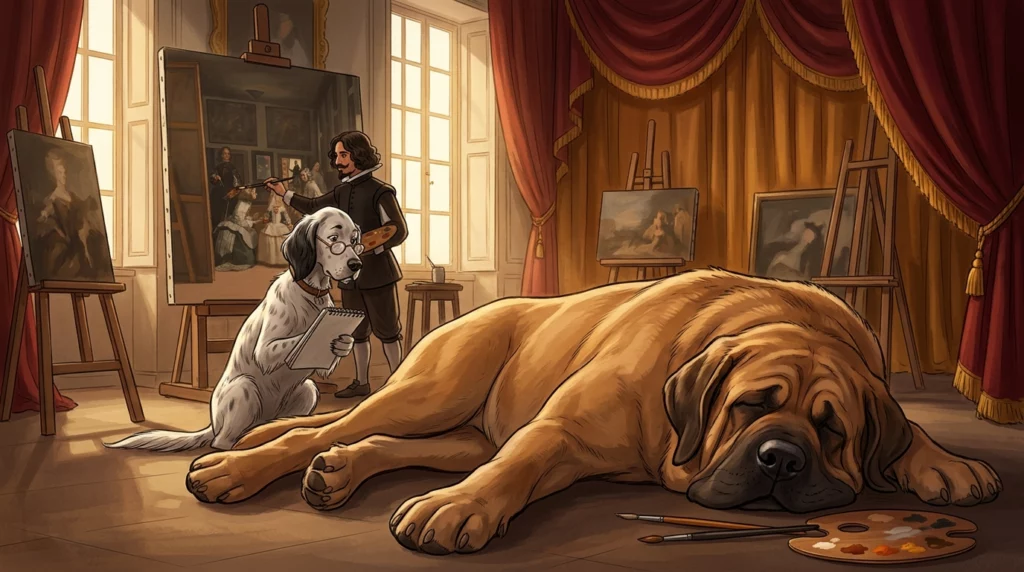
Hello, refined friends of the canine persuasion (and the humans who serve us). Niki here—5.5 years young, proud English Setter, and self-appointed guardian of editorial rigor here at SnoutScoop. While my fellow pack member Blu might be currently chasing his own tail with unbridled enthusiasm, I prefer to direct my sharp eye toward life’s more sophisticated mysteries. Today, we are discussing high culture, fine art, and the ultimate icon of historical dog chillness: the giant sleeping hound in Diego Velázquez’s 1656 masterpiece, Las Meninas.
If you have ever visited the Museo del Prado in Madrid or leafed through an art history textbook, you know Las Meninas is widely considered one of the most brilliant paintings in Western art. It features five-year-old Infanta Margarita Teresa, her attending ladies-in-waiting (the meninas), court dwarfs, Velázquez himself standing before a giant canvas, and a mirror reflecting King Philip IV and Queen Mariana of Spain. But right there in the lower right corner, taking up prime foreground real estate, lies a colossal, supremely relaxed Spanish Mastiff.
As a dog who respects both artistic excellence and a high-quality nap, I couldn’t help asking: why did one of history’s greatest court painters decide to anchor his grand royal portrait with a sleepy, unbothered dog? Let’s examine the evidence.
Meet the Unbothered Royal Guard: The Spanish Mastiff
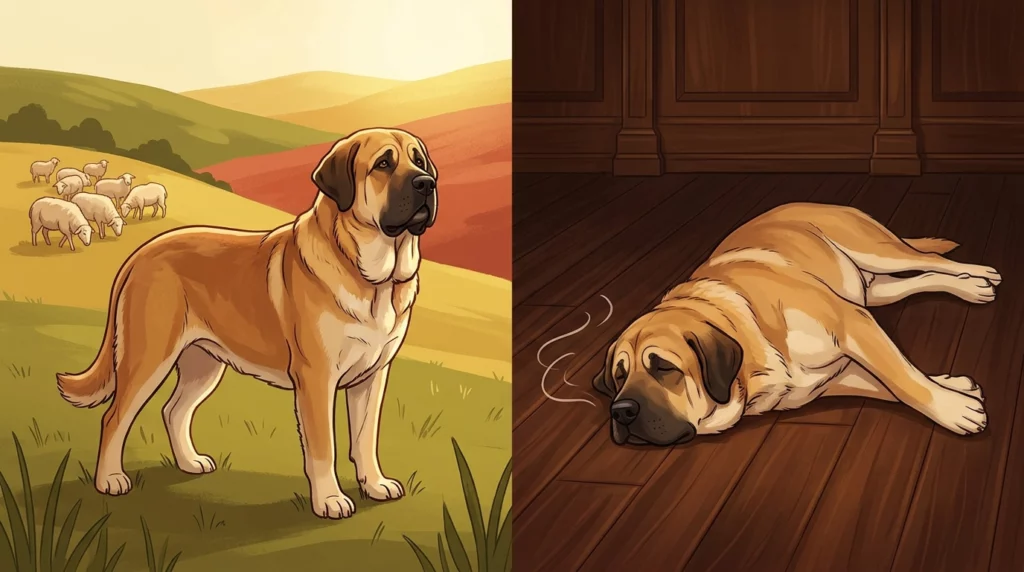
First, let’s identify our canine hero. Art historians and breed enthusiasts generally agree that the dog resting in the foreground is a Spanish Mastiff (Mastín Español). This ancient livestock guardian breed was historically prized across the Iberian Peninsula for protecting sheep from predators like wolves, as well as guarding noble estates and royal residences.
According to Britannica’s analysis of Las Meninas, the scene takes place in Velázquez’s studio inside the Royal Alcázar palace in Madrid. In 17th-century Spain, royal dogs were not merely working animals kept outdoors; they were familiar, well-cared-for members of the royal household who roamed palace rooms freely. A massive mastiff lying comfortably among princesses and nobility was not an unusual sight at court—it was simply everyday life for King Philip IV’s family.
The Foot-Tapping Scene: Nicolasito and the Mastiff
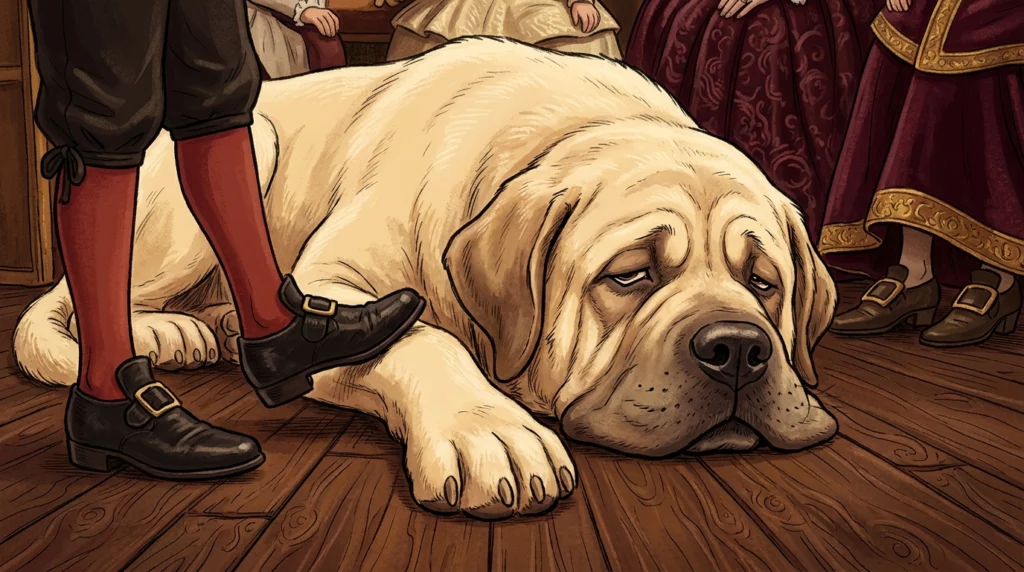
If you look closely at the right side of the painting, you will spot Italian court dwarf Nicolasito Pertusato gently nudging or placing his foot on the dog’s back. For years, viewers have wondered whether Nicolasito is trying to wake the dog up or play with him.
As detailed by Painting Meanings, the contrast between the playful human gesture and the dog’s complete indifference is deliberate. Nicolasito’s foot presses into the dog’s side, yet the mastiff barely blinks. His heavy head remains resting on the floor, eyes half-closed, emitting pure, unshakable serenity. As someone who routinely ignores Blu’s playful antics when I am resting on my favorite velvet cushion, I deeply respect this level of stoic composure.
Why Did Velázquez Include the Dog? 4 Key Reasons
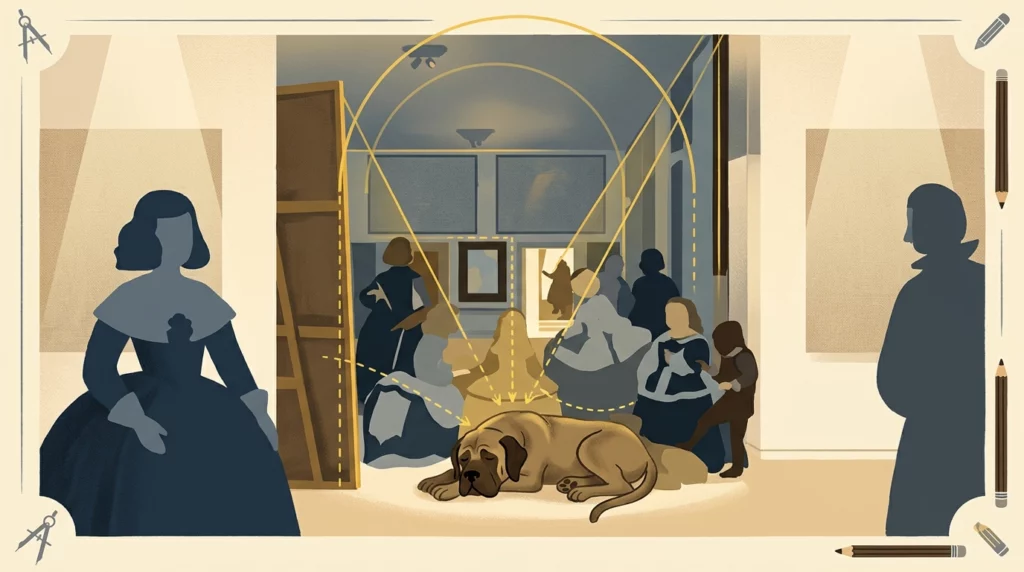
Velázquez was a master strategist of visual storytelling. Nothing in Las Meninas was painted by accident. According to art historians at Smarthistory, every character and object helps construct the painting’s revolutionary sense of spatial depth and realism. Here is why our sleepy mastiff plays such a vital role in the canvas:
1. Symbol of Loyalty and Protection
In classical European painting, dogs frequently symbolized fidelity, watchfulness, and loyalty. Positioned between the viewer and the young Infanta Margarita Teresa, the mastiff acts as a symbolic guardian of the royal heir. Even while resting, his massive presence reassures the viewer that the princess is safe under royal protection.
2. Compositional Anchor and Perspective
As My Modern Met points out, Las Meninas relies on intricate perspective tricks, including light streaming from right-hand windows and reflections in a distant mirror. The heavy, dark mass of the sleeping mastiff anchors the lower right corner of the canvas. He creates immediate foreground depth, drawing the viewer’s eyes into the room toward the brightly lit princess and the painter himself.
3. A Touch of Warm Realism
Formal royal portraits of the 17th century were usually stiff, artificial, and strictly controlled. Velázquez flipped the script by creating a spontaneous “behind-the-scenes” glimpse into palace life. The sleeping dog introduces warmth, casual human-animal interaction, and domestic intimacy. It reminds us that behind the silk dresses, court etiquette, and crown politics, this was a real living space shared with beloved pets.
4. Establishing Calm Amidst Motion
While the ladies-in-waiting curtsy, offer water, and attend to the princess, the dog remains totally calm. His absolute stillness balances the subtle movements of the surrounding people, giving the lower half of the painting a grounded, peaceful rhythm.
What Modern Dog Lovers Can Learn from Las Meninas
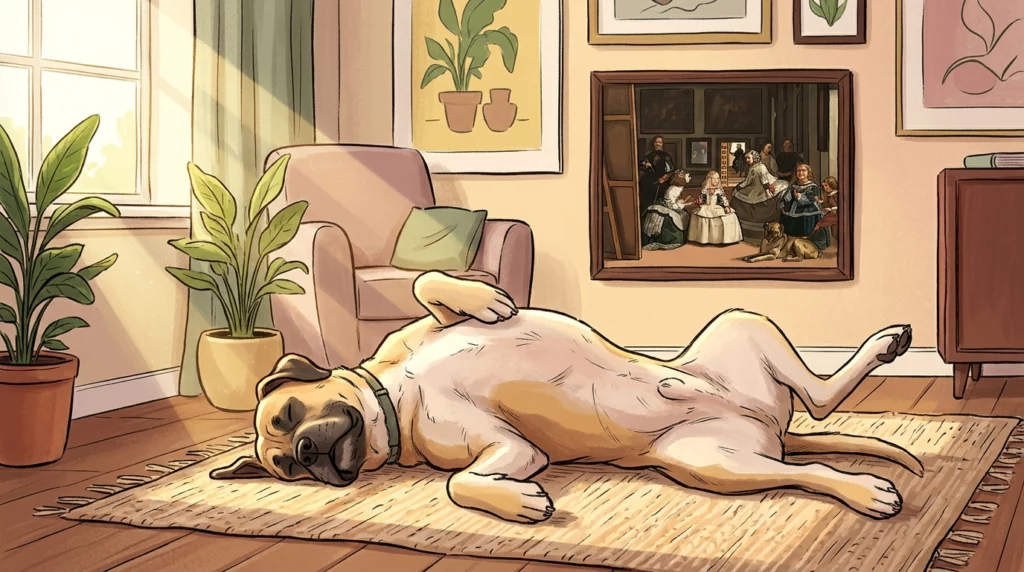
As an English Setter with an appreciation for fine craftsmanship, I find Las Meninas deeply satisfying. It proves that nearly 400 years ago, humans understood what we dogs bring to a home: comfort, beauty, unwavering presence, and an unmatched ability to relax in any high-stakes environment.
Whether you are a king of Spain commissioning court portraits or a modern dog parent working from home, having a calm, loyal hound resting nearby makes any room feel complete. So next time someone accuses your dog of taking up too much floor space during family gatherings, just tell them they are simply participating in a classic 17th-century artistic tradition!
Until next time, keep your coat brushed, your standards high, and your nap spots comfortable.