
The Great Duvet Takeover: A Setter’s Perspective
Hello, dear readers. Niki here. As an English Setter of refined tastes and impeccable posture, I believe a bed is not merely a piece of furniture. It is a sacred temple of comfort, a cloud of memory foam, and—most importantly—my personal domain. My human thinks they graciously ‘allow’ me to sleep at the foot of the bed. In reality, I am simply conducting a nightly quality control assessment of the high-thread-count sheets.
But it wasn’t always this way. There was a dark, drafty time in history when dogs were not allowed on the Egyptian cotton. In fact, we weren’t even allowed in the bedroom. How did we transition from guardians of the muddy barnyard to chronic mattress hogs? Pull up a blanket, curl into a tight circle, and let’s dive into the fascinating history of how dogs won the battle for the bed.
The Cold Utility of the Ancient and Medieval Dog

To understand how we got here, we have to look back at our ancestors. For thousands of years, dogs were working partners. We guarded livestock, hunted game, and kept pests away. Because of this, our sleeping quarters were practical, not luxurious.
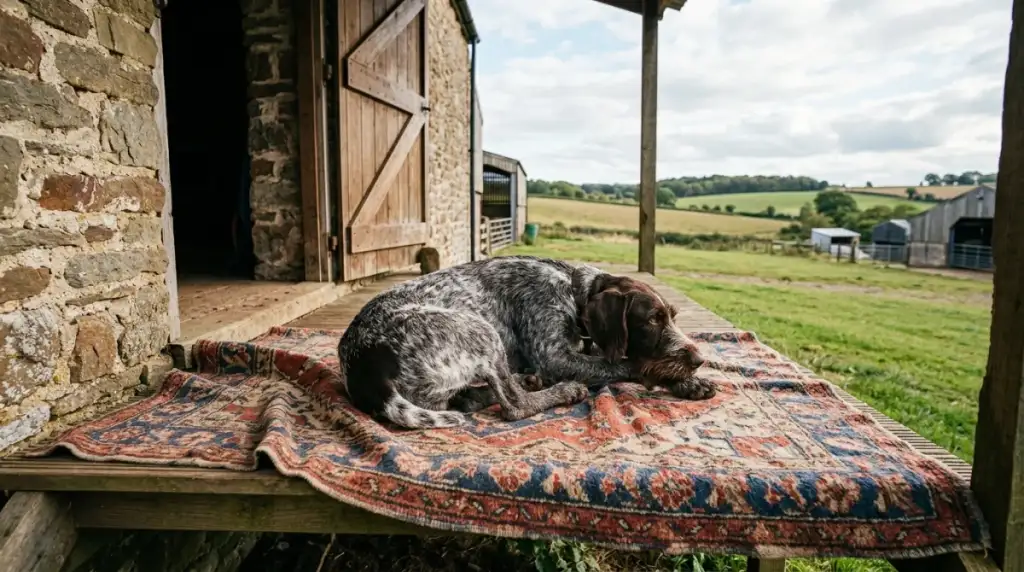
Historically, most dogs slept outdoors, in barns, or in rudimentary shelters. According to historical accounts compiled by The Pet Historian, early “dog houses” or kennels were strictly utilitarian, designed to keep working hounds dry enough to hunt the next day, rather than cozy. In many cultures, letting an animal inside the main living quarters was considered unsanitary. Dogs were expected to brave the elements, wrapped in their own fur coats, while humans slept elevated on wooden frames away from the drafty floors.
However, even in ancient times, there were exceptions for the ultra-wealthy. Roman nobility and Chinese royalty often kept small lapdogs that enjoyed pampered indoor lives. But for the average mutt? It was the cold barn floor or nothing.
The “Three Dog Night”: Nature’s Central Heating

As humans migrated to colder climates, they realized something very important: dogs are incredibly warm. When you combine a drafty cabin, a freezing winter, and a lack of modern insulation, a fluffy canine suddenly looks less like an outdoor sentinel and more like a furry hot water bottle.
This is where we get the famous phrase “three dog night.” As detailed by The Idioms, this expression originated in the freezing outbacks and maritime regions, where temperatures would drop so low that a person would need to pull multiple dogs into bed with them to survive the night. A relatively chilly night was a “one dog night,” while a bone-chilling, frostbite-inducing evening required the thermal output of three dogs.
This history is also backed up by community historical lore on Reddit’s Idiom Discussions, which notes that indigenous populations and early settlers relied on dogs as essential survival heaters. So, the next time your human complains that you are radiating heat like a small pizza oven, you can remind them that we literally kept their ancestors from freezing to death. You’re welcome!
The Victorian Revolution: From Strays to Spoiled Companions
The real turning point in our journey from the barn to the bedroom occurred during the 19th century. The Victorian era completely reshaped how humans viewed pets. Before this period, dogs were largely divided into two categories: useful working animals or stray nuisances.
As explored in the historical analysis of domestic dogs on Ohio State University’s Origins, the Industrial Revolution led to a rising middle class that had the leisure time and resources to keep animals purely for companionship. Suddenly, dogs weren’t just tools; they were members of the family.
This cultural shift created a massive divide. According to historical research published on Pet Histories, the late nineteenth century saw a formal societal separation between “stray” dogs and “pet” dogs. To keep your dog safe and distinguish them from strays, you brought them inside. As detailed in ResearchGate’s At Home and Astray, Victorians began sentimentalizing the domestic dog, depicting them as symbols of loyalty, purity, and home comfort. And once a dog is inside the home, it is only a matter of time before they find the softest spot in the house.
Coming Indoors for Good
As the 20th century rolled around, advancements in veterinary medicine, flea control, and pet hygiene made the transition complete. As explained by In-Home Dog Training, the invention of commercial pet food and effective pest treatments meant dogs were cleaner and healthier than ever, making them welcome guests in every room of the house—including the bedroom.
Today, sharing a bed with a dog is more than just a survival tactic; it’s a mainstream lifestyle choice. In an article for Psychology Today, canine expert Stanley Coren notes that a surprising majority of modern dog owners share their sleeping spaces with their pets. Surveys show that nearly half of all dogs sleep in their owner’s bed, proving that our centuries-long campaign to conquer the mattress has been a resounding success.
Niki’s Guide to Perfect Bed-Sharing Etiquette
Now that we have successfully secured our rightful place on the mattress, we must maintain decorum so we don’t get demoted back to a dog bed on the floor. Here are my top rules for sharing a bed with your human:
- The Diagonal Stretch: Always start small at the foot of the bed. Once the human is asleep, slowly rotate your body 90 degrees. This maximizes your surface area and ensures your human learns the art of sleeping in a pretzel shape.
- The Pillow Claim: If you are a small dog, the pillow is yours. If you are a larger dog (like myself), resting just your chin on their ankles is a great way to assert gentle dominance while staying cozy.
- The Heavy Sigh: If your human moves and disturbs your sleep, let out a deep, dramatic sigh. It lets them know that their movement was highly inconvenient.
From the cold, muddy barns of the Middle Ages to the plush, temperature-controlled bedrooms of today, we dogs have come a long way. We didn’t just adapt to human society; we snuggled our way right into the very center of it. Now, if you’ll excuse me, the sun is hitting a specific spot on the duvet, and I have a very important, historically significant nap to take.