
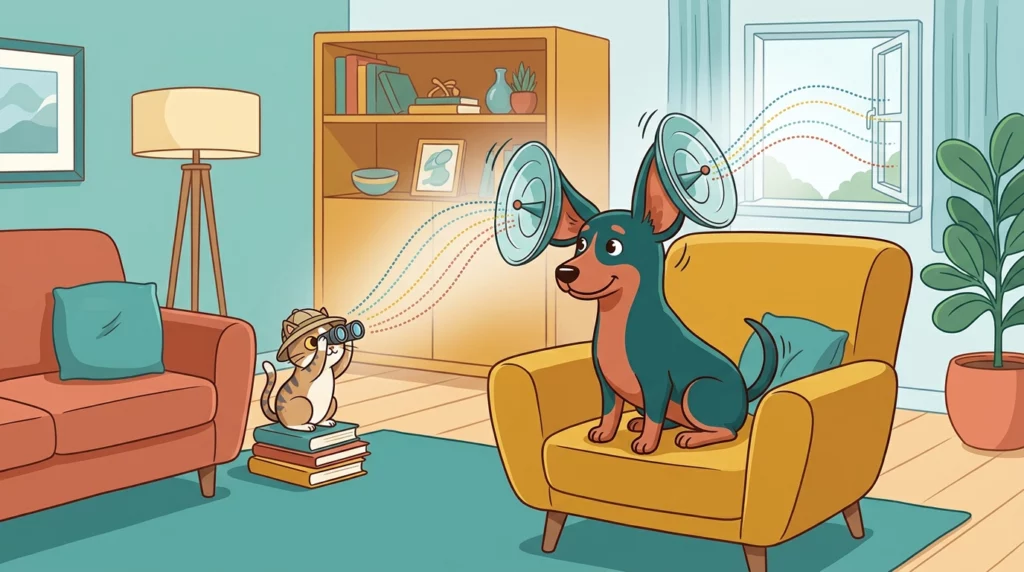
Hello, curious humans! Yuna here. As a highly sophisticated, two-year-old feline adventurer, I spend a lot of my time observing the strange, chaotic creatures I share a roof with. While my canine brother Blu is busy chasing his own tail or drooling on the rug, I’m usually perched on the bookshelf, analyzing his bizarre behavior.
One thing that constantly mystifies me is his ears. Blu has these massive, floppy ears that look like two velvet pancakes draped over his head. Niki, our resident English Setter, has elegant, feathered ears. But despite their ridiculous shapes, those ears possess powers that border on the supernatural. I’m not talking about their ability to ignore the word "come"; I’m talking about actual acoustic wizardry.
Because I am a generous and intellectually curious cat, I decided to dig into the science. Here are 10 incredible facts about your dog’s hearing that will make you look at those furry head-flaps in a whole new light!
1. They Have 18+ Ear Muscles (We Only Have Six!)

Have you ever watched your dog’s ears twitch, rotate, and flatten like little satellite dishes? That’s because they have at least 18 muscles dedicated solely to moving their ears. According to the specialists at VCA Animal Hospitals, these muscles allow dogs to tilt, turn, raise, and lower their ears independently to pinpoint exactly where a sound is coming from. Humans, on the other hand, have a measly six ear muscles, which mostly just sit there doing absolutely nothing (unless you’re one of those rare humans who can wiggle your ears to impress people at parties).
2. They Can Hear Four Times Farther Than You

If you think your dog is barking at “nothing” in the backyard, think again. According to the American Kennel Club, a dog’s hearing is approximately four times stronger than the average person’s. While you might only hear the wind rustling the leaves, your dog can hear a squirrel stepping on a dry twig three yards over—or the mail carrier starting their truck three blocks away. They aren’t crazy; they just live in a much louder world than we do!
3. They Hear in Ultrasonic High-Fidelity

Human hearing tops out at around 20,000 Hertz (Hz). Dogs, however, can easily detect frequencies up to 45,000 Hz or even higher, as detailed by the experts at AKC. This is why silent dog whistles work so perfectly; they emit a high-pitched frequency that is completely outside the human range of hearing but sounds like a loud siren to your pup. (Personally, I think this is cheating, but I have to respect the range.)
4. Puppies Are Born Completely Deaf

You might think puppies are born ready to explore, but they actually enter the world with their eyes and ears sealed shut. As the AKC’s puppy development guides explain, a puppy’s ear canals don’t open until they are about 10 to 14 days old. During those first two weeks, they navigate purely by touch, warmth, and their sense of smell. It’s probably for the best; the world is a noisy place, and a soft, quiet start is just what a tiny puppy needs.
5. The Adorable Head Tilt is Actually a Scientific Adjustment
When you say “Do you want to go for a…” and your dog tilts their head, your heart probably melts. But that head tilt isn’t just a ploy for extra treats. As noted by FirstVet, dogs tilt their heads to adjust their outer ears (the pinnae) to better funnel sound waves. By changing the angle of their ears, they can more accurately calculate the distance and direction of the sound. It also helps them align their eyes and muzzle to read your facial expressions better!
6. Their Ear Canals Are Shaped Like an “L”
Unlike human ear canals, which go straight in, a dog’s ear canal is shaped like an “L.” According to the Merck Veterinary Manual, this structure goes vertically down and then takes a sharp horizontal turn before reaching the eardrum. While this unique shape helps protect their delicate eardrum from injuries and foreign objects, it also makes them highly prone to trapping moisture, debris, and wax. This is why dogs are so susceptible to ear infections, especially if they love swimming!
7. Ear Shape Dictates Hearing Ability
Not all dog ears are created equal. Dogs with upright, pricked ears (like German Shepherds or Chihuahuas) generally have a slight advantage in catching sound waves compared to dogs with long, heavy, floppy ears (like Basset Hounds or our very own Blu). The floppy shape can act as a physical barrier to sound waves. However, those floppy ears aren’t useless—when a hound sniff-scuffs the ground, their long ears act like little brooms, sweeping up scents toward their powerful noses!
8. They Can Filter Out Background Noise (Selective Hearing!)
Have you ever noticed how your dog can sleep soundly through a blaring action movie on TV, but the absolute second you whisper-peel a slice of cheese in the kitchen, they are standing right behind you? Dogs have a remarkable ability to filter out repetitive, non-threatening background noises. They keep a mental “watch list” for sounds that actually matter to them—like car doors, treat bags, and the word W-A-L-K.
9. They Can Move Their Ears Independently
Because of those 18+ muscles we mentioned, dogs can rotate each ear in completely different directions. This means one ear can be pointed forward to listen to you explain why they can’t eat the cat’s food, while the other ear is swiveled backward to listen to a bird outside. It’s like having two independent radar dishes operating on the same furry head. Truly, it’s a miracle they can concentrate on anything at all with that much sensory data coming in!
10. Hearing Loss is Common but Highly Manageable
Just like humans, dogs can experience hearing loss as they grow into their golden years. According to health resources on CareCredit, age-related nerve degeneration can make it harder for senior dogs to hear high frequencies first. Fortunately, because dogs rely so heavily on their sense of smell and sight, deaf or hard-of-hearing dogs adapt incredibly well. You can easily train them using hand signals, flashlights, or vibration collars to keep them safe and happy.
Keep Those Ears Happy and Healthy!
Now that you know just how hard your dog’s ears are working, it’s easy to see why they deserve a little extra love. Because of that tricky L-shaped ear canal, make sure to check their ears regularly for redness, unusual odors, or debris. If they start shaking their head or scratching their ears like crazy, a quick trip to the vet is always the best move.
As for me? I’ll continue to watch Blu from the safety of my cat tree, occasionally letting out a high-pitched squeak just to see if his ears do that funny little radar dance. Until next time, keep exploring, keep learning, and give your pup an extra ear scratch from Yuna!