

Hello, dear readers. Niki here—the five-and-a-half-year-old English Setter who prides herself on keeping the content here at SnoutScoop up to paw-level standards. While my high-energy colleague Blu is currently outside trying to make friends with a very confused leaf, I prefer to engage in more intellectual pursuits. Today, we need to talk about your communication skills. Don’t look so surprised. You see, while you humans rely heavily on words, we dogs are master class physical actors. We are constantly writing invisible novels with our ears, tails, and eyebrows.
Unfortunately, many of our most subtle signals get lost in translation. To help close the communication gap, I have compiled a scientifically backed guide to canine body language. Let us put on our metaphorical reading glasses and dive into what your dog is actually trying to tell you.
The Myth of the Wagging Tail

Let us begin with the biggest misconception in human-canine history: the idea that a wagging tail always equals a happy dog. I cannot emphasize this enough: it does not.
According to the experts at the American Kennel Club (AKC), a wagging tail simply indicates emotional arousal or excitement. It is the canine equivalent of an engine revving—it tells you the system is running, but not which direction the car is going. To truly understand the wag, you must look at the speed, height, and even the direction of the movement.
- The Relaxed, Broad Wag: This is the classic, friendly sweep. If the tail is at mid-height and making wide sweeps that make our whole back end wiggle, you are in the clear!
- The High, Rigid Twitch: If the tail is held high, stiff, and vibrating rapidly like a flagpole in a windstorm, beware. This indicates high arousal and potential reactivity.
- The Left vs. Right Wag: This is where science gets fascinating. A fascinating study highlighted on PubMed Central (NIH) suggests that dogs wag their tails more to the right when experiencing positive emotions (like seeing their owners) and more to the left when experiencing negative or anxious emotions (like seeing an unfamiliar, dominant dog). Yes, we are that precise!
The Subtle Signals: Face, Eyes, and Ears

While the tail gets all the press, a dog’s face is where the real nuance lies. When we are feeling stressed or uncomfortable, we try to drop subtle hints before resorting to anything as dramatic as a growl. According to the ASPCA, these are often referred to as displacement or appeasement behaviors.
1. The “Whale Eye”
If you see a dog showing the whites of their eyes (the sclera) in a crescent shape, this is known as “whale eye.” It typically means the dog is feeling threatened, anxious, or is guarding a highly valued resource. If Blu is guarding his favorite squeaky toy and gives you the whale eye, he is politely asking you to back away slowly.
2. Lip Licking and Yawning (Out of Context)
Of course, we lick our lips when you are holding a piece of cheese, and we yawn when we wake up from a four-hour nap. However, if your dog is yawning during a training session or licking their lips while a toddler is petting them, VCA Hospitals notes that this is actually a sign of stress or discomfort. It is our way of trying to calm ourselves down and signal that we need a little space.
3. Ear Positions
As an English Setter, my ears are long, silky, and excellent for framing my face. But they are also highly communicative. Neutral, relaxed ears show a relaxed dog. Pricked forward ears show intense curiosity or alertness. Ears pinned flat against the head indicate fear, submission, or anxiety—especially if accompanied by a tense posture.
The Great “Guilty Look” Misunderstanding
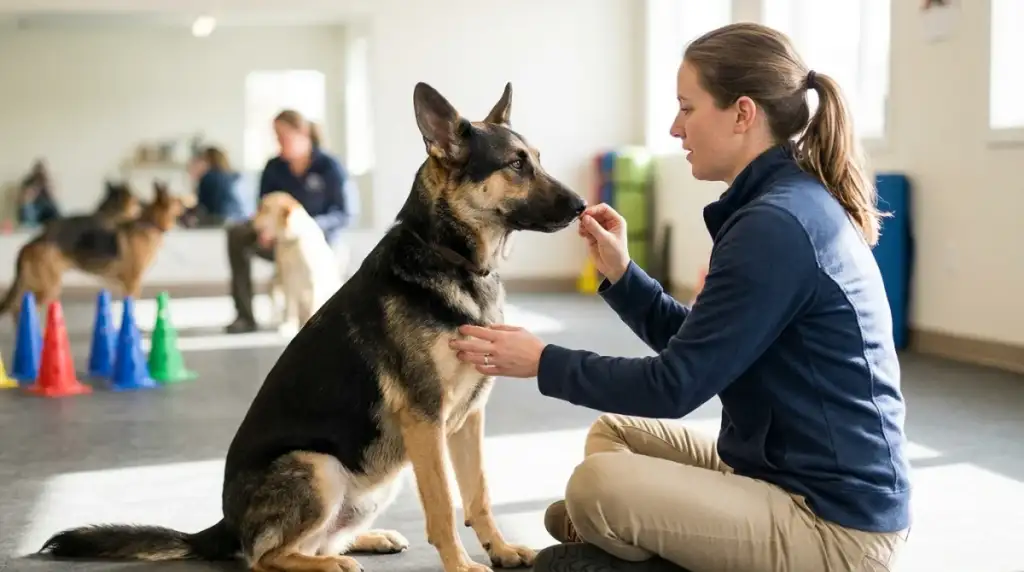
We have all seen the viral videos. A human comes home to a shredded trash can. The dog is sitting there with squinted eyes, ears flat, head low, slowly licking their lips. “Look how guilty he looks!” the human laughs.
I hate to burst your bubble, but we do not feel guilt the way you do. That look is actually a display of appeasement behaviors. As detailed by Dog Training Careers, your dog is reacting to your tense body language, angry voice, or past experiences of trash-can-related anger. We are offering submissive cues to defuse your anger and keep the peace. We aren’t saying “I am sorry I ate the garbage”; we are saying “Please don’t be mad, you look very scary right now!”
Reading the Whole Dog
When trying to translate our language, you must look at the entire context rather than focusing on just one body part. A guide from Texas A&M University emphasizes that body posture tells the ultimate story. Is the dog’s weight shifted forward (alert, potentially aggressive) or backward (fearful, preparing to flee)?
Even “hackles” standing up (piloerection)—where the hair along our spine raises—is often misunderstood. As explained by Valley Highway Animal Hospital, raised hackles are an involuntary reflex, much like human goosebumps. It indicates high arousal, interest, or surprise, but it is not a definitive sign of aggression. Your dog could have their hackles raised simply because they are incredibly excited to play!
Understanding the interplay of these signals takes time and observation. For a deeper academic dive into how these signals are categorized, researchers have compiled extensive studies on the subject, such as this Dog Body Language Literature Review on ResearchGate.
Niki’s Final Verdict: Listen with Your Eyes
Building a truly spectacular relationship with your dog requires you to become an active observer. When you learn to read the subtle shifts in our ears, the tension in our shoulders, and the true meaning behind our wags, you aren’t just managing a pet—you are having a real, two-way conversation.
Now, if you will excuse me, I hear Blu outside barking at a mailbox. I must go translate his high-pitched, chaotic yips and explain to him that the metal box is not, in fact, a threat to our territory. Happy observing, humans!