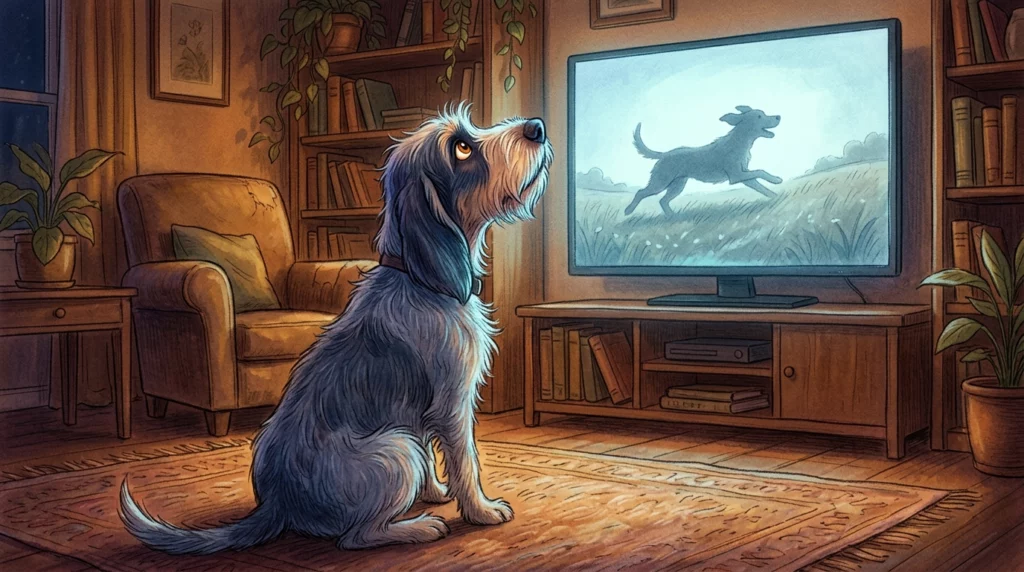
Hello, human friends! Blu here, your resident blue-furred, high-energy Griffon Bleu de Gascogne rescue. When I’m not chasing my tail, trying to convince Niki to share her toys, or running laps around the living room, I have a very serious hobby: staring at the giant, glowing rectangle on the wall.
My humans love putting on movies for me. They’ll cue up classics like Air Bud, Homeward Bound, or some action-packed dog documentary, cuddle up on the couch, and look at me expectantly. But as I sit there, ears flopping, head tilted, it begs the question: Do we dogs actually watch dog movies, or are we just staring at the pretty lights while plotting our next snack heist?
As it turns out, there is some fascinating science behind what goes on in our furry heads when the TV turns on. Let’s sniff out the truth together!
The Strobe-Light Struggle: Why Old TVs Were a Bust
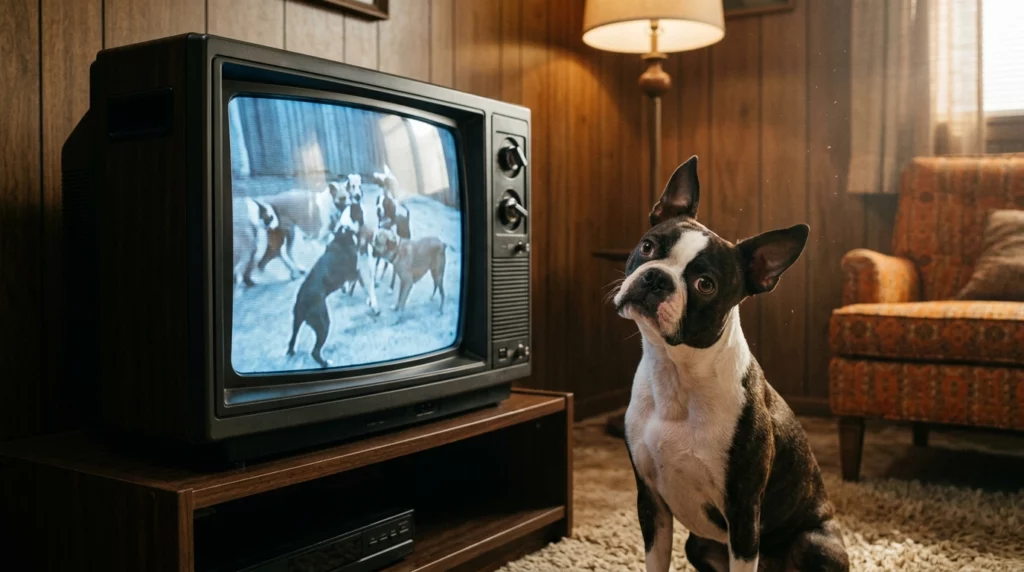
To understand what we see today, we have to look at the history of television. Have you ever wondered why your childhood pup didn’t care about the TV at all, but modern dogs seem fascinated? It all comes down to something called the flicker fusion rate.
Humans process visual information at about 60 frames per second (Hz). Anything faster than that looks like a smooth, continuous stream of motion to your eyes. But dogs are evolutionary superstars when it comes to motion detection. We need to see things at about 75 to 80 Hz for it to look like a real, continuous image, as explained in this fascinating Psychology Today article.
On older, analog TV sets which ran at about 50 to 60 Hz, the screen didn’t look like a movie to us. It looked like a flickering, strobing mess—kind of like a very slow, annoying slideshow. No wonder older dogs ignored it! But thanks to modern high-definition, 120Hz+ screens, the picture finally moves fast enough for our eyes. According to the team at Doggywoods, modern television screens allow us to see smooth, realistic movement just like you do. Welcome to the future, baby!
The Color Palette: No, It’s Not Black and White!
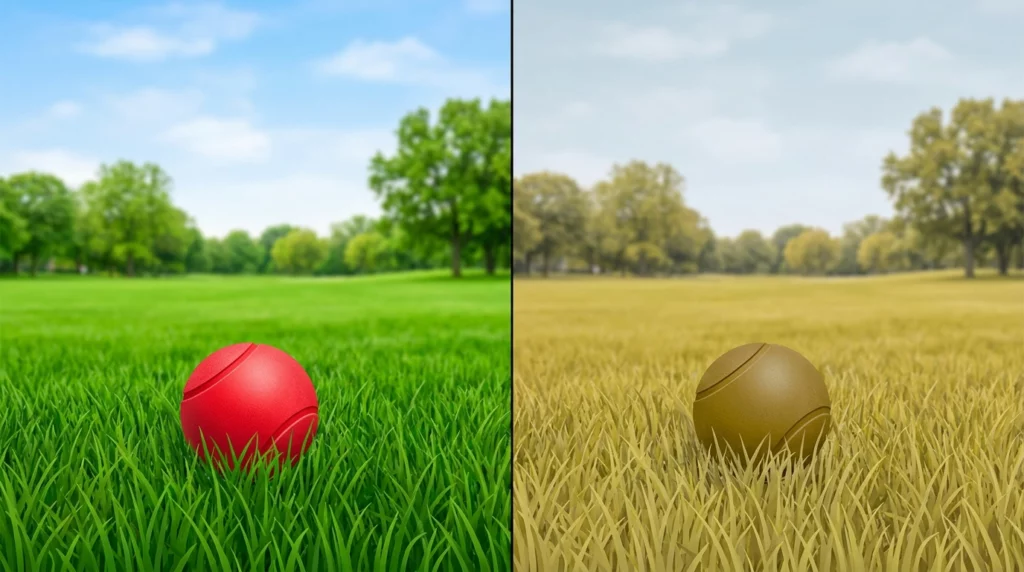
Let’s bust a massive myth right now: dogs do not see the world in black and white. However, we don’t see the full rainbow like you do, either.
Humans have trichromatic vision (three color receptors: red, green, and blue). Dogs have dichromatic vision, meaning we only have two color receptors: blue and yellow. This visual makeup is well-documented in research hosted by the National Institutes of Health (NIH).
So, when you put on a movie with a lush, green forest and a bright red ball, we don’t see those vibrant hues. The red ball looks like a brownish-gray blob, and the green forest looks like yellow-gray background noise. But if there’s a bright yellow ball soaring against a crisp, blue sky? Oh, boy! That pops right out at us. If you want us to enjoy our movie night, pick films with plenty of blues and yellows!
Can We Actually Recognize Other Dogs on Screen?
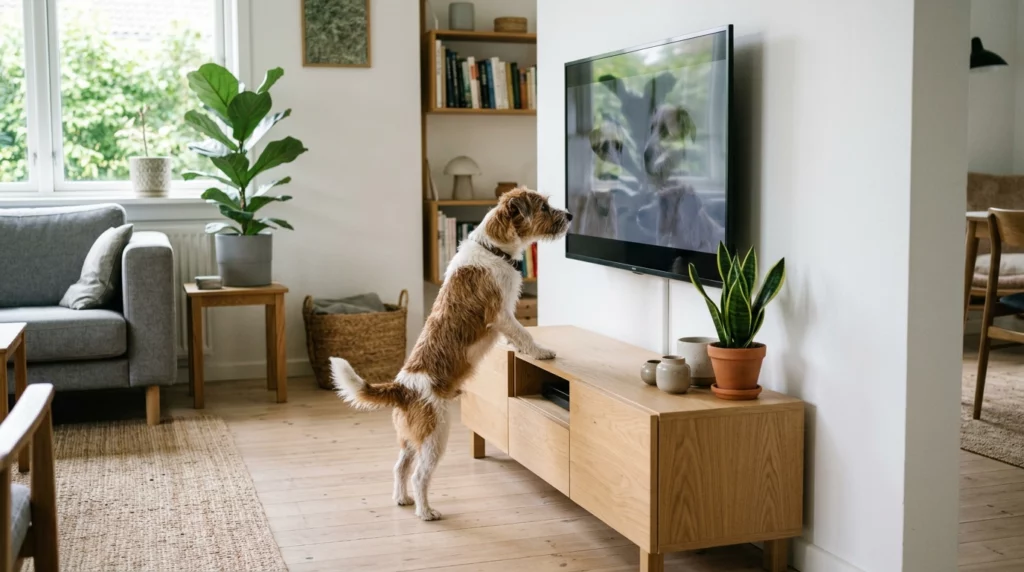
Now, here is where it gets really cool. Do we actually know that the creature on screen is a dog? Or do we just think it’s a weirdly shaped bird?
Science says: yes, we absolutely know it’s a dog! A groundbreaking study published in ScienceDaily proved that dogs can visually categorize images of other dogs. In the study, dogs were shown pictures of various animal faces, and they successfully identified and grouped the images of dogs—regardless of the breed, size, or shape—away from other species.
So when I see Lassie running across the screen, my brain immediately says, “Hey! That’s one of my people!” Even if Lassie is a Colley and I’m a Griffon Bleu, I recognize my canine family.
The Audio Allure and the “Where Did It Go?” Mystery

While visual details are neat, sound is what really gets our attention. Squeaky toys, rustling leaves, high-pitched whistles, and—of course—barking will make our ears perk up instantly.
According to research highlighted by RSPCA Queensland, sound plays a massive role in whether a dog engages with the television. If a movie has a realistic soundtrack with ambient nature sounds and dog vocalizations, we are far more likely to sit up and pay attention.
However, we sometimes get a little confused. Have you ever watched those funny YouTube videos of dogs trying to look behind the TV cabinet? That’s because our eyes tell us a dog is right there, but our noses tell us… nothing. The complete lack of smell is incredibly baffling! If a dog runs off-screen, we might naturally assume they ran behind the plastic box, prompting us to go on an investigation mission.
What Are Our Favorite Shows?
Just like you might prefer a fast-paced thriller over a slow documentary, dogs have individual TV preferences. As noted by ScienceAlert, research suggests that dogs are naturally drawn to footage of other dogs, but their level of interest varies widely based on their personality, breed, and energy levels.
For example:
- Herding breeds (like Border Collies) might be hyper-focused on fast-moving objects or sheep on screen.
- Scent hounds (like yours truly!) might lose interest quickly because we can’t smell anything, preferring to sniff the floor for dropped popcorn instead.
- Reactive dogs might get highly excited, vocal, or even stressed by shows featuring dog trainers or intense dog interactions, which is a common topic in many Quora discussions about how dogs react to reality pet shows.
So, Should You Have a Movie Night With Your Pup?
Absolutely! Even if we don’t fully comprehend the complex plot of The Incredible Journey, we love the sensory stimulation and, most importantly, the quality bonding time with you.
If you want to make the ultimate doggy movie theater experience, here are my top tips:
- Upgrade your tech: A modern LED or OLED TV with a high refresh rate (100Hz or more) will make the picture look smooth and realistic to your dog.
- Pick the right colors: Look for shows with bright outdoor settings, blue skies, and yellow toys.
- Keep the volume moderate: Our ears are super sensitive! Keep the volume at a comfortable level so loud sound effects don’t scare us.
- Provide real snacks: Since we can’t eat the digital treats, make sure to share some dog-friendly popcorn or a stuffed chew toy!
Now, if you’ll excuse me, I hear the opening theme song of my favorite nature documentary playing, and I am pretty sure I saw a squirrel on the screen. Time to go investigate!
Do your dogs watch TV with you? What are their favorite shows? Let Niki, Pisino, Yuna, and me know in the comments below! Woof!